PresbyLASIK: LASIK for presbyopia correction
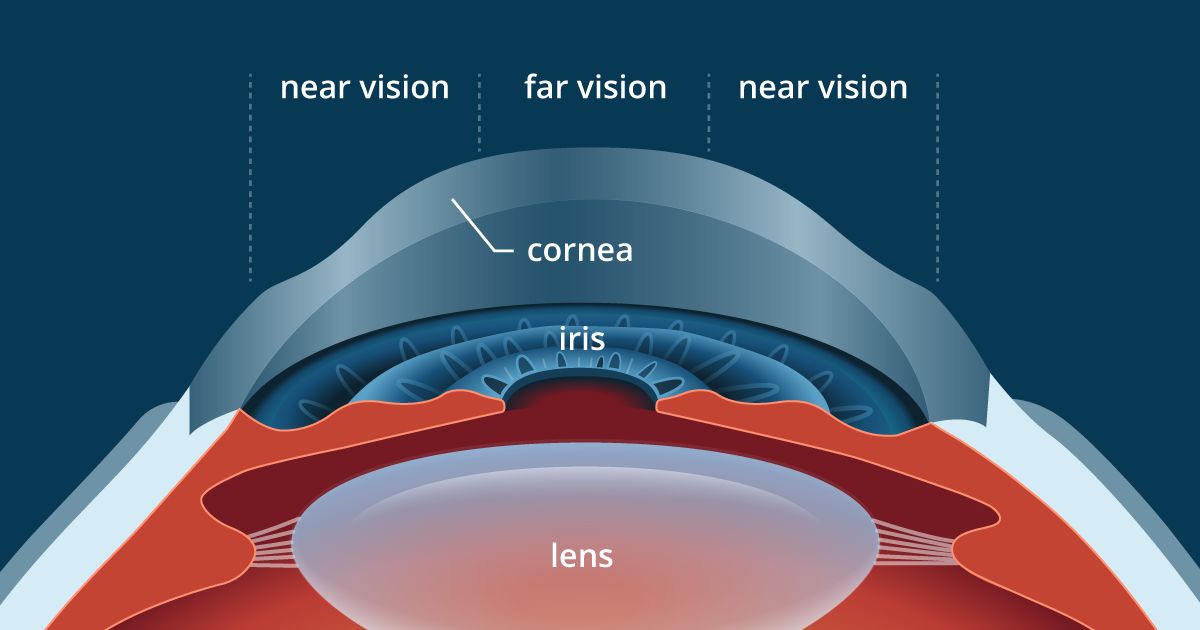
Multifocal LASIK — sometimes called presbyLASIK — is an advanced type of laser vision correction surgery that changes the shape of the eye's cornea to create different power zones for seeing at varying distances.
Like progressive lenses and other multifocal eyeglasses and contact lenses, multifocal LASIK corrects presbyopia, which causes near vision to blur as the eye's natural lens begins to lose its focusing flexibility later in life (generally, soon after age 40).
LASIK for presbyopia: How it works
Manufacturers of excimer lasers and femtosecond lasers are developing multifocal corneal treatments so people with presbyopia will be able to see clearly at all distances without reading glasses, bifocals or other multifocal eyeglasses.
Multifocal LASIK corrects presbyopia like this:
An excimer laser reshapes your cornea into different zones for near, far and intermediate vision. Your brain then selects which zone it needs to see through to get the sharpest vision, depending on whether an object is near or far away.
In each zone, light is bent or refracted differently, allowing people with presbyopia to regain good vision at all distances — similar to how multifocal contact lenses correct presbyopia.
However, multifocal contact lenses resting on the surface of any eye can move and cause vision distortions. Multifocal LASIK, on the other hand, provides fixed, stationary zones directly on the eye's surface.
Just as multifocal contact lenses and progressive eyeglass lenses have different designs, various approaches are used in multifocal LASIK to determine exactly how the cornea should be shaped to achieve the best correction for presbyopia.
PresbyLASIK with distance vision in the center
Refractive surgeon Robert L. Epstein, MD, director of the Mercy Center for Corrective Eye Surgery near Chicago, prefers a central zone for distance vision in presbyLASIK.
"I chose this approach because of the possibility of easy reversibility to pure monofocal distance correction, should it be needed," said Dr. Epstein. "I felt this was safer than the opposite approach, where the peripheral cornea is corrected for distance and the center for near."
PresbyLASIK with near vision in the center
Jorge L. Alio, MD, PhD, professor of ophthalmology at Instituto Oftalmologico de Alicante in Alicante, Spain, prefers a multifocal ablation with the center of the cornea shaped for near vision, surrounded by a peripheral zone for distance vision.
Dr. Alio says this approach enables the surgeon to provide a stronger correction for reading and other near vision tasks. He also believes that the near-center approach causes fewer aberrations than distance-center ablations.
LASIK for presbyopia that is based on refractive error
The best multifocal LASIK design for you may depend on what kind of refractive error you have. For example, a distance-center multifocal LASIK design may be preferred for people who have nearsightedness and presbyopia, and a near-center multifocal LASIK design may work better for someone who has farsightedness and presbyopia.
During your LASIK consultation, your eye surgeon can discuss which design is best for your specific refractive error and vision needs.
PresbyLASIK with modified monovision
Another approach is to have a presbyLASIK procedure performed in one eye and a standard (full distance correction) LASIK procedure performed in the other eye.
This type of "modified monovision" approach might give you sharper distance vision for driving than having multifocal LASIK performed in both eyes. However, you may need to use reading glasses more frequently.
You might also notice a slight loss of depth perception with a modified monovision correction.
Dr. Epstein said strong distance vision is essential with LASIK of any kind. So he favors the modified monovision approach of using presbyLASIK in one eye and wavefront-guided (custom) LASIK in the dominant eye.
"We just cannot match what (distance-only) wavefront-guided LASIK provides for good distance vision," he said.
He said tolerance for modified monovision easily can be tested before a procedure is done. Whereas straight monovision typically provides only two focal points (near and far), modified monovision with multifocal LASIK adds a third, intermediate focal point that otherwise would be unobtainable with monovision.
"This gives vision over a broad range of distances," he explained. "It's also much easier to adapt to the milder difference in correction in the eyes when we use presbyLASIK in the non-dominant eye and wavefront-guided distance LASIK in the dominant eye."
Can PresbyLASIK be reversed?
If you are unhappy with your driving vision after multifocal LASIK, it may be possible to use a LASIK enhancement procedure to fully correct your distance vision. But be aware that this will also make your near vision less clear without reading glasses).
Dr. Epstein said refractive surgeons have found it more difficult to reverse presbyLASIK with a central zone designated for near vision than for a central zone designated for distance vision.
How effective is multifocal LASIK?
Studies of presbyLASIK outcomes have shown good results, with most patients seeing 20/20 or 20/25 in the distance and being able to read newspaper print up close without glasses.
If your vision was normal except for presbyopia prior to multifocal LASIK, it's possible your distance vision may be blurry immediately after the surgery. This problem may not necessarily go away, either. It's also possible you'll experience reduced contrast sensitivity and/or a tendency to see halos around lights at night.
Reduced contrast sensitivity means difficulty seeing objects against backgrounds of similar colors. But some research indicates that reduced contrast sensitivity associated with multifocal LASIK may be only temporary and tends to disappear in three to six months.
If you develop cataracts after multifocal LASIK surgery, you will still be able to have cataract surgery. But changes made to your cornea during the LASIK procedure make it more challenging for your cataract surgeon to determine the correct power for your intraocular lens to give you a perfect visual outcome after cataract surgery.
It's possible you may need to wear eyeglasses after cataract surgery or you may need additional corneal refractive surgery to regain acceptable vision for driving and/or reading without glasses.
Finally, there is no guarantee that results of your multifocal LASIK surgery will be permanent. If your eyes change as the years go by after your LASIK surgery, future surgical enhancements may be needed.
Another possible complication associated with the procedure can include an inability to see as well as you once did, even with the help of glasses or contact lenses after surgery.
See an eye doctor
The only way to know for sure if you are a good candidate for PresbyLASIK or some other type of presbyopia surgery is to see an eye doctor for a comprehensive eye exam. Click here to find an eye doctor near you.
Central presbyLASIK for hyperopia and presbyopia using micro-monovision with the Technolas 217P platform and SUPRACOR algorithm. Journal of Refractive Surgery. August 2015. The future of presbyopia correction. Review of Ophthalmology. February 2015. Presbyopia treatment by monocular peripheral presbyLASIK. Journal of Refractive Surgery. June 2009. Multifocal ablation: Alive, well and evolving. Review of Ophthalmology. July 2008. Correction of presbyopia in hyperopia with a center-distance, paracentral-near technique using the Technolas 217z platform. Journal of Refractive Surgery. May 2008.
Page published on Wednesday, February 27, 2019