Safety glasses and protective eyewear
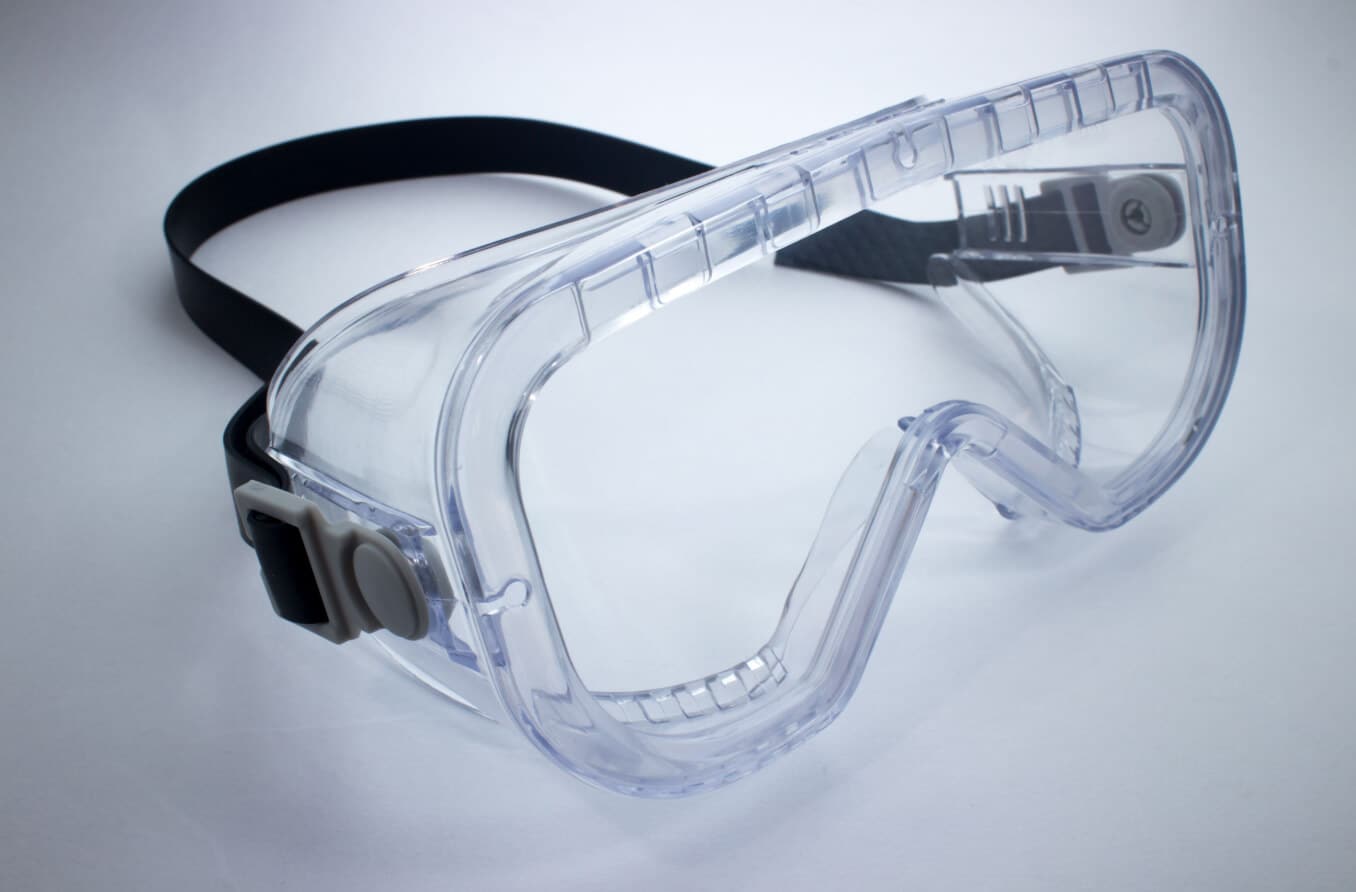

Why risk losing precious eyesight when wearing safety glasses or protective goggles can help keep your eyes and vision safe?
More than 700,000 Americans injure their eyes at work each year, with approximately 2,000 workers sustaining job-related eye injuries requiring medical treatment each day, according to the National Institute for Occupational Safety and Health (NIOSH). Prevent Blindness estimates that accidents involving common household products cause an additional 125,000 eye injuries each year. An estimated 30,000 to 32,000 sports-related eye injuries are treated in U.S. emergency rooms annually, according to Prevent Blindness and the American Academy of Ophthalmology (AAO), while many additional injuries go unreported.
Because experts say proper protective eyewear could prevent up to 90 percent of all eye injuries, you might want to learn more about the safety glasses and goggles that suit your lifestyle needs.
How do safety glasses and goggles differ from regular eyeglasses?
Safety eyewear must conform to a higher standard of impact resistance than regular eyeglasses, which optical professionals sometimes call "dress eyewear." This higher standard applies to both the lenses and the frames of safety glasses and goggles.
There are two kinds of safety glasses: prescription safety glasses and non-prescription (also called "plano" safety glasses).
Regardless of their size or the durability of the frame and lenses, regular prescription eyeglasses do not qualify as safety glasses unless they meet specific criteria.
In the United States, the federal government establishes safety guidelines for workplaces, to decrease the risk of on-the-job injuries. The Occupational Safety and Health Administration (OSHA) within the U.S. Department of Labor oversees safety practices in the workplace and in educational settings.
OSHA has adopted safety eyewear standards established by the American National Standards Institute (ANSI), a private, non-profit organization that creates quality and safety standards for a wide variety of products.
The ANSI standard applying to eye safety includes several types of eye protection devices, including eyeglasses (both prescription and non-prescription), goggles, face shields, welding helmets and full-face respirators.
ANSI standards for safety eyewear
Updated ANSI safety eyewear standards include the following key features:
- For the basic impact tests, lenses are tested separately (not mounted in a frame). For the high impact classification, the frame and lenses are tested together as a unit.
- Non-prescription lenses used for high impact testing are considered to be structurally weaker than prescription lenses made of the same material; the prescription lenses are generally thicker.
- Thinner prescription safety lenses are now allowed, if they meet the high impact testing requirements. (Previously, all prescription safety lenses had to have a minimum thickness of 3 mm, making them significantly thicker and heavier than regular eyeglass lenses.)
- Safety lenses now have two classifications of performance: basic impact and high impact.
- The "drop ball" test determines the basic impact safety classification for lenses. In this test, a one-inch diameter steel ball is dropped onto the lens from a height of 50 inches. To pass, the lens must not crack, chip or break. All glass safety lenses must undergo this test. For plastic safety lenses, however, only a statistical sample of a large batch of lenses needs to be tested.
- In high impact testing, a high velocity test is performed by shooting a quarter-inch diameter steel ball at the lens at a speed of 150 feet per second. To pass, the lens must not crack, chip or break, and it must not become dislodged from the lens holder.
How to assess ratings of safety eyeglasses and goggles
Plus mark. To determine if a lens has passed the high velocity test described above, look for the "+" mark that indicates its approval at high impact.
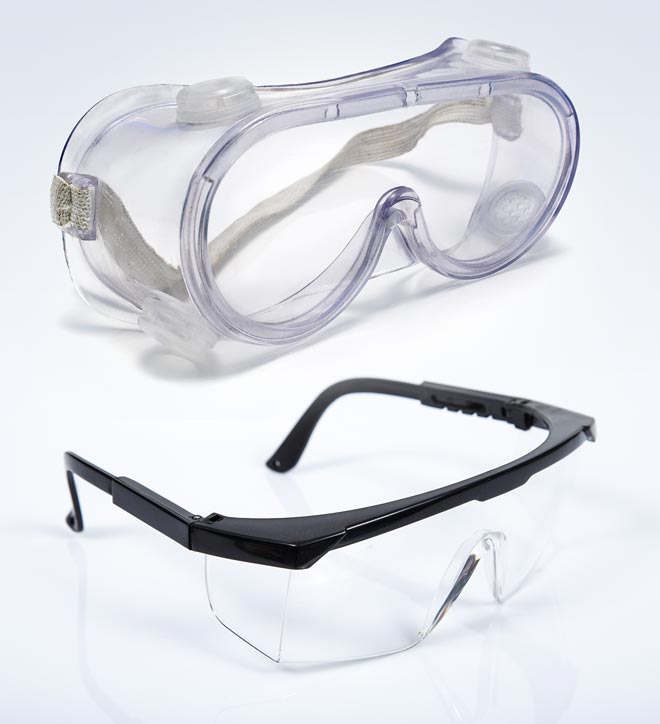
Top: This safety shield is found in hardware stores. It fits over smaller glasses but sometimes fogs up.
Bottom: These safety glasses have side shields that don't offer quite as much protection, but they fog less.
This mark may be applied to any prescription lens of the same or greater thickness (at the thinnest point of the lens), made of the same material by the same manufacturer and with the same coating(s) applied.
"V" and "S" marks. Other lens markings that appear on safety lenses are "V" (indicating the lens is photochromic) and "S" (indicating the lens has a special tint). In some cases, a number may also be marked on a shaded safety lens to indicate how much light transmittance is reduced by the tint.
Shaded safety glasses for use when working with molten metal and in soldering, brazing, cutting and welding operations have tint densities that can range from 1.5 to 3.0 (mild to moderate shade for torch soldering) up to 10 to 14 (very dark shades for electric arc welding).
All safety lens markings must be permanent. If lenses do not meet the high impact standard, a warning label that can be removed only by the wearer must be affixed to prescription safety eyewear.
Testing of frames for safety eyeglasses and goggles
Frames for safety glasses are tested using the same criteria whether they will be used in basic impact or high impact applications. Frame tests include:
- High mass impact. In this test, a one-inch diameter steel projectile weighing 17.6 ounces is dropped through a tube from a height of 50 inches onto a safety lens mounted in a frame. The frame is "worn" by an artificial head form. To pass, the frame must fully retain the lens, and no piece can become detached from the inner surface of the frame component that holds the lenses.
- Durability. Safety frames must also pass a flammability-resistance test, a corrosion-resistance test and other durability tests.
- High velocity impact. This test involves shooting a quarter-inch steel ball at the lens and frame at a velocity of 150 feet per second from a distance of just under 10 inches. The test is repeated multiple times (each time with a new frame and lens) at different angles and positions of impact. The pass criteria are the same as for the high mass impact test.
How to assess standards for frames used in protective eyewear
Non-prescription safety eyewear with non-removable lenses must be permanently marked with the manufacturer's trademark and "Z87" (basic impact) or "Z87+" (high impact) on either the front of the frame or on one temple.
Prescription safety frames must be permanently marked with the manufacturer's trademark and "Z87-2" on the front of the frame and on both temples.
For complete information, you can purchase a copy of the ANSI Z87.1-2003 safety eyewear standard at the American National Standards Institute website.
What type of safety lenses do I need at work?
Your company's safety officer should determine which level of protection (basic impact or high impact) is needed for your job duties.
A few occupations requiring high impact protection in eyewear include:
- Carpenters
- Plumbers and pipe fitters
- Machinists
- Millwrights
- Laborers
Some activities may require side shields, goggles or full face protection. Employers and safety officers should consult OSHA to help determine which type of safety eyewear is most appropriate for different job positions. To learn more, visit the eye and face protection section of OSHA's website.
Also, the International Safety Equipment Association has published the "Eye and Face Protection Use and Selection Guide" as a companion to the ANSI Z87.1-2003 standard. You can purchase this guide from the organization's website.
If you work as an independent contractor, consider choosing safety eyewear that has been rated at the high impact standard for all activities, just to be extra safe.
Which safety glasses are ideal for home use?
As with independent contractors, consider choosing safety frames and lenses rated for high impact, for maximum protection.
If you don't require prescription lenses, or you wear contact lenses, you can purchase non-prescription safety eyewear from most hardware, building supply and sporting goods stores.
These safety glasses usually are made of lightweight polycarbonate for comfort and are available in wrap-style frames. For the optimal protection value, choose models that have the high impact rating. (Look for the "Z87+" marking on the frame.)
Some models are also available with a bifocal reading segment in the bottom half of the lens for those who have presbyopia.
If you need prescription safety glasses, you must purchase these from an eye doctor or at an optical store with a valid eyeglass prescription written by a licensed eye care professional. Again, for optimal protection, choose safety eyewear with a high impact rating. (The lenses will bear the manufacturer's trademark and a "+." The frame will be marked "Z87-2" on the inside of the front and temples.)
If you have a bifocal eyeglass prescription, safety-rated progressive lenses are available to help you see clearly at all distances without bifocal or trifocal lines in the lenses.
For mowing lawns and using a power trimmer or other power tools, choose a frame with side shields to protect you from flying particles or larger objects.
What types of safety glasses are ideal for sports?
The same recommendations for safety glasses for home use apply here. Also, consider purchasing an elastic band that attaches to the back of your temples, to keep your safety glasses securely on your head during active sports.
For hunting and sport shooting, always choose safety lenses that have a high impact rating. Consider a wrap-style frame with a non-shiny, matte finish and lenses with anti-reflective coating, to reduce distracting reflections.
Safety frames with camouflage patterns are also available for hunting. If you need prescription shooting glasses, look for styles that have side shields for added eye protection.
For hunting, golfing and other sports that require acute vision, consider adding a sport-specific tint. Amber or yellow tints, for example, can help enhance contrast for shooting.
Fish hooks are a major cause of sports-related eye injuries, so for fishing choose a wrap-style frame and safety lenses with a polarized tint, to cut glare from the surface of the water. Reducing the glare will not only let you see into the water more easily, but it will also make your eyes feel more comfortable.
Also, consider photochromic lenses for optimum vision and comfort in changing outdoor lighting conditions. An optician or other eye care professional can advise you as to which tints work well for your particular activities.
If you enjoy paintball, be aware that players without proper eye and head protection can sustain devastating injuries from paintball pellets fired from paintball guns. Head shields for paintball should combine eye and ear protection, and the shield should have a high impact safety rating. This is because some guns are capable of propelling paint pellets at speeds over 180 mph.
The most important rule for paintball is, never take your head shield off while you're in the playing area, even when a game has not yet begun.
Which lens material is ideal for safety glasses?
Typically, the preferred lens material for safety eyewear is polycarbonate. This material has less than half the weight of glass, so the eyewear is more comfortable. Polycarbonate lenses are also more impact-resistant than glass lenses.
Keep in mind that polycarbonate is a much softer lens material than glass. Even with a scratch-resistant coating, polycarbonate lenses will scratch more easily than glass lenses.
Can I get anti-reflective coating on safety glasses?
Anti-reflective coating (or AR coating) reduces distracting lens reflections and therefore may be desirable for certain activities that require safety eyewear. But be aware that AR coating may affect the impact resistance of certain lenses, so impact resistance tests must occur after the coating is applied. Your eye care professional may need to verify that the optical lab did indeed test the lenses properly for impact resistance after applying the coating.
Your eyesight is precious. Regardless of whether you need non-prescription safety eyewear or prescription safety glasses, the investment you make to protect your eyes and vision will pay dividends as you reduce your risk of a sight-threatening injury.