
Choosing an eye doctor is an important health care decision. Your eye doctor will help you see as clearly as possible and protect your vision — the sense people say they fear losing more than any other.
Optometrist vs. ophthalmologist
The first step in your decision is to understand there are two types of eye doctors — optometrists and ophthalmologists — and to know the differences between the two.
What is an optometrist?
An optometrist is an eye doctor who has earned the Doctor of Optometry (OD) degree and specializes in eye and vision care. To become an optometrist in the United States, a candidate typically must earn a four-year college degree in the sciences and then attend an accredited school or college of optometry and obtain a four-year OD doctorate degree.
Most optometrists provide the following services:
- Perform routine eye exams
- Prescribe eyeglasses and contact lenses
- Perform contact lens fittings
- Diagnose eye health problems
- Medically manage many eye diseases, infections and injuries
In addition, some optometrists:
- Perform eye exams before and after cataract surgery and LASIK
- Provide low vision exams and services
- Prescribe and supervise vision therapy
With few exceptions, optometrist eye doctors are not trained or licensed to perform eye or vision surgery.
READ MORE about optometrists.
What is an ophthalmologist?
An ophthalmologist is a medical doctor (MD) or a doctor of osteopathic medicine (DO) who specializes in eye and vision care, including providing medical care and surgery for management of eye and vision problems.
To become an ophthalmologist in the United States, a candidate typically must:

Ophthalmologists are medical eye doctors who are licensed to perform eye surgery.
- Earn a four-year college degree in the sciences
- Attend medical school and earn a four-year doctorate degree to become a physician (MD or DO)
- Complete a one-year internship
- Complete a three-year residency in the medical and surgical care of the eye
An ophthalmologist can provide all the services an optometrist (OD) provides, and:
- Has more comprehensive training in the medical care and management of eye health problems
- Is trained and licensed to perform eye and vision surgery
- May specialize in the medical and surgical treatment of a specific eye disease (e.g., glaucoma) or part of the eye (e.g., retina)
SEE RELATED: Neuro-ophthalmologists and retina specialists
Pediatric eye doctor
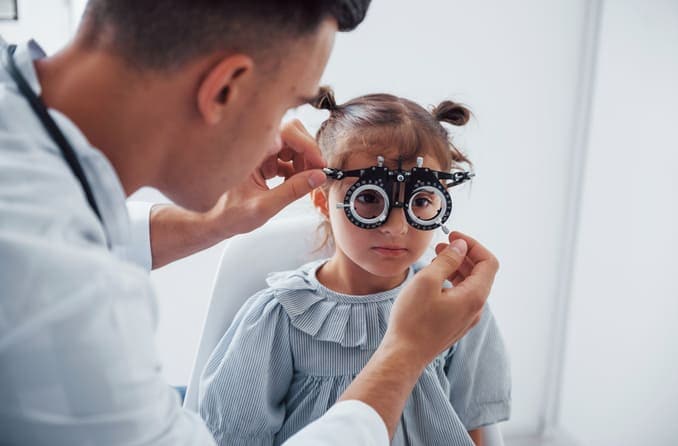
A pediatric eye doctor, also called a children’s eye doctor or a kids' eye doctor, can be an optometrist or an ophthalmologist.
A pediatric optometrist typically specializes in:
- The normal development of vision in children
- Fitting children with contact lenses
- Vision therapy to treat lazy eye (amblyopia), binocular vision problems and learning-related vision problems.
READ MORE about pediatric optometrists.
A pediatric ophthalmologist typically specializes in:
- The surgical treatment of misaligned eyes (strabismus)
- Other childhood eye and vision problems (e.g., congenital cataracts)
READ MORE about pediatric ophthalmologists.
Which eye doctor to choose
For routine eye exams and contact lens fittings, most people choose an optometrist. Therefore, most prescriptions for eyeglasses and contact lenses are written by ODs.
There are several reasons for this, including:
- ODs are primary eye care providers. The training of optometrists is designed primarily for routine eye and vision care. Most people don’t need the specialized medical care or eye surgery provided by an ophthalmologist.
- Greater number of ODs. There are more optometrists than ophthalmologists. In 2020, there were about 46,000 optometrists and 18,000 ophthalmologists in the United States.
- Wider availability of ODs. Optometrists are more widely spread geographically. Ophthalmologists tend to be located in relatively large population centers.
- Cost. Most of the services provided by both optometrists and ophthalmologists are at least partially covered by medical insurance or vision insurance. Without insurance, a routine eye exam provided by an optometrist tends to cost less than an eye exam performed by an ophthalmologist.
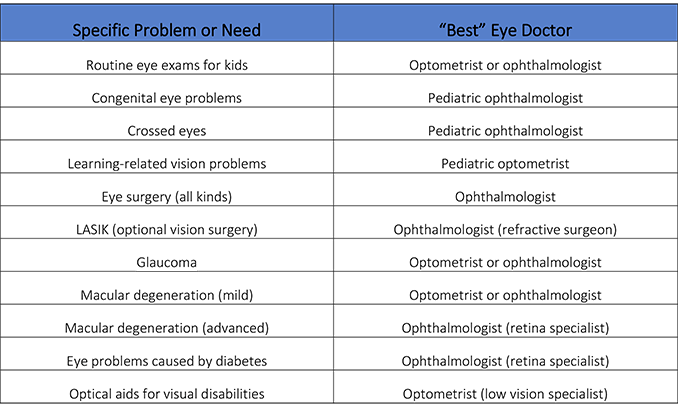
Which is the best eye doctor for specific needs?
If you have needs beyond a routine eye exam or contact lens fitting, the following table lists which type of eye doctor is likely the best choice for your specific needs.
NOTE: This table is intended as a general guide only to help you with your search for specialized eye care and is not all-inclusive. The best eye doctor for your needs depends on several factors and may not be predicted with 100% accuracy by the following suggestions. Also, the scope of specialized eye care provided by optometrists may vary depending on where you live.
Referrals
An important consideration when choosing an eye doctor is the recommendation of friends, family members and co-workers. Word-of-mouth referrals often provide the best way to find a friendly, competent and caring eye doctor and avoid unpleasant surprises when you seek eye and vision care.
If you have a special need, the optometrist or ophthalmologist who provides your routine eye care will refer you to an appropriate specialist.
READ MORE: What is an optician? and What is an ophthalmic technician?