Glasses: Frequently asked questions
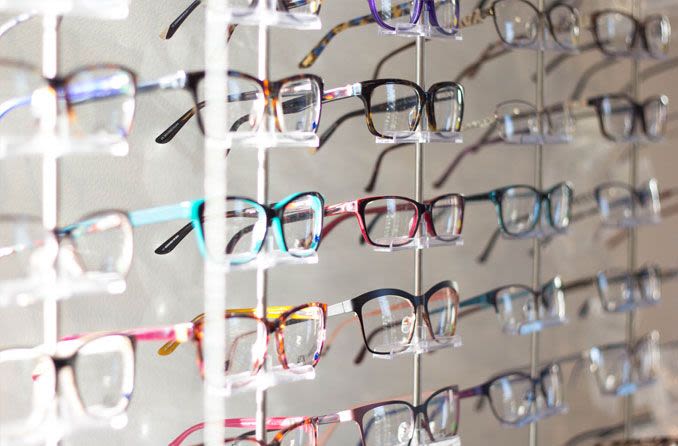
Eyeglasses, with all of the lenses and frames options, can sometimes be overwhelming.
To help you, we've compiled a list of frequently asked questions about eyeglasses and the answers to put your mind at ease:
Why should I bother to go to the optician when I can simply pick up an inexpensive pair of eyeglasses at the store?
Some people do have good luck with drugstore reading glasses. However, you need to visit your eye doctor regularly for two reasons:
Regular eye exams are the only way to catch "silent" diseases, like glaucoma, in their early stages, so they can be treated before permanent vision loss occurs.
One-size-fits-all reading glasses don't work well for people who have astigmatism, a different prescription in each eye, or eyes that are closer together or farther apart than "average." In such cases, pre-made "readers" can cause eye strain and headache.
What's the secret to getting eyeglasses that look great on me?
First, decide which of the seven basic face shapes you have and read the accompanying tips about frames that go well with your shape. Then, find out which colors suit your skin, eye and hair colors.
How do I avoid annoying reflections on my eyeglasses?
Anti-reflective coating, also known as AR coating, helps you to see through your eyeglasses more easily, lets others see your eyes better and eliminates the annoying white glare spots in photos taken with a flash.
I'm interested in the glasses that change to sunglasses when you go outside. Can you tell me more about them?
Glasses that change to sunglasses when you go outside are called photochromic lenses.
When exposed to the sun's UV rays, photochromic lenses darken automatically, becoming sunglasses; when no longer exposed to UV, they quickly become clear again. Photochromic lenses are a great choice if you typically wear glasses all day, frequently go outside, and don't want to bother with prescription sunglasses.
But be aware that most photochromic lenses don't darken very much inside your car or truck. This is because the windshield (and sunroof) glass used in today's vehicles blocks most of the sun's ultraviolet radiation that is required to initiate the lens darkening process.
So, you still might want to purchase a pair of prescription sunglasses for driving on sunny days.
I find most eyeglasses to be too small for my head. Do you know of any brands that carry larger frames?
There was a time when unisex eyeglass frames were very popular. But most gender neutral frames were available only in medium, "one-size-fits-most" sizes.
Today, many eyewear companies have introduced larger frames (including larger unisex styles), greatly expanding the options available for people who need larger frames for a comfortable fit.
You often will have better luck finding larger frames at optical boutiques and shops that have a large selection of high-quality frames. Discount frames often are available only in a single size, which rarely fits a person with a large head.
For the greatest satisfaction with your frame selection, seek the assistance of a knowledgeable optician. In some cases, if you like a frame that you see in a store but it's too small for your face, the optician may be able to special order it for you in a larger size.
What are the warning signs that a child might need glasses?
Common signs that a child has a vision problem that requires corrective eyewear include:
Consistently sitting too close to the TV or holding a book too close
Losing his or her place while reading
Using a finger to follow along while reading
Squinting
Tilting the head to see better
Frequent eye rubbing
Sensitivity to light
Excessive tearing
Closing one eye to read, watch TV or see better
Avoiding activities that require near vision, such as reading or homework, or distance vision, such as participating in sports or other recreational activities
Complaining of headaches or tired eyes
Receiving lower grades in school than usual
Schedule an appointment with your optician if your child exhibits any of these signs.
How do I choose glasses that my child will actually wear?
The most important factor in getting a child to wear glasses is to let him or her help select them.
When children are allowed to choose eyeglass frames that they like and feel are attractive, they are much more likely to wear the glasses
I'm worried that my son's glasses could break while he's wearing them. What's the best way to protect his eyes?
Polycarbonate lenses are recommended for children because it's very impact-resistant. Trivex is another very impact-resistant lens material that also works well for children's glasses.
How can I prolong the life of my eyeglasses?
Follow these tips to keep your eyeglasses in good condition:
If you're buying just one pair of glasses, avoid trendy frames that could go out of style quickly.
If you're buying glasses for a child whose prescription changes often, ask to have new lenses put in the old frames, rather than buying new frames each time.
Choose a style with spring hinges, which allow the temples to flex slightly outward without breaking the eyeglasses.
Have scratch-resistant coating applied to the lenses.
Follow your eye optician’s instructions for the proper care of your glasses. Improper care is a primary cause of damage to anti-reflective coating and can cause other problems as well.
How often should I get a new pair of glasses?
You should get a new pair if your prescription has changed.
To keep seeing clearly, see your optician annually or every two years. Your doctor can tell you what schedule is right for you.
I can see fine to read or drive, but I'm having trouble with certain tasks, especially at work. What's wrong?
It sounds like you may be starting to experience presbyopia, which is the term used to describe the normal, age-related loss of clarity of vision within arm’s length.
This is a common complaint among computer users who wear bifocals (which correct only far and near vision) or reading glasses (which correct only near vision). The vision you need for tasks such as seeing your computer screen and other items within your workstation clearly is between these two extremes of far and near vision, so both bifocals and reading glasses aren't the best solution.
Progressive lenses are an improvement for people with presbyopia, because these line-free multifocal lenses provide a correction for intermediate (computer) vision as well as for distance and near vision.
But even these lenses may be inadequate for comfortable computer vision because the intermediate zone of general-purpose progressive lenses is relatively limited in size.
To reduce the risk of computer eyestrain or other work-related vision problems, ask your eye doctor if specially prescribed computer glasses are a good choice for your needs. These lenses provide a very large field of view for reading or performing other tasks on a computer screen, eliminating eye strain, neck pain (from adopting unhealthy postures to see your screen clearly through bifocals) and other symptoms of computer vision syndrome.
Computer glasses may have single vision lenses, lined trifocal lenses, line-free "office" progressive lenses or some other design of occupational lenses to suit your needs.
Many people who try computer glasses find they are very comforting for office work and result in far less eye fatigue throughout the day.
Be aware, however, that computer glasses are optimized for intermediate and near vision and they should not be worn for driving or other activities that require a clear distance vision. Keep this valuable "second pair" of glasses near your computer and wear whenever you need to perform tasks within arm's length for extended periods of time.
I'm tired of my "Coke-bottle" eyeglass lenses. Is there anything I can do?
Yes — you can replace your thick, unattractive lenses with thinner, lighter high-index lenses.
For the thinnest, most attractive lenses possible, choose lenses that have an index of refraction of 1.67 or higher and are aspheric lenses. This combination of features can make your lenses up to 50 percent thinner than your current lenses — and make your eyeglasses lighter and more comfortable, too.
And don't forget about other popular ways to escape wearing thick, unattractive glasses: contact lenses and LASIK vision correction surgery. Ask your eye doctor if you are a good candidate for these options as well.
What do all those numbers on my eyeglass prescription mean?
An eyeglass prescription is written in a standardized format so it can be interpreted worldwide. Let's look at one and see what all the numbers mean:
Let's say the eyeglass prescription for your right eye is: -2.00 -1.00 x 180.
The first number (-2.00) indicates the spherical lens power to correct nearsightedness or farsightedness. If the number is preceded by a minus sign (as it is here), this indicates a lens power to correct nearsightedness. If the number were preceded by a plus sign (+), then the lens power would be one to correct farsightedness. In all cases, the unit of power for numbers in an eyeglass prescription is called a diopter (D). So this eyeglass prescription is calling for the correction of 2.00 D of nearsightedness.
In all cases, the unit of power for numbers in an eyeglass prescription is called a dioptre (D). So this eyeglass prescription is calling for the correction of 2.00 D of short sightedness.
The second number (-1.00) is the supplemental lens power (called "cylinder" power) being prescribed for the correction of astigmatism. Cylinder power can be preceded by a minus sign or a plus sign, depending on the prescribing style your eye doctor chooses. If you have no need for astigmatism correction, your doctor might simply draw a horizontal line through this box on your prescription or write "SPH" or "DS" to indicate that only spherical power to correct short sightedness or long sightedness is needed.
The third number (x 180) indicates the location of what's called the "axis" of the astigmatism correction. Unlike spherical lens powers that correct nearsightedness or farsightedness, cylinder powers to correct astigmatism have a different amount of power in different meridians of the lens. (Think of meridians like the spokes of a wheel.)
The axis of astigmatism is the meridian of the cylinder that has zero power, and it always will be a number between 1 and 180 on your prescription, preceded by an "x." If you have no astigmatism, this part of your eyeglass prescription will be left blank.
If you have presbyopia and need bifocals or other multifocal lenses, your eyeglass prescription will contain a number in a box marked "ADD". This is the additional magnifying power placed in the lower half of your lenses to improve your reading vision. It might be preceded by a "+" sign, and it typically will be a number between 0.75 and 3.00.
Finally, you may see the notations "OD" and "OS" on your eyeglasses prescription. These are abbreviations for Latin terms that mean "right eye" (OD) and "left eye" (OS). Sometimes, you might see a third abbreviation: "OU." This means "both eyes."
Page published on Friday, July 5, 2019