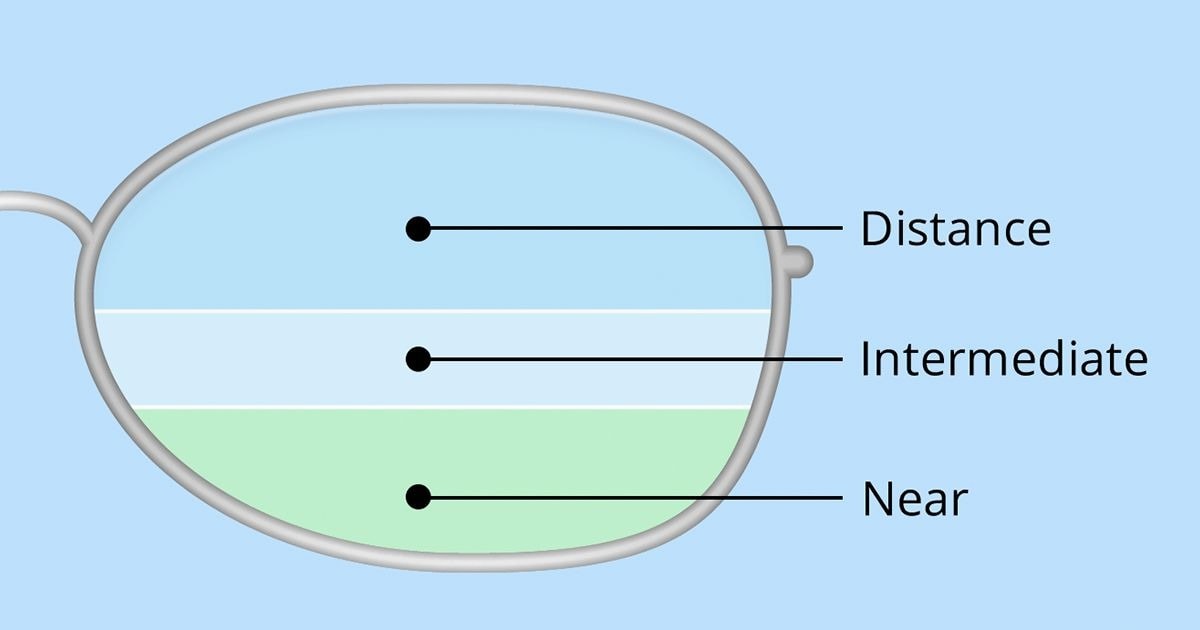

Occupational bifocals and trifocals are special multifocal lenses that are designed to help people over age 40 who are experiencing presbyopia perform specific work-related tasks, hobbies and other activities that require clear intermediate and near vision.
These special-purpose lenses have atypical multifocal designs, with (usually larger) power zones for intermediate and near vision that are positioned differently in the lens, compared with regular bifocals and trifocals designed for multipurpose all-day wear.
Because occupational multifocal lenses typically have large intermediate and near zones (with only a small area of the lens devoted to far vision), these lenses should not be worn for driving and other tasks that require clear, unobstructed distance vision.
Double-D Lenses For Overhead Near Work
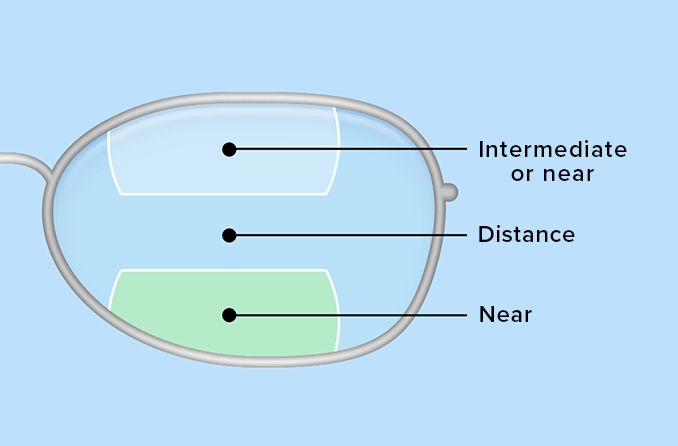
The Double-D design is an example of eyewear that has a D-shaped bifocal segment at the bottom of the lens and an upside-down "D-seg" at the top of the lens. The rest of the lens area provides distance correction.
An auto mechanic who has presbyopia could benefit from this lens, which enables the wearer to see clearly up close — both when looking down to read and when looking overhead to view the undercarriage of a car on a lift.
The Double-D also is an excellent occupational lens for librarians or mail clerks who routinely need to file and read items overhead.
Double-round segs are additional occupational lenses that can be used for the same purposes as the Double-D.
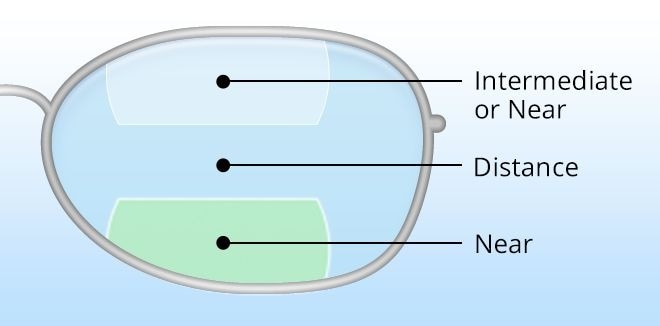
In the Double-D trifocal lens design, there are two segments for near vision.
E-D Lenses With Emphasis On Intermediate Zones
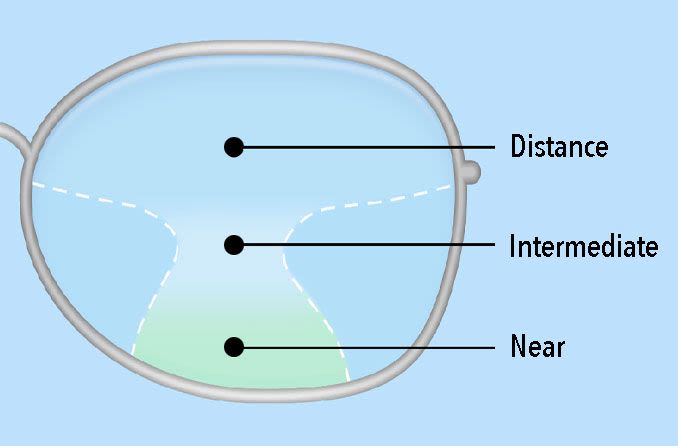
An E-D trifocal has a distance correction along the top half of the lens, separated from the intermediate correction in the bottom half by a line that goes all the way across the width of the lens (called Executive style). A D-shaped segment with near correction is in the lower half of the lens.
The E-D trifocal is suitable for someone who needs a clear, wide field of view at an intermediate distance and who also needs to see clearly both close up and in the distance. An example of a good candidate for this lens would be a television production person who must watch several TV monitors that are spread out in front and to the sides. This person also must read notes from a clipboard and recognize someone across the room.
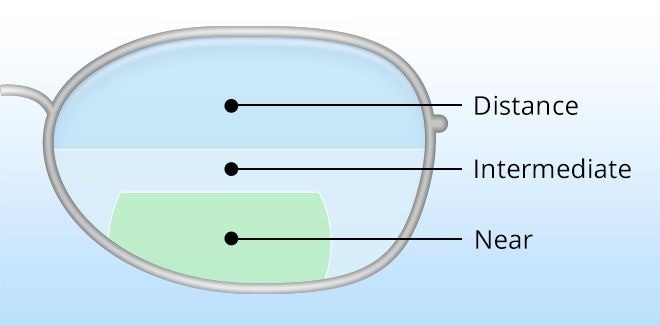
E-D trifocal. This lens has a relatively large distance zone, a full-width zone for intermediate vision and a D-shaped near segment.
Multifocal Lenses For Reading And Near Vision Tasks
Common multifocal lenses sometimes can be converted to occupational lenses when design changes are made to the height of bifocal or trifocal segments.
For example, the normal position of the top line of a flat-top trifocal is just below the pupil. If this portion of the lens is positioned higher instead — directly in front of the pupil — the wearer is better able to see nearby items clearly without looking down or tilting back the head.
This occupational trifocal would be inappropriate for tasks such as driving, because wearers would need to tip down their heads to see over the intermediate portion of the lens for good distance vision. But this lens would be an excellent choice for a pharmacist who spends most of the work day reading small print on labels at or slightly below eye level.
Special Lenses For Golfers
Presbyopic golfers want clear distance vision when looking down at their golf ball and when lining up a drive or a putt. But they also want to be able to read their scorecard.
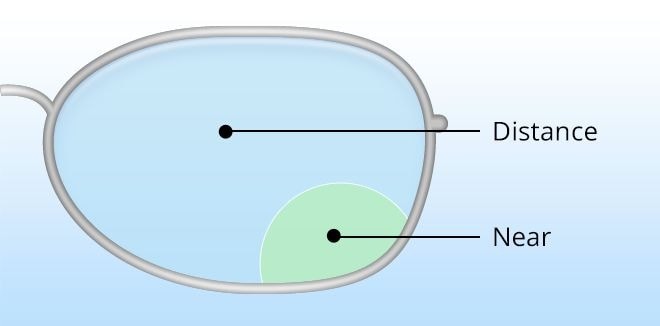
A round-top bifocal can be used to create an occupational lens called a "golfer's bifocal." The small, round reading segment is placed low and in the outside corner of one lens only. Typically the right lens has this segment for right-handed golfers, and the left lens has the segment for left-handed golfers.
In this position, the reading segment is completely out of the way and doesn't interfere with distance vision for shot-making. But the lens still is very functional for brief near vision tasks like reading a scorecard or viewing a menu in the clubhouse.
Recommended For Special Bifocals And Trifocals
In most cases, polycarbonate is the best lens material for occupational and special-purpose bifocals and trifocals. This high-index lens material is thinner and lighter than regular glass or plastic lenses, and it's the most impact-resistant eyeglass lens material available.
Also, anti-reflective coating is highly recommended. AR coating eliminates distracting lens reflections for the clearest, most comfortable vision possible. (It also reduces the visibility of the "seg" lines in bifocals and trifocals by eliminating reflections from the straight top edges of the segments of the lenses dedicated to intermediate and near vision.)
Finally, for golf bifocals or if you find yourself going outdoors frequently throughout the day, consider photochromic lenses. This technology allows your special-purpose bifocals or trifocals to be clear indoors and darken automatically in sunlight. Photochromic lenses are available in a variety sun-activated tints, including contrast-enhancing brown, neutral gray and soothing green.
READ NEXT: What are bifocal reading glasses?
Original version of this article was by Liz DeFranco, ABOC, NCLC.