How is technology helping people with vision loss live more fully?
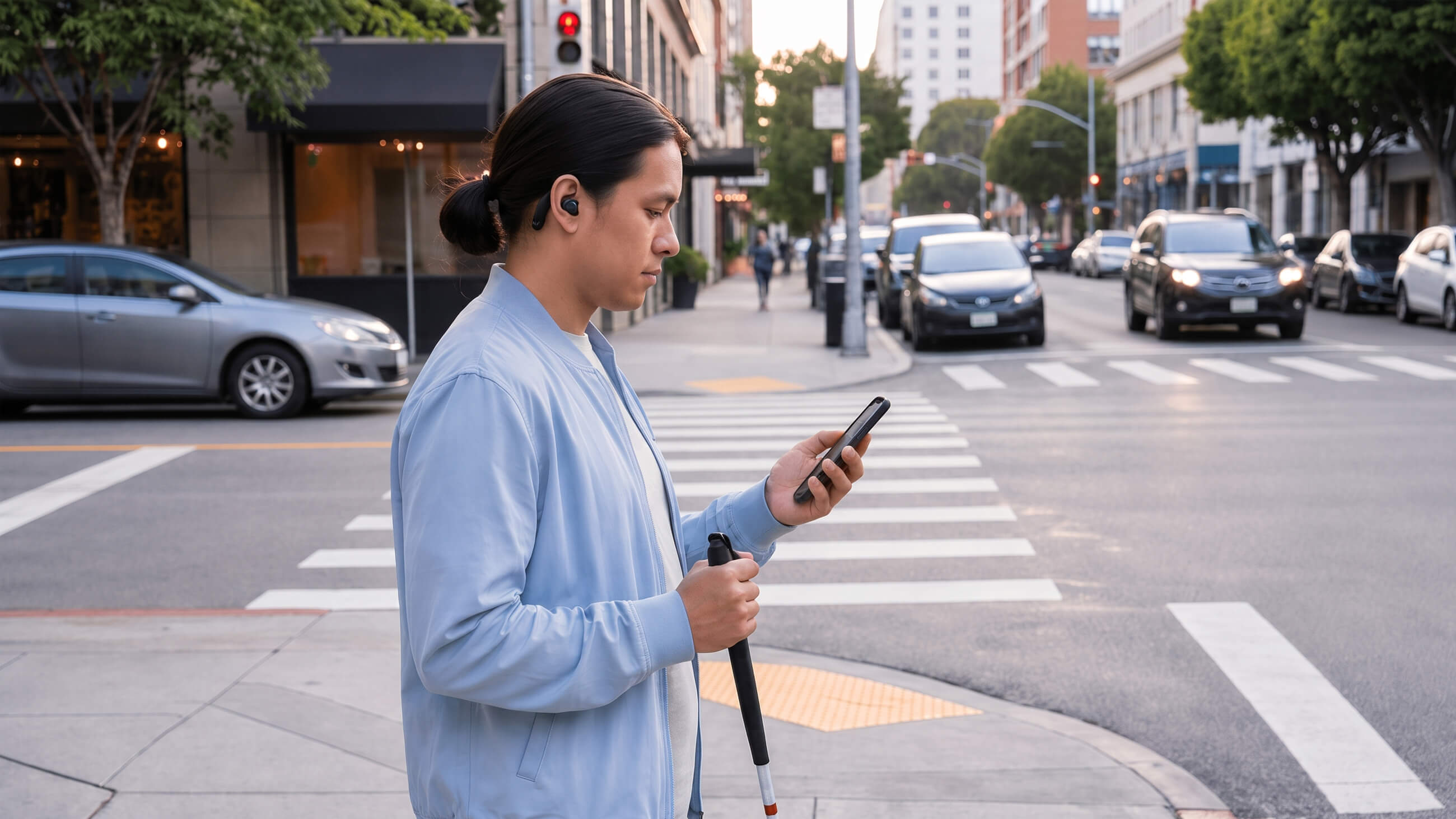

Breakthrough technology has been a lifeline for Justin Romack, who lost his vision at the age of 26. Romack’s sight slowly eroded after he was born with congenital glaucoma. He underwent nearly 100 surgeries to try and sustain some form of vision, but finally lost his remaining light perception in 2008.
Like many who experience vision loss, Romack had to reimagine how he functioned. At the time, analog solutions were the norm, be it braille or a cane.
Back then, smartphones were in their infancy and were primarily tools for the sighted. But today, smart devices and digital tools are the foundation for how Romack operates. Now in his 40s, he “can’t imagine” a day without his phone. He uses an app that verbally describes what his camera sees, making even once challenging tasks like selecting clothing or using a vending machine simpler.
“I used to carry five or six devices to support reading, navigation, notetaking and more, but now my phone is a single touchpoint for all access needs,” Romack said.
He extends this thinking to his advocacy for students as the assistant director of disability resources for the Division of Student Affairs at Texas A&M University. Technology should widen access across the classroom and daily life, according to Romack.
“Accessibility used to be a niche discussion, but now it’s mainstream,” he said.
His technology-first approach is fast becoming the predominant mindset among low-vision specialists to help patients with vision loss. These specialists counsel their patients on how to use consumer and bespoke devices to experience more of life with less friction than in the past.
Not long ago, vision loss meant having to reconstruct one's independence by relying on specialized equipment or help from others. Reading a menu required a magnifier. Telling banknotes apart needed a currency reader. And for tasks like choosing an item from a vending machine, it often took a friend or family member.
Today, a smartphone can do much of what once took several separate devices. Advances in accessibility applications and artificial intelligence (AI) can help those with limited or no vision navigate with greater independence and confidence.
The smartphone as the digital hub
Ashley Deemer, OD, FAAO, an associate professor and low vision rehabilitation specialist at the Southern California College of Optometry at Marshall B. Ketchum University, said the smartphone is the starting point for helping patients navigate life since it’s the device most already carry. According to the American Foundation for the Blind (AFB), 82% of people with vision challenges own a smartphone.
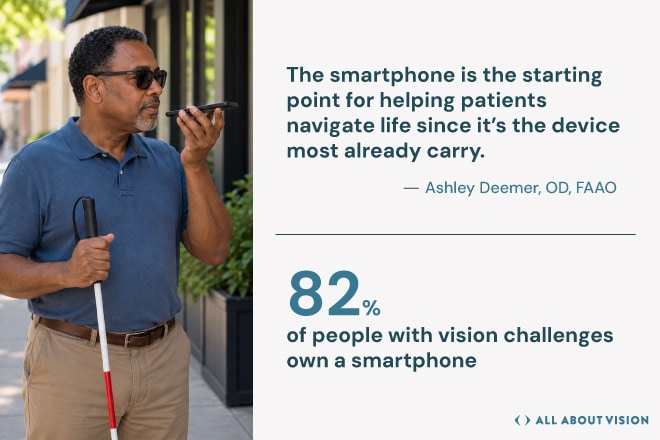
“The first thing I'll start with is, okay, let's maximize what you're already using with your smartphone,” said Dr. Deemer.
People who have lost their vision over time often use features like increasing font size, but Dr. Deemer’s goal is to ensure they access all that’s available through platform accessibility services. Other patients with more limited vision need advanced tools beyond bigger text.
“There are even more features within there, like those that can speak out loud to you, make an article on your web page more user-friendly to read visually, and screen readers to read text out loud for you,” Dr. Deemer said. “Tools like changing the contrast options to make the text bolder or to reverse the contrast, where you have the black background with white letters, help a ton of patients who might have a lot more glare sensitivity or issues with contrast.”
David Simpson, OD, FAAO, an assistant professor of ophthalmology at the University of Colorado School of Medicine and a vision rehabilitation provider at UCHealth, said the number of apps that one needs has consolidated. A consumer artificial intelligence (AI) app can speak aloud text that’s viewed with the device camera, function as an optical character recognition (OCR) device for the visually impaired, or replace a money reader app.
“We’ve never had more options for people with visual impairment,” he said. “I think we’re getting better and better at meeting patients where their needs are.”
A new generation of devices
Smartphones can do a lot, but other specialized devices also play a critical role. Dr. Deemer pointed to smartglasses as a device patients have gravitated toward compared to head-mounted video displays. While the latter have been available for several years, she said many patients found them heavy and drew too much attention to them in public.
“Oftentimes, people would say that the devices themselves are heavy. And they don't necessarily want to use them for long extended periods of time because of the weight and because of just the appearance itself,” said Dr. Deemer. “So that's where smart glasses came in, kind of filled that gap where it cosmetically looked like a regular pair of glasses. It wasn't as if you were out in the world and everyone knew you had a vision impairment because you had this funny thing on your face.”
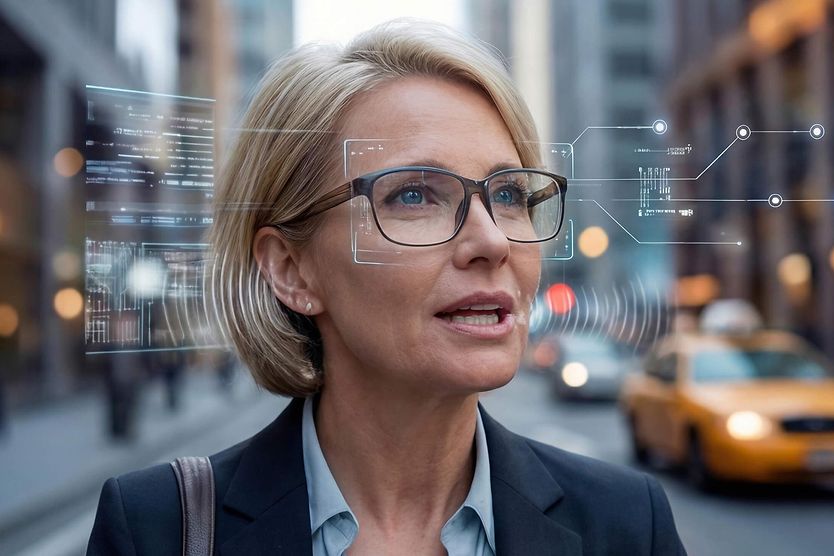
Smart glasses have the advantage of looking like a typical pair of glasses. While imperfect, AI voice accessibility tools describe surroundings and answer questions.
Third-party apps offer services for the wearer to speak with a sighted volunteer who can, with permission, access the glasses’ camera and help navigate or describe surroundings.
“That camera and the AI capabilities really just help the visually impaired person interact with the world a little bit better,” Dr. Deemer said. “For example, they might take a picture of a menu and then ask, 'What items have chicken on them for me?’ Rather than having to have their partner or their family member read something out loud for them, at least they have a little bit more independence.”
Smart glasses remain an emerging technology and may be cost-prohibitive. Both experts cited cost as a common challenge in low vision strategies, as some patients may not be able to afford or wish to invest in technology as the solution.
Getting around
Navigating outside the home is one area where technology can play an important role, though it often should be combined with other support, according to experts.
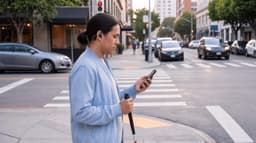
Traditional aids like a cane are still essential. Crosswalk signal audio cues and braille instructions on signage will continue to be important. A low vision specialist will assess if someone is a candidate for an orientation and mobility (O&M) specialist, depending upon how much independent travel that person wants to do. A certified O&M specialist is trained in helping someone use a broad set of skills to safely navigate their environment.
“In terms of just basic travel, I think, depending again on the vision loss, just having basic orientation, mobility and cane travel skills goes a long way,” Dr. Deemer said. “No technology is perfect.”
“If a patient limits where they go, how much they leave the house, or they always need to be with somebody when they’re walking because of their vision, or if there is a risk of falling because they can’t see steps or curbs, those are patients I would want to connect with an orientation and mobility specialist,” Dr. Simpson said.
The combination of O&M training with technology could be a solution. With a sighted volunteer speaking through smart glasses, for example, an individual could ask for directions or get a detailed description of their surroundings, using a cane and implementing O&M skills.
As with other AI applications, the experience may be inconsistent. AI systems still hallucinate, confidently stating facts that are inaccurate or potentially inventing what isn’t actually there. A traditional OCR reader, a common device to use in low vision management, may garble text that it has difficulty reading. However, an AI system could completely invent what’s in front of it.
GPS for visually impaired apps can help people plan routes and follow walking directions. But when heading indoors, they tend to hit a limit. Buildings can be more of a challenge to navigate, especially if the layout is too complex or GPS signals don’t function inside.
Some newer navigation apps are designed to help. They enable access to a device camera, Wi-Fi or Bluetooth to gather information about the environment and speak directions.
Making reading more accessible
Dr. Deemer said she finds that reading is the top skill for those with whom she works. Reading is an essential source of pleasure that impacts a sense of independence for people who have lost their sight.
OCR for the visually impaired has long been a useful software tool, and is an example of one that has been absorbed into the smartphone ecosystem. An AI text reader can read aloud text when a smartphone camera is pointed at the copy.
Reading isn’t always just for pleasure, however. Text is essential for education and full participation in university life.
Romack, in his role advising students at the university, finds that there’s still a gap in making material accessible to students.
“I hear from students and educators that access to technical, visual and STEM content continues to lag. Braille and tactile graphics still remain important in these spaces. Technology is not the barrier — it’s our willingness to be proactive and purposeful with design and delivery that ends up being the barrier,” he said.
Many eReader devices include a mode for audiobooks. Speakers and headphones can allow one to purchase and begin listening to a book.
Dr. Simpson noted that consumer apps developed for the general public can sometimes be a better fit than those built specifically for blindness and low vision. For example, one consumer AI app can speak aloud text or identify details like a color. AI could also replace a dedicated currency identifier app, which recognizes banknotes through the device camera.
Applications for daily living
Devices like smartphones, smart glasses and speakers have closed important gaps. However, research on home-based tasks indicates that integrating technology with more tactile strategies can ensure someone has a breadth of strategies to use if an app or device doesn’t work out.
One study found that misplacing objects at home was a common challenge. Participants gravitated toward low-tech strategies to help. The researchers determined that technology didn’t always fill the gap, noting that “existing assistive technologies often fail to integrate seamlessly with users’ preferred strategies.”
A common challenge is that using smartphone applications or accessing the features native to an operating system requires digging through the on-screen layout. The help of a friend, family member or low-vision specialist can help.
It’s important not to overlook other strategies. Dr. Deemer walks patients through ways to make their home more accessible and safer with a few items.
“I talk to people about using a high-contrast cutting board that has white on one side and black on the opposite side,” Dr. Deemer said. “That way, when you’re cutting something like a white onion, you can put it on a black cutting board and just have that contrast to see it a little bit better.”
Dr. Simpson has worked with patients who said they wanted a better way to get a real-time description of what they’re seeing, such as at a youth sports event. While smart glasses with AI features and low-vision applications are showing promise, a more seamless integration may still be off in the future.
“For people with visual impairment, I think the holy grail would be having something that can provide audio descriptions and have a visual component to it, while looking like a regular pair of glasses and being affordable for patients. I think we're getting closer and closer to that sort of device,” he said.
What to ask your eye care provider
Goals are key to what devices will work best for one’s low-vision strategy. Working with an eye doctor or low-vision specialist can help. The provider will discuss what needs to be accomplished and take into account a person’s comfort level using technology.
Since no single app or device fits every diagnosis or stage of vision impairment or loss, it’s recommended that people treat consumer technology as a complement to and not a substitute for low-vision care.
A low-vision specialist can ensure that any devices used as part of the strategy provide a path to greater independence and participation in activities that lead to a richer, more fulfilling life experience.