Low vision doesn’t mean game over: Accessible video games are here to stay

For a long time, Steve Saylor believed he was terrible at video games. When his family got its first home gaming console in the 1980s, he regularly fell short when playing against his brother, mother or a friend.
Saylor said that for years, he assumed he wasn’t good at gaming. He was diagnosed with nystagmus related to albinism, a condition he’s had since birth. It creates involuntary eye movements and, along with other eye-related changes associated with albinism, makes his vision extremely blurry. Saylor can see light, shapes and colors, but little visual detail.
It explained why in school, he couldn’t see as well as his friends. He was usually seated at the very front of the class and provided handouts with larger print.
“It wasn't until much later in adulthood that I realized it wasn't that I sucked at games. It was that games sucked for me,” Saylor said. “That's when I really got into accessibility and thought, I need to figure out a way to make games more accessible for myself, but also make sure kids like me don't grow up without being able to play video games.”
Today, Saylor’s professional life focuses on video games. As a self-described “blind gamer,” he works with game studios and developers to help make their games more accessible for those with disabilities.
The crux of his work is advocating to expand and improve how people with disabilities can play without watering down the challenge and intensity that make gaming fun.
A new way to think about video games
Low-vision and blind players have long played video games, but the choices have been limited to options with reduced complexity. Saylor resigned himself to being satisfied with low performance.
In prior years, there’d been some attempts to make games fun for everyone. More recently, software developers and hobbyists have developed games that rely on audio to navigate the environment. Other games are text-based, with screen readers used to dictate the action.
Times have changed, technology has improved and there’s been a push for equity across many industries. In recent years, accessibility has become a higher priority for mainstream games released by major studios. Popular console games have added tools, especially paired with more accessible controllers, that let blind players race or navigate more complex environments.
Brian A. Smith, PhD, an associate professor of computer science at Columbia University, thinks that accessibility can go further. He directs the Computer-Enabled Abilities Laboratory (CEAL), which develops computers and assistive technologies that benefit the low-vision and blind communities.
One of the lab’s projects is creating video games specifically for blind players that maintain the challenges sighted players experience.
“The deeper challenge is understanding what makes different games fun and what moment-to-moment decisions are inherent to gameplay,” Dr. Smith said. “Games are about meaningful choices. How can we give blind and low-vision players the ability to make the same meaningful choices from moment to moment?”
One example is a tool called a racing auditory display (RAD) used in race car video games. The feature converts information about the car and racetrack into sound. To develop RAD, researchers recorded sighted players and examined their steering inputs frame by frame, identifying the car’s position on the track and upcoming turns. The display then translates that information into sound. The engine’s noise shifts left or right as the vehicle approaches the corresponding edge of the track. A series of beeps helps the player anticipate the direction and timing of upcoming turns.
If the game only dictated where and how to turn, it wouldn’t offer that much difficulty. The concept is to give the player just enough information so they can have agency and a challenge to work through.
“If we can provide that same small amount of information to blind players in those same moments, in real time so that they can make the same choices, then we’re preserving the feeling of racing,” Dr. Smith said.
Saylor said accessibility doesn’t oversimplify a video game.
“We’re not trying to make games easier,” he said. “We want to keep the same challenge that each game provides. We just want to give equal access, or level the playing field.”
Dr. Smith’s lab partners with several organizations that serve the blind and low-vision community in New York City. Some of the researchers and interns are also blind.
Popular games for everyone
The major studios that create some of the most popular video games are now building accessible features directly into the software. While there is still room to grow, blind and low-vision players now have far more options than in the past.
Features include high-contrast modes, color adjustment options and the ability to increase text size. Magnification tools also help low-vision players see some in-game text.
For Saylor, high-contrast modes help make a game more playable. Some games feature the ability to assign colors to characters while muting the background. This makes other characters, specifically enemies in combat games, easier to locate with his limited vision.
“I can just try to find that red enemy, essentially, if that’s the color I chose,” Saylor said. “I know that I can aim in that general direction and that I’m aiming toward an enemy.”
In addition, screen readers can read menus and other text aloud. They can be difficult to build into more complex games, Saylor said, because on-screen text can change quickly during gameplay.
Dr. Smith noted there remain several ways to bridge where we are today to a more fully accessible world of gaming. The software innovations that let blind and low-vision players access their games require considerable development work.
“One holy grail our lab is working toward is building accessibility features and supports into game engines themselves, so that once a game is exported from the engine, accessibility is simply built in,” said Dr. Smith.
Many games are built on top of a gaming engine that provides the underlying framework for the graphics, audio and other features. If accessible tools are built into these engines, Dr. Smith said, it would simplify adding those features to games. This could increase the number of games that are simpler for low-vision and blind users to access.
Saylor said that even with the industry's progress, games that are fully playable by blind players aren’t common.
“It is still very rare to find a game that is totally playable, fully playable, by a blind player on any side of the blind spectrum,” he said.
Developing accessible gaming hardware
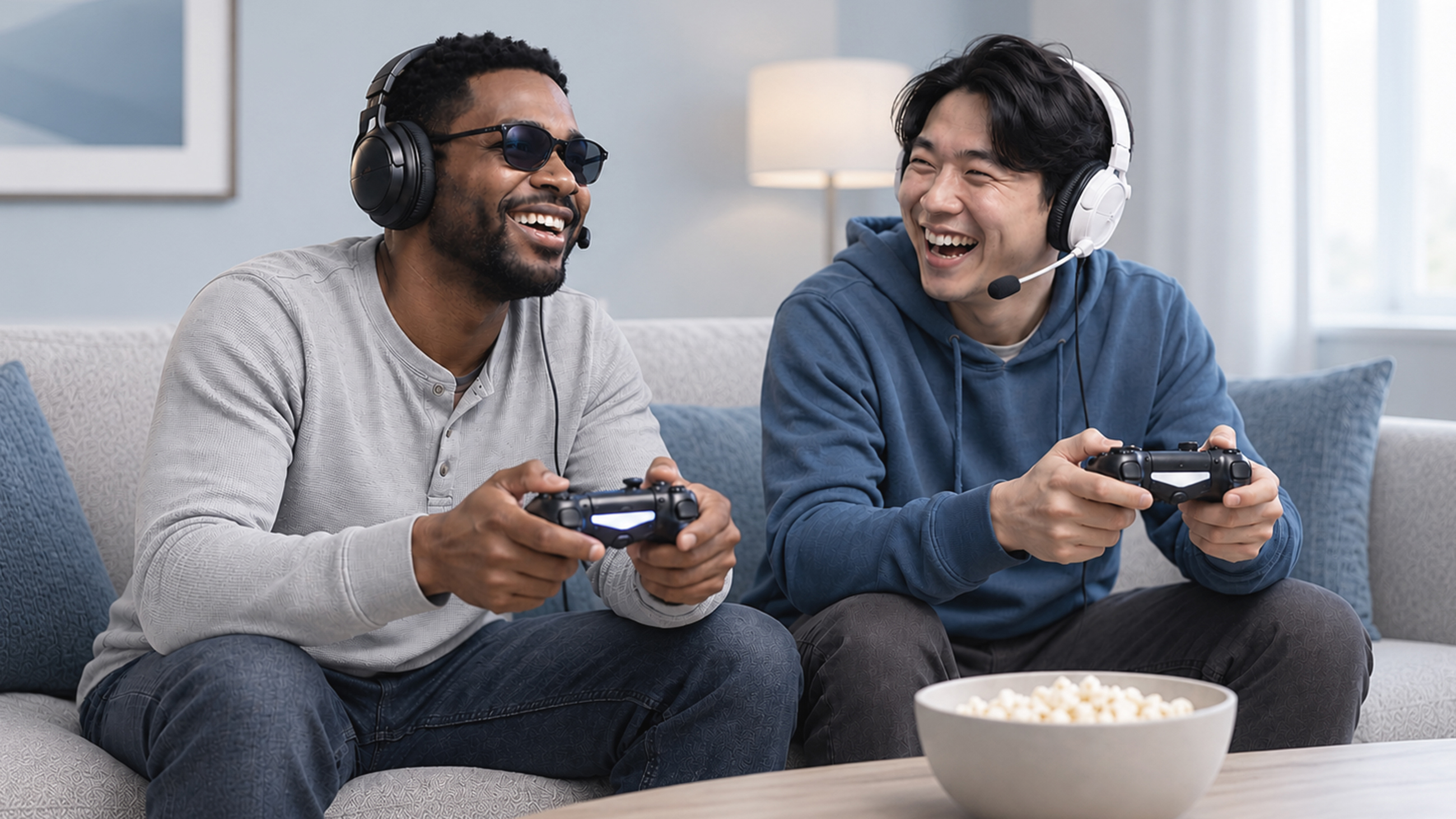
Gaming hardware can be a crucial link for a blind or low-vision gamer to what’s happening on-screen. During a video game, the controller’s vibration can warn of a collision or signal that a vehicle is about to veer off the track.
Newer controllers offer more specific feedback, such as what direction an enemy attack may be coming from.
“If you’re taking damage, you can have the haptics happen on either the left or right side of the controller,” Saylor said. “A blind player can know, okay, I’m getting hit from the left or the right.”
Headphones and spatial audio are other important tools. Through audio tones or the swoosh of an enemy creature, the gamer can quickly respond.
Many manufacturers have developed hardware that gives the buttons distinctive shapes and tactile markings to assist a player in navigating the game by touch.
“Haptics is important. Sound and audio, in particular spatial audio, are really important,” Dr. Smith said. “What’s important is that players don’t have to learn a whole new language to understand the world.”
More than fun and games
Gaming isn’t just another fun activity. It carries benefits that can bring together a community and sharpen the skills of people who are sighted as well as those with low vision. Gaming places substantial demands on memory and rapid decision-making.
Tiffany Tsoi, OD, FAAO, is an optometrist who completed a residency in vision therapy and vision rehabilitation and has written about the visual demands of electronic sports (esports), also known as competitive, organized gaming. She found that gaming strengthened her own spatial awareness.
“For me, first-person shooter games improved my spatial orientation,” Dr. Tsoi said. “Players have to navigate maps, remember what is behind them and to either side, visualize where they have been, and estimate how far to turn to reach a wall or doorway.”
“Before playing those games, my spatial orientation was poor. I found that the practice helped me navigate real places, such as a downtown area, and estimate how many blocks I was from a destination,” she said.
How gamers can protect their eyes
For many, gaming is more than just a hobby. At the highest levels, participants are known as esports players. They compete with the same intensity as professional athletes.
Diane Tucker, OD, a Cleveland Clinic optometrist and member of its esports medicine team, evaluates gamers for focusing and eye-teaming problems associated with extended computer use.
“We’re looking for eye-focusing and eye-teaming problems related to near work and computer use,” Dr. Tucker said. “Symptoms can include eyes that hurt after focusing, intermittent blurry vision or double vision at near.”
Dr. Tucker recommends taking breaks, looking away from the screen and keeping up with one’s regular comprehensive eye examinations. Anyone who regularly experiences headaches or more severe symptoms like blurred or double vision should discuss them with an eye doctor.
Creating more ways to play
A clear indicator of progress is how game studios are responding. Saylor said he’s hopeful about the transformation taking place.
“What I'm seeing a trend of is more studios including accessibility in their games for the first time, which is very encouraging to see,” Saylor said.