How technology is helping people with low vision enjoy sports and recreation
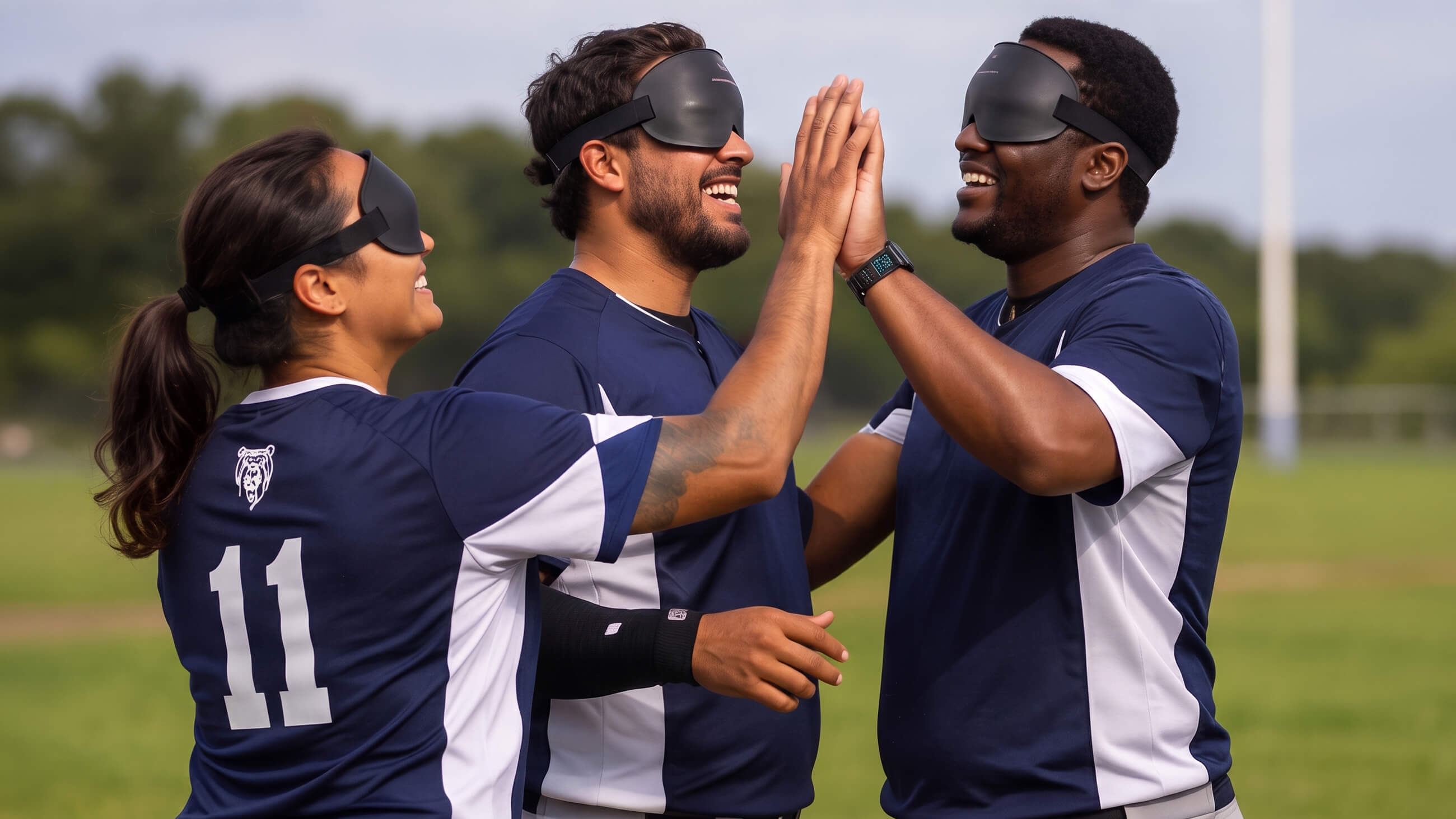

The moment Stephen Guerra walks onto the baseball field, he’s aware of his senses. The sound of the ball whistles through the air, emitting a melodic beep during flight. He hears and feels the smack of his bat against the ball, then the sensation of his feet pounding against the dirt as he runs to first base.
Guerra focuses on his non-visual senses to compete in beep baseball, a modified form of the sport for people with low vision. The batter and players in the field wear a blindfold, so neither has a visual advantage. A sighted pitcher throws a ball that emits a loud beeping sound to the team’s batter, who hits it into the field — just like traditional baseball.
After hitting the ball, the batter charges toward a buzzing base about 100 feet away, while defenders track the ball and try to secure it before the runner reaches base. A sighted spotter is stationed on the field to call out a number marking the zone where the ball is headed, giving the fielders directions for where to run. If the runner reaches base before the defenders secure the ball, the team scores a run. If a fielder gets the ball first, the batter is out.
“You have individuals who are blind and visually impaired who, no matter how old they are, are striving for that excellence in athleticism, in loyalty to their team, to have a victory,” Guerra said. “There's no sweeter scene to see — someone who is older, or someone who is 18 or 19 years old, having this opportunity to play a sport at the highest level of competition.”
Beep baseball is one example of many ways that people with vision impairment can participate in athletic competition. Blind soccer, goalball and several other adaptive sports enable those with limited vision to experience the joy and competition of athletics. Optometrists and other eye care specialists who work with low-vision patients often encourage patients to pursue athletic activities for the physical and social benefits that come with sports.
More than 49.5 million U.S. adults report some difficulty seeing, according to estimates from the 2024 National Health Interview Survey. Of those, 3.8 million report “a lot of trouble seeing,” while 420,000 say “they cannot see at all.” Adaptive sports give many of them a way to engage in organized competition.
A baseball field where players don’t need to see
Guerra has been playing beep baseball for nearly 30 years, first picking up the sport when a friend introduced him to it on Long Island, New York. He plays for the Minnesota Millers, based in the Twin Cities region, and is the secretary for the National Beep Baseball Association, which is celebrating its 50th anniversary in 2026.
Guerra was born with congenital cataracts and lost his vision after developing an infection from the subsequent surgery. After doctors operated on Guerra’s eyes, they both became infected.
Surgical practice has changed considerably since then. When both eyes need surgery, surgeons now treat each eye as a completely independent operation with separate instrument sets, gloves, gowns and medications specifically so that an infection in one eye cannot be carried to the other. The American Academy of Ophthalmology’s (AAO) registry data compared same-session and separate-session bilateral cataract surgery, finding similar low rates of postoperative infection.
“I knew there was nothing I could do about it, so I built on what I could do,” said Guerra. “I modified things so I could complete what I wanted to complete: public school, college, being gainfully employed as an adult, using guide dogs, modifying what I needed so I could be successful and productive.”
He wrestled in high school and credited his family and teachers for encouraging him not to let his vision loss limit what he accomplished. Today, the baseball field stands out as a place where differences between him and sighted players disappear.
A world of accessible sports
People with limited vision have several other options if they want to participate in an accessible sport, with some competing at the Olympic level.
Goalball is a Paralympic team sport invented in 1946 for World War II veterans who had lost their vision. Two teams of three roll a ball with bells inside it, attempting to score against the opposing goal. Every player wears a set of opaque eyeshades, allowing athletes across the full spectrum of vision impairment to compete on identical terms. Defenders try to block the ball, using the bells’ sounds to sense the ball’s location.
Blind soccer is an adaptation of the world’s most popular sport, known as “the beautiful game.” Visually impaired soccer has five players on each side and a smaller field than a traditional soccer pitch. The four team members playing offense and defense wear blindfolds and follow the ball by ear, listening to rattles or bells inside it. Boards along the outside of the pitch keep the ball in play.
In order to keep competitors safe, players are required to shout, “voy,” Spanish for “I’m going,” when they’re approaching or they might concede a foul. The goalkeeper can be sighted or partially sighted. Sighted guides provide verbal cues to help players navigate during the match.
Jorge Polanco is the head coach of the U.S. men’s blind national soccer team, which will make its Paralympic debut at the 2028 games in Los Angeles.
Polanco, who has played and coached sighted soccer, said players develop orientation and awareness of their position on the field and become attuned to the sounds of the ball.
“When they get on the field, it’s freedom,” Polanco said. “It’s just listening to the guide, listening to the ball, listening to what’s going on around you and being able to just run.”
With more training, practice and gameplay, he said players orient themselves and dribble, run and pass with increasingly fewer verbal directions. He cited elite players with more established blind soccer teams like Japan and Brazil who move fluidly.
“Some of the things they do are just unreal,” he said.
Showdown is a sport that doesn’t use any sighted players to guide play. It’s played on a specially designed table with two players trying to bat the ball off a side wall and into the opponent’s goal. Players listen to small metal pellets rolling inside the ball to locate it during play.
Accessibility is expanding to more casual competitions, like darts. Guerra plays a variation known as audio darts, in which a talking electronic dartboard announces every number and score aloud.
“I'm playing against sighted people, and if I can just keep up with them, then I'm successful. On occasion, will I beat them? Yeah. And it'll be bittersweet, and the phrase comes up: I can't believe we just got beat by a blind guy. Well, tough. That's just the way it happens,” he said.
Limited vision doesn’t mean athletic limitations
Adaptive sports aren’t the only option for those with vision loss. Many amateur and professional athletes participate in traditional sports by maximizing the vision they have.
Jarrod Davies, OD, FCOVD, is the clinical director of the Utah Vision Development Center, specializing in sports vision performance training and vision rehabilitation. Each patient is an individualized case; some have low vision and may need to focus on getting the most from peripheral vision.
“The athlete may need to rely on different visual cues because they cannot see the same details, but motion processing, multiple-object tracking, eye coordination and peripheral vision still apply to a patient with low vision,” Dr. Davies said.
Dr. Davies noted that some people with low vision have primarily lost their central vision. Sports are often highly dependent on peripheral awareness, so an athlete uses a lot of side vision dynamically and may not need as much central acuity.
The reason comes down to how the retina is built. The central retina handles fine detail and color vision, used for reading books and recognizing faces. The peripheral retina is different. It’s highly sensitive to detecting motion and to low light conditions.
He pointed to soccer as an example, where players may not need to see every detail on the soccer ball to follow it. Strong peripheral awareness helps them interpret the field. In his work as president of the International Sports Vision Association, Dr. Davies advocates for vision training for athletes to help them achieve the highest levels of athletic performance.
Jennifer Stewart, OD, is an optometrist and the founder of Look New Canaan, a private practice in Connecticut. In her clinical and consulting practice focused on sports and performance vision training, she works with patients on how certain aspects of vision connect to athletic performance.
“There are countless ways to stay active with the right adaptations. High contrast, good lighting and sport-specific modifications can allow these athletes to continue to be active. Athletes naturally become more aware of sound, touch and body position as well,” said Dr. Stewart.
She noted that having 20/20 vision isn’t what’s most important for an athlete. It’s about how efficiently a person’s eyes and brain work together.
Protecting the vision you have
For an athlete with vision loss in one eye, the better-seeing eye does all the work. An injury to it carries different consequences than for a typically sighted athlete. For that reason, eye doctors recommend polycarbonate protective eyewear that meets the ASTM F803 standard for the specific sport, worn during every practice and competition.
Ask your eye doctor which sports need eye protection and whether any activity should be modified or avoided. Some reasons for modifying or avoiding certain activity may include:
- Previous eye injuries
- After recent eye surgery
The importance of an active lifestyle
Being physically active and involved in sports can begin early, regardless of one’s vision status.
Dr. Davies works with children and families to help find adaptations for people with visual impairment. The physical health benefits of exercise and team sports are as important for these patients as anyone else, he said.
“When parents learn that their child has low vision, their immediate impulse may be to protect the child and make sure the child does not get hurt,” Dr. Davies said. “However, the child may be just as athletic as anyone else.”
He said parents should still encourage their children to be active, head to the playground, and participate in sports and physical activities.
It’s not difficult for people to foster an inclusive sports environment in their community. New England Low Vision and Blindness highlights volunteering and advocacy as important steps in raising awareness of people with low vision’s needs and fostering opportunities to participate in these community-building activities.
For Guerra, beep baseball provides camaraderie with fellow players and an intensity that matches that of any athletic competition.
“Having this opportunity to play this sport at the highest levels of athleticism really is a dream come true, for myself and other people in the league,” said Guerra.
Dr. Davies recommends tuning in to peak performing athletes to understand how much of a difference sports can make.
“I think everyone should spend more time watching the Paralympic Games and seeing how remarkable those athletes are,” he said.