The myopia awareness gap: What every parent needs to know


Eye doctors and parents have more options than ever to treat and slow the progression of myopia in children. However, many parents either aren’t aware of available resources or don’t take advantage of the recommended strategies to reduce myopia’s onset and progression.
“The Myopia Awareness Gap,” an All About Vision (AAV) survey conducted by The Harris Poll in July 2026, sought to identify gaps in parents' understanding of myopia prevention and treatment. The online survey of 704 parents with children under the age of 18 found several areas where parents have misconceptions and notable awareness gaps:
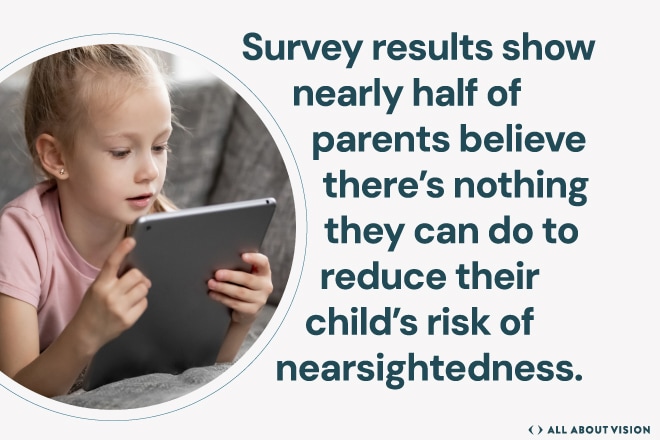
- Almost half of parents, 48%, believe nothing can be done to reduce a child’s risk of developing myopia.
- A majority of parents say their children aren’t following recommended behaviors like having routine vision screenings at well-child visits (62%), holding devices at an appropriate distance (68%), or avoiding screens before bed (68%).
- Just over 2 in 5 parents (42%) have heard of specialty glasses for myopia control that can be used to manage the condition in children.
Source: The Harris Poll Myopia Survey. Conducted on behalf of All About Vision. July 2026.
It’s clear from the survey that doctors and experts still need to address misconceptions and educate parents on the range of myopia management strategies and preventive lifestyle changes. Parents seemed to lack understanding on topics ranging from how much time children should spend outdoors to newer treatments like specialty glasses and contact lenses.
The symptoms that are being overlooked
Spotting nearsightedness symptoms early is critical to seeing an eye doctor for timely diagnosis and treatment. AAV’s survey of 704 parents showed mixed results in parents’ knowledge of the most common symptoms.
For example, just over one in five parents recognize complaints from their children of faraway objects looking blurry (22%) and needing to squint at distant objects (23%) as the most common nearsightedness symptoms.
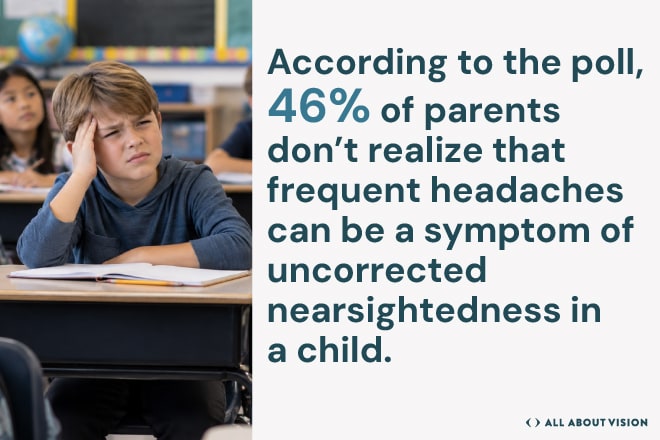
Headaches are another important tell. Yet nearly half of parents (46%) don’t realize that frequent headaches can be a symptom of uncorrected nearsightedness in a child.
Family history is the strongest risk factor parents cannot change. A child with one nearsighted parent is more likely to become nearsighted than a child with none. The likelihood rises again when both parents are myopic.
Parents may miss critical signs until children reach school age, when clear vision is necessary for a variety of daily activities and gaps become evident. Sudha Nallasamy, MD, pediatric ophthalmologist and associate director of The Vision Center and chief of the pediatric ophthalmology service at Children’s Hospital Los Angeles, said that paying attention to what children describe at school along with their various experiences is important to spot clues if they are developing nearsightedness.
“Difficulty seeing the board is probably going to be the first sign. At home, parents might notice that their child can't read street signs from as far away as they can,” Dr. Nallasamy said.
Paying attention to these signs and then following up with a comprehensive eye exam is critical, she said. Common symptoms of nearsightedness also include needing to move objects closer to see them clearly, squinting and eye strain. Regular school vision screenings can also be an important mechanism for flagging issues early but do not replace a comprehensive eye exam.
Source: The Harris Poll Myopia Survey. Conducted on behalf of All About Vision. July 2026.
The evolving challenge of managing screen time
Screen time advice and best practices are frequent topics when parents bring their children in for a visit, said Dr. Nallasamy. She said she’s regularly asked about how much screen time is appropriate for children and the latest recommendations.
Based on AAV’s research, parents tend to overestimate how much screen time to allow. According to the poll, 46% of parents believe it takes three hours or more of daily screen time before it’s linked to a higher risk of myopia.
But research indicates the threshold is much lower. Risk can begin to rise after one hour daily of screen time, nearly doubling with four hours of use.
While the amount of screen time matters, some parents might not realize that the devices children use have an impact as well. Dr. Nallasamy encourages a shift away from phones and tablets and toward larger-screen devices like a television whenever possible.
“I tell parents that if their child wants to watch something, they should have the child watch it on a television instead of a phone or tablet. A television is larger and viewed at a distance, so the child doesn’t have to accommodate as much. That’s less likely to induce myopia than watching something on a small screen held nearby,” she said.
Watching TV from the couch can also be instructive. If the child has to strain or move very close to see, it could be another sign that they are nearsighted and need to have their eyes examined.
Much of the concern with screens is connected to other health concerns, according to the survey. Over 4 in 5 parents are concerned about sleep quality (86%), the ability to focus and pay attention (86%), vision/eye health (85%), overall mental health (85%), and the ability to communicate and interact with others in person (81%).
Based on those concerns, a child’s relationship with screens should be interactive and educational, rather than passive content consumption, according to Dr. Nallasamy. Video calls with relatives can build connections and are key to childhood development. Allowing a child solely to play video games on a phone may not only be noneducational, she said, but can contribute to nearsightedness.
Dr. Nallasamy recommended that parents investigate if their child’s smart device has a feature that sends an alert if the device is being held too closely for an extended period of time.
Better habits for eye health
Helping children make good lifestyle choices is critical for the prevention and treatment of nearsightedness.
When children are prescribed glasses, it’s critical to encourage a regular habit of wearing them. This might mean addressing a common misconception some parents have.
Marina Eisenberg, MD, a pediatric ophthalmologist at the Cole Eye Institute, Cleveland Clinic, finds that many parents she works with mistakenly think their children’s nearsightedness will worsen the more they wear their glasses.
“Keeping them out of glasses longer when they’re nearsighted is actually detrimental to their vision, and we think it can make the myopia progress faster,” she said. “Some parents really believe it’s the glasses that are causing it, but in reality it’s just biology.”
Uncorrected nearsightedness can do more than blur the board. Children who can’t see distance clearly might miss details in the classroom, drift away from sports that depend on tracking a ball or tire quickly during sustained reading. These behaviors may be interpreted as inattention or disinterest rather than a vision problem.
In addition, AAV’s poll revealed that parents are missing the mark to encourage other healthy behaviors. About 4 in 10 or fewer parents say their children:
- Eat a balanced diet: 41%
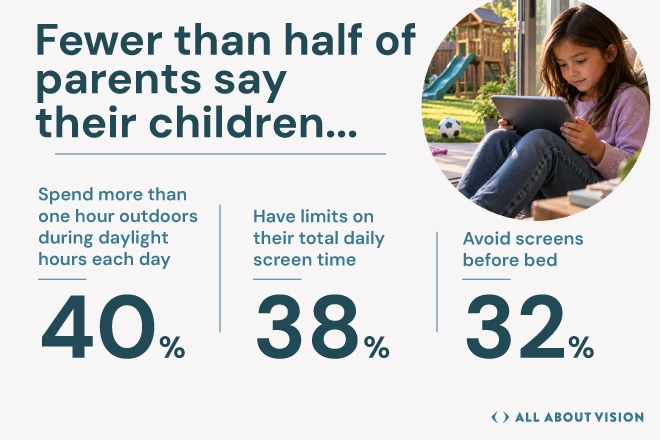
- Spend more than one hour outdoors during daylight hours each day: 40%
- Have routine vision screenings at well-child visits: 38%
- Have limits on their total daily screen time: 38%
- Have an annual comprehensive eye examination: 35%
- Avoid screens before bed: 32%
Dr. Nallasamy said factors behind parent choices can be complex, and not always within their control.
“Many families have two parents working outside the home. Devices often become babysitters,” she said. “Childcare is very challenging in the United States, and not everyone can afford it. Even when a parent stays home with a child, that parent has to accomplish other things besides watching the child all the time.” As a result, some parents may depend on devices to occupy their children more than they’d otherwise prefer to do.
Several studies have examined the role of spending time outdoors in lowering the risk of myopia. Many have found that significant time outdoors can reduce or delay the risk of developing nearsightedness. The specific way outdoor time helps is not fully understood, but many experts recommend at least two hours or more of time outside per day.
Outdoor time and unstructured play inherently come with other physical and mental health benefits. Parents should observe best practices for managing sun exposure, such as hats, sunglasses and sunscreen.
Jeffrey Cooper, OD, a professor emeritus at the State University of New York College of Optometry who practices in Manhattan, New York (no relation to All About Vision’s Executive Director of Medical Content, Michael S. Cooper, OD), cautions that parents should have realistic expectations for what increased outdoor time actually accomplishes.
“Being outside is a good avenue for reducing the risk of developing myopia, but once you develop myopia, the studies haven’t shown it to be that effective in slowing progression,” he said. Once myopia has developed, studies on this effect have shown mixed results, some showing beneficial effects while others show minimal impact on the rate of progression.
Once a child has myopia, Dr. Cooper said there are many effective treatments. According to the survey, parents overwhelmingly believe that there are strategies that may help slow progression (89%).
“We’re very aggressive in our approach,” he said. “We look at children who are young and not yet myopic but have significant risk factors. The discussion begins immediately, particularly if the parents are myopic. We may have the option of either slowing myopia once it begins or doing something to prevent it from starting.”
Source: The Harris Poll Myopia Survey. Conducted on behalf of All About Vision. July 2026.
A new era of myopia control
Eye doctors have several options for managing nearsightedness, with recent advances offering even more.
Dr. Cooper said for children who are at risk but not yet nearsighted, he discusses low-dose atropine eye drops.
Once a child has been diagnosed as nearsighted, choices expand to myopia control eyeglass lenses or contact lenses or orthokeratology lenses that are worn overnight to gently reshape the cornea during sleep.
The AAV survey found low awareness among parents about many of the new treatments. Only 42% have heard of specialty glasses for myopia control and only 35% are aware of specialty contact lenses. Less than one third, or 30%, have heard of prescription eye drops.
Myopia control glasses are designed to slow axial elongation, the front-to-back growth of the eye. The eye is often too long front to back in those with nearsightedness, which causes light to focus on the front of the retina rather than directly on the retina. The glasses refocus light onto the retina in a manner that signals the eye to slow growth.
Myopia control contact lenses work similarly. Some are worn during the day, while others, known as orthokeratology lenses, are worn overnight. These lenses work to gently reshape the cornea. Atropine eye drops have been found to be effective, with a small dose administered at bedtime to help slow the progression of axial myopia.
Parents should be aware that slowing progression is the goal of each of these treatments. None will reverse or eliminate nearsightedness. It is recommended to get started as soon as possible, as delaying the onset of myopia by just one year is equivalent to two to three years of myopia control efforts.
“All of these devices and drops help slow down the progression of nearsightedness, but they don’t completely stop it,” Dr. Eisenberg said.
Untreated nearsightedness often advances through the teen years, which can result in a higher risk of serious eye disease later in life. The survey results indicate this is top of mind for parents, as 89% believe childhood myopia could raise the risk of serious eye conditions later on.
Acting early is important for staving off potentially more serious conditions later in life. Dr. Cooper said doctors should discuss myopia management options with parents, noting that once a prescription reaches four diopters (the unit used to measure an eyeglass prescription), the incidence of conditions like glaucoma, myopic macular degeneration and retinal detachment can increase. However, there is increased risk even with low amounts of myopia.
A successful strategy involves an open conversation with parents and children about what treatments are available, what to reasonably expect they’ll accomplish and continual monitoring. This can include measuring axial growth and choosing what best fits a child’s interests and lifestyle. He noted that if a child doesn’t like the idea of contacts, prescribing them won’t work.
“The choice should really be made by the child and the parent, not by me,” Dr. Cooper said.
Note: While many studies have looked at and eye doctors have used atropine eye drops over the years, the U.S. Food & Drug Administration (FDA) has not approved it for the indication of myopia control. It is considered off-label use.
Survey Method Statement
This survey was conducted online within the United States by The Harris Poll on behalf of All About Vision, supported by EssilorLuxottica from June 25-29, 2026, among 704 parents of children under age 18. The sampling precision of Harris online polls is measured by using a Bayesian credible interval. For this study, the sample data is accurate to within +/- 4.1 percentage points using a 95% confidence level. This credible interval will be wider among subsets of the surveyed population of interest. For complete survey methodology, including weighting variables and subgroup sample sizes, please contact Emily Hackel.