Evidence-based management to possibly slow childhood myopia progression

Special glasses, contact lenses and nightly drops, oh my…
After learning from the eye doctor that her daughter Emma's myopia (nearsightedness) could worsen over the coming years and increase her risk of serious eye problems later in life, Sarah faced a question she had not anticipated: Should they try to slow the myopia’s progression, and if so, how?
Emma had been diagnosed with myopia at age seven. Eighteen months later, her prescription had already progressed enough to require new glasses. At their appointment, the eye doctor had mentioned myopia control strategies, designed to correct Emma's vision and also impact how her eyes develop over time.
Some treatments involved special glasses or contact lenses — others used eye drops. The options felt both promising and overwhelming.
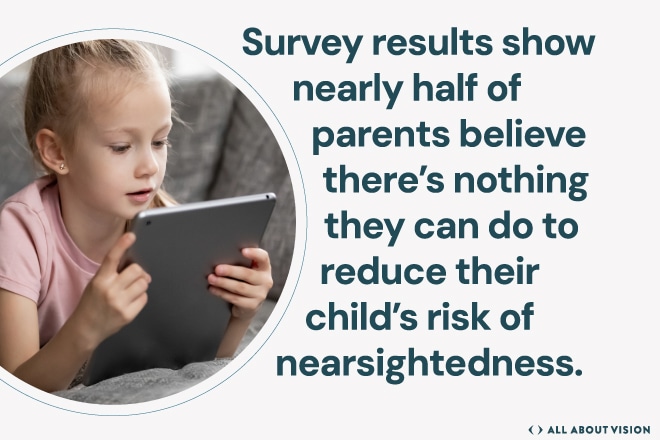
Source: The Harris Poll Myopia Survey. Conducted on behalf of All About Vision. July 2026.
Research published over the past several years has shown that children whose myopia progresses during their developmental years face substantially higher risks of retinal detachment, glaucoma and other vision-threatening conditions in adulthood.
Sarah had already started implementing lifestyle strategies the doctor recommended: ensuring Emma spent at least two hours outdoors daily, avoiding reading in dim light and taking regular breaks from near work. But she wanted to understand what clinical interventions were available and whether she should add a medical or optical strategy.
There was a lot to process. Which treatments had been tested rigorously? How much could they slow myopia progression? What were the trade-offs in terms of cost, daily routine and potential side effects? And perhaps most important, how would she know if a treatment was working for her daughter?
While Sarah and Emma are fictitious, their story is very real. These are questions facing a growing number of families as childhood myopia becomes more common and the evidence base for intervention expands. The answers aren’t always simple, but they are increasingly grounded in clinical trials and real-world experience.
Evidence-based strategies to slow childhood myopia
Doctors and scientists have expanded the range of strategies available to manage childhood myopia as research has clarified both the risks of early onset and the benefits of delaying progression.
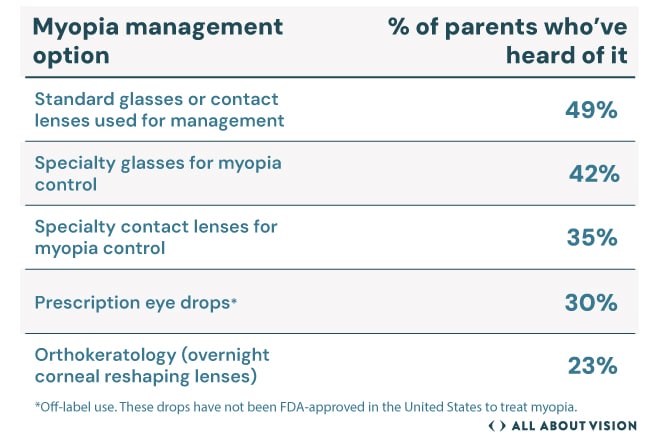
In recent years, several specialized lenses designed to slow myopia progression in children have received regulatory approval in the United States and other countries. These include FDA-authorized eyeglass (spectacle) lenses and one-day soft contact lenses.
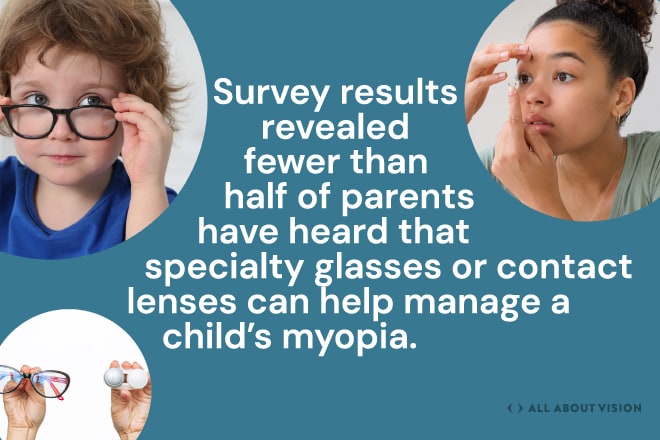
Source: The Harris Poll Myopia Survey. Conducted on behalf of All About Vision. July 2026.
One type of spectacle lens received FDA market authorization in September 2025 and is available in the U.S. and internationally, while another is currently available in Europe, Asia and Australia.
Parents seeking myopia control options can ask their primary eye doctor or a myopia management specialist about which of these FDA-authorized or internationally available products might be appropriate for their child's specific situation.
These approaches have been tested in large clinical trials and are used in many eye care practices offering myopia management. Even so, availability and regulatory approval vary by region. For this reason, families should consult an eye doctor to determine which options are appropriate for their child and available to them locally.
Cost could be prohibitive for some families. Myopia control treatments may involve out-of-pocket fees that range from hundreds to thousands of dollars per year. That’s why the strategy recommended by an eye doctor typically depends on multiple factors, including the child's age, eye measurements, lifestyle, ability to manage contact lenses safely and family budget.
How success is measured
When researchers evaluate whether a treatment slows myopia, they track two related but distinct measurements. The first is structural changes in the eye — specifically its physical elongation — measured in millimeters. The second is how much the glasses prescription may have increased over time.
How long researchers follow patients is also an important factor. Two months of data can tell a different story than two years. This time-dependent relationship means that comparing treatments requires understanding not just the numbers, but how long the study lasted.
Because various studies use different methods and patient populations, it can be difficult for researchers to combine all the data into one unified statistical analysis.
Instead, when multiple studies examine the same treatment approach, researchers calculate the middle value (called the median) and the range where the middle half of the results fall. This approach reveals what's typical, while also showing how much variation could exist between individual patients.
Comparing treatments
As researchers have clarified the risks of progressive myopia, they’ve also developed a growing set of tools to slow its progression. In 2025, the International Myopia Institute (IMI) reviewed the strongest available evidence, focusing on treatments tested in randomized controlled trials that measured eye elongation over at least one year of follow-up.
Together, these studies offer a clearer picture of what can work and reveal how complex treatment decisions might be for families.
Advanced eyeglass lens designs
Peripheral defocus glasses use different zones across the lens surface. The clear center works like a regular lens. Tiny segments in the outer part of the lens change how light hits the edges of the retina. These zones are designed to signal the eye to possibly slow its growth.
Across 10 randomized trials, IMI found that these lenses could reduce eye elongation by as much as 0.35 millimeters over two years compared with standard single-vision glasses.
Soft contact lenses
Some soft contact lenses use a similar concept, combining a clear center zone with outer parts that modify peripheral focus. IMI’s analysis of 14 randomized trials found that these lenses slowed eye growth by up to 0.19 millimeters after one year and up to 0.28 millimeters after three years.
While the differences may seem small, even modest reductions in eye growth can have a meaningful reduction in lifetime risk of eye disease.
Overnight corneal reshaping
Orthokeratology uses rigid lenses worn overnight to temporarily reshape the cornea. IMI’s review of 10 randomized trials found a median reduction in eye elongation of 0.17 millimeters after one year, increasing to about 0.30 millimeters after two years.
This approach appeals to some families because the lenses are worn while children sleep, but it requires careful hygiene and follow-up.
Low-dose atropine eye drops
Atropine eye drops, used daily, represent another strategy. Although the drug visibly relaxes focusing muscles and dilates the pupil, researchers believe its effects on eye growth could extend beyond these surface changes.
Clinical trial results vary, but overall findings suggest that atropine may slow myopia progression and possibly reduce eye elongation.
As of early 2026, no low-dose atropine formulation has received FDA approval for myopia control in the United States, meaning treatment is currently prescribed off-label by some eye care providers. Off‑label use means a medicine is being used for a purpose that isn’t listed in its official indications for use, even though studies suggest it could help, and many doctors may use it that way.
Since 2019, 21 randomized trials have examined low-concentration atropine (0.01%). IMI reported median reductions in eye growth of about 0.08 millimeters after one year and 0.12 millimeters after two years.
Trials using higher doses showed larger effects, up to 0.50 millimeters over two years, but were more often associated with side effects such as light sensitivity and blurred vision.
Source: The Harris Poll Myopia Survey. Conducted on behalf of All About Vision. July 2026.
Combining treatments
Could using two treatments simultaneously produce better results than either on its own? Pairing optical strategies with medication may offer additive benefits, but evidence remains limited.
IMI identified only five randomized trials examining the combination of orthokeratology and low-dose atropine. These studies suggest that adding atropine increased the reduction in two-year eye growth by a median of 0.12 millimeters compared with orthokeratology alone.
While promising, researchers emphasize that larger studies are needed before combination approaches become routine.
Light-based strategies: Researchers are cautious
Light-based therapies represent a possible new frontier in myopia management, but the evidence remains early and uneven. Ultraviolet light has shown no significant benefit in clinical trials, and initial studies examining blue-light stimulation of the optic nerve head, the structure that connects the eye to the brain, have produced inconclusive results.
Red-light therapy, more commonly used in dermatology and eye aesthetic procedures, has also been investigated as a potential myopia treatment. In an analysis of seven randomized trials, IMI reported a median reduction in axial eye elongation of about 0.40 millimeters after one year.
Researchers, however, urge substantial caution because the therapy remains experimental. Reports of eye injury have raised additional safety concerns and it’s not recommended for routine clinical use because long-term safety has not yet been established.
Rebound concerns
As researchers evaluate new and existing myopia treatments, they’re also closely watching what happens when therapy ends. A central question for both doctors and families is whether stopping treatment could cause the eye to return to faster growth.
So far, studies of myopia control glasses and soft contact lenses have found no significant evidence of rebound. This means there does not appear to be acceleration of myopia progression after treatment ends. Some rebound has been observed with atropine eye drops and red-light therapy.
Even so, available evidence suggests that certain interventions, particularly behavioral strategies such as outdoor time, can meaningfully slow myopia progression without harmful rebound effects.
The ripple effects
Research on myopia control strategies now reaches far beyond laboratory findings and clinical trials. It can shape everyday decisions made by families and guides how doctors approach childhood eye care.
The evidence base for myopia control has grown substantially in recent years, offering families more options than ever before. At the same time, the choice of which intervention to pursue, or whether to pursue one at all, depends on factors that extend beyond clinical trial data alone.
Parents should consider:
- The child's age and myopia progression rate – Some treatments might work better when started early, while others may be more appropriate for older children or those with rapid progression.
- Lifestyle and compliance – Glasses must be worn daily during waking hours. Contact lenses demand careful hygiene. Eye drops need nightly administration.
- Cost and access – Insurance coverage varies and out-of-pocket expenses can be substantial.
- Individual response – Not every child responds equally to every treatment and some trial and error may be necessary.
Early detection through comprehensive eye exams, increased time outdoors, and thoughtful management of screen use and near work can support children's eye health well into adulthood. At the same time, growing evidence suggests that myopia control strategies may help slow progression. The Global Myopia Awareness Coalition offers a free Myopia Awareness Toolkit to guide parents through available options.
A surge of myopia research signals a broader transformation in how myopia is managed, emphasizing prevention and early intervention alongside correction. For parents navigating these decisions, the availability of evidence-based options represents both current and future possibilities.