What new myopia research means for your child's vision

What scientists have discovered about myopia in kids
When Sarah brought Emma in for an eye exam, she was prepared to hear that her daughter’s myopia (nearsightedness) had worsened and that she would require a stronger prescription, just as Sarah herself had at that age. Emma had been diagnosed at seven, and now, just 18 months later, her prescription had already changed significantly.
What Sarah did not expect was how much the office visit would challenge her understanding of myopia, a disease she had always considered a mild inconvenience.
Along with a new prescription, the doctor explained the risks of worsening myopia and its potential impact on her daughter’s long-term eye health. Research published over the past several years has shown that progressive myopia in childhood is strongly correlated with a higher occurrence of serious vision conditions later in life, including retinal detachment, glaucoma and myopic maculopathy.
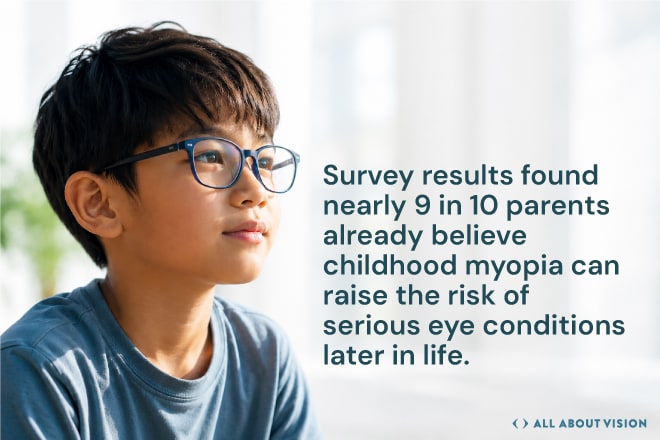
Source: The Harris Poll Myopia Survey. Conducted on behalf of All About Vision. July 2026.
Nearsightedness often develops as the eye gradually gets longer, a physical change that can stretch delicate tissue and increase the risk of serious eye disease decades later. Because of this growing body of research, he told Sarah, eye care providers (ECPs) are changing how they manage myopia.
As he reviewed Emma’s test results, the doctor pointed to the numbers: her prescription, baseline scans, and projected changes over time. The more Emma’s myopia progressed, he explained, the greater her risk of serious eye conditions. That’s why he recommended managing Emma’s vision, as eye doctors had long done, and also working to slow the condition using myopia control strategies.
Sarah left that appointment with a new prescription for glasses, a follow-up scheduled, and a new sense of urgency. Emma's myopia was no longer just about seeing the classroom more clearly.
While Sarah and Emma are fictitious people, their story is quite relatable.
From inconvenience to eye disease
The doctor’s advice reflects an evolving approach toward myopia within the eye care and research communities. What was once considered an optical problem is now viewed by many experts as an active biological process that can cause irreversible structural changes and potentially permanent tissue damage in the eye.
According to the Global Myopia Awareness Coalition (GMAC), which promotes awareness of childhood myopia as a treatable disease, myopia is among the most significant threats to eye health today. Nearly 1 in 3 children worldwide now develops the condition, a rate that has doubled over the past 50 years and continues to rise at an exponential rate.
In September 2024, the National Academies of Sciences, Engineering and Medicine formally recommended that federal health agencies reclassify myopia from a refractive error (a common problem causing blurry vision) to a disease, emphasizing prevention and disease management alongside vision correction.
The recommendation carries significant weight for children and doctors alike. While any degree of myopia increases the risk of vision-threatening complications, that risk rises sharply as myopia progresses.
Yet for many families, this shift has largely gone unnoticed.
A critical disconnect
Despite growing scientific consensus, outreach to families is still underway, so an awareness gap remains. According to 2022 data from the Global Myopia Awareness Coalition, about one-third of parents are unfamiliar with the signs and symptoms of myopia. A similar proportion is unaware that early intervention can help slow myopia’s progression.
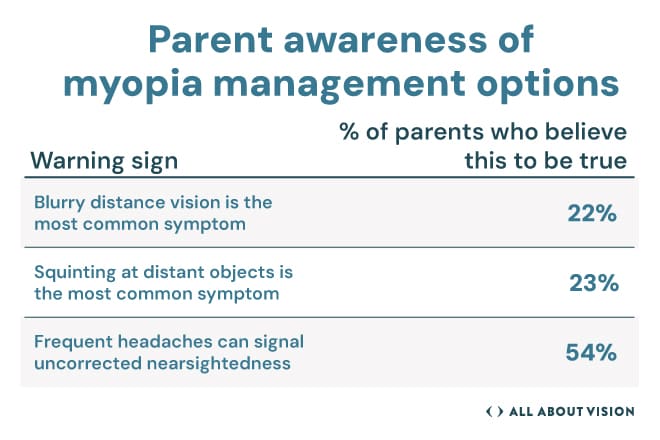
Source: The Harris Poll Myopia Survey. Conducted on behalf of All About Vision. July 2026.
This is particularly consequential as myopia prevalence continues to climb. The National Eye Institute (NEI) projects that approximately 44.5 million Americans will have myopia by 2050. Global projections suggest that by that same year, half the world's population will be nearsighted, with approximately 10% experiencing high myopia severe enough to create substantial, lifelong vat an exponential rateision risk.
East Asia has some of the highest rates. For example, in China, more than half of school-aged children are now myopic, with nearly 1 in 5 high school students experiencing high myopia. Experts suspect that a combination of genetics and environmental factors plays a role in these growing global trends.
High myopia’s long shadow
Doctors emphasize that parents should understand how other health risks increase steadily with increased levels of myopia. High (severe) myopia is associated with a stronger likelihood of developing several serious eye conditions, including:
Cataracts
People with high myopia are significantly more likely to require cataract surgery earlier in life than those with low (mild) or moderate myopia.
Glaucoma
Those with moderate to high myopia are about 1.5 times more likely to develop glaucoma than those with low myopia, increasing the risk of optic nerve damage and vision loss.
Retinal conditions
Children who progress to high myopia (typically -5.00 diopters or greater) are five to six times more likely to potentially experience retinal detachment than those with low myopia. This increased risk is largely driven by eye elongation, which stretches and thins the retina, making it possibly more vulnerable to tears.
In addition, highly myopic eyes tend to be more prone to degenerative changes in the vitreous (the gel inside the eye), which can collapse and pull away from the retina, further raising the risk of detachment.
Another serious concern is myopic maculopathy, a degenerative condition of the central retina that can result in permanent central vision loss. Estimates suggest that by age 75, roughly 40% of people with high myopia will experience some degree of uncorrectable vision loss.
While myopia severity plays a major role in long-term risk, genetics can strongly shape who develops myopia in the first place.
When myopia runs in the family
Family history is one of the strongest predictors of myopia risk. Children with one myopic parent have about twice the risk of developing myopia compared with children whose parents are not nearsighted. Children with two myopic parents face roughly five times the risk.
Research in Chinese children with myopic parents suggests that rapid eye growth can begin even before myopia is clinically detectable, indicating that genetic factors may influence eye development early in childhood.
At the same time, genetics alone do not tell the full story. The risk of developing myopia is shaped by a tapestry of biological and environmental influences.
For families with a history of myopia, Dr. Ken K. Nischal, chief of the Division of Pediatric Ophthalmology and Strabismus at UPMC Children's Hospital of Pittsburgh and a panel member of the 2025 World Society of Pediatric Ophthalmology and Strabismus (WSPOS) Consensus Statement, recommends practical strategies for children, such as:
- Spending two hours outdoors daily
- Avoiding reading in dim light
- Routinely taking near-work breaks (such as when spending extended periods looking at digital screens)
When paired with early comprehensive eye examinations, research has found that these lifestyle changes give parents their best opportunity to delay the onset of myopia and slow its progression during the critical window when intervention is most effective. Among these strategies, time spent outdoors stands out.
Good for growing bodies and eyes
Time spent outdoors has emerged as one of the most effective strategies for preventing myopia, as researchers have found that natural light seems to regulate how a child's eyes develop. When kids get sufficient daily sunlight exposure, it helps maintain healthy eye growth and lowers their risk of becoming nearsighted. Experts recommend that children spend at least one to two hours outdoors daily.
The protective mechanism appears to involve bright light signaling in the retina. During late morning to mid-afternoon when outdoor light levels are the strongest, the retina seems to trigger dopamine release, a chemical that can help regulate eye growth. Although the exact process remains an active area of research, cumulative evidence from various studies consistently points to a protective effect worthy of further investigation.
While outdoor time can help reduce risk, it is not a substitute for regular eye care on at least a yearly basis (potentially monthly to quarterly depending on the level of myopia). Even children who spend plenty of time outside can develop myopia, so doctors emphasize the importance of regular exams, early detection and ongoing monitoring.
Screenings and eye exams are not the same
A misconception among some parents is that vision screenings at pediatricians' offices or at school are sufficient to detect myopia and other eye-related conditions/diseases. These screenings play an important role, but they are designed as a basic screening check of visual function rather than a full evaluation.
A comprehensive eye exam evaluates the structure and health of the visual system coupled with how the eyes function to work together and focus. It includes measuring visual acuity (sharpness), determining a glasses prescription, eye pressure, retinal assessment, and other diagnostic tests when needed. The exam may also include measuring the length of the eye, a key data point that can help assess myopia risk and monitor progression over time.
Parents do not need to wait for a failed vision screening notice from the school nurse. If a child squints, sits close to screens or books, tilts their head, complains of frequent headaches, or struggles to see distant objects, it’s a good time to schedule a comprehensive eye exam. Early evaluation matters because timing of diagnosis and management can shape long-term outcomes.
Delaying the onset of myopia
Research has shown that delaying the onset of myopia can meaningfully reduce disease severity. In some studies, postponing onset by just one year has been associated with a reduction of about 0.75 diopters or more in a child’s final prescription.
This is comparable to several years of treatment with current myopia control methods. The benefit is especially strong among children of East Asian heritage, though it also appears in other populations to a somewhat lesser degree.
Building on these findings, researchers have also turned their attention to how doctors can proactively take a role in slowing the progression of myopia.
Several evidence-based interventions are now available:
- Eyeglasses with advanced lens designs that alter how light reaches the peripheral retina
- Soft contact lenses engineered with similar optical principles
- Overnight contact lenses that help reshape the cornea
- Low-dose atropine eye drops that can slow eyeball growth
Over the past several years, U.S. regulatory bodies and those abroad have authorized multiple specialized lenses designed to slow myopia progression in children. Options available to American families include one-day contact lenses and eyeglass lenses, some of which are also available internationally.
Parents can work with their primary eye care provider or a myopia management specialist to identify which approved products might be appropriate for their child. A free Myopia Awareness Toolkit from the Global Myopia Awareness Coalition can also help families navigate these options.
For Sarah, understanding these prevention strategies and their impact on risk factors shifted the way she thought about Emma's eye care. The conversation that began with a discussion around a routine prescription check opened her eyes to long-term health implications she’d never considered.
Now she knows that ensuring Emma spends time outdoors, scheduling comprehensive eye exams and understanding Emma’s family medical history could influence her daughter's vision not just in third grade, but in her 30s, 50s and beyond— because the decisions made today may well determine whether Emma sees the world clearly for a lifetime.