Smart eyewear on the job site: How extended reality technology could transform industrial work

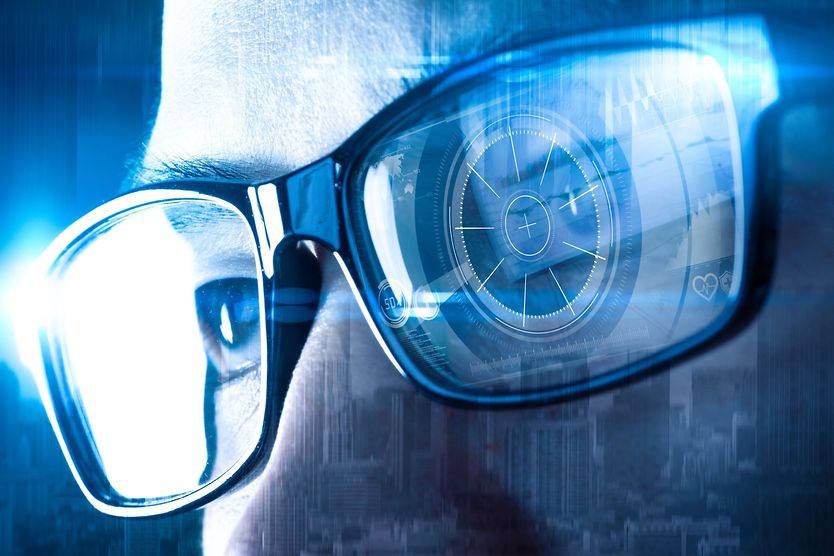
A technician puts on a hard hat fitted with smart safety glasses and heads to a malfunctioning piece of equipment on the assembly line. With a few taps on a smart tablet, a 2D model of the machine’s inner workings appears in her peripheral vision, helping her pinpoint the source of the problem.
When her initial repair attempt fails, the technician realizes she needs to escalate the issue. She records a short video clip through the smart eyewear. The footage, along with the machine’s performance data, is instantly transmitted to the facility’s maintenance supervisor. From his office more than 50 miles away, he can assess the situation in real time and guide her through the next steps.
This may sound like science fiction, but the use of extended reality (XR) is transforming industries from manufacturing to medicine.
XR includes new visual technologies like:
- Virtual reality (VR) – An interactive simulation that immerses users into a fully digital environment.
- Augmented reality (AR) – A technology that overlays more complex, three-dimensional content directly onto the physical world.
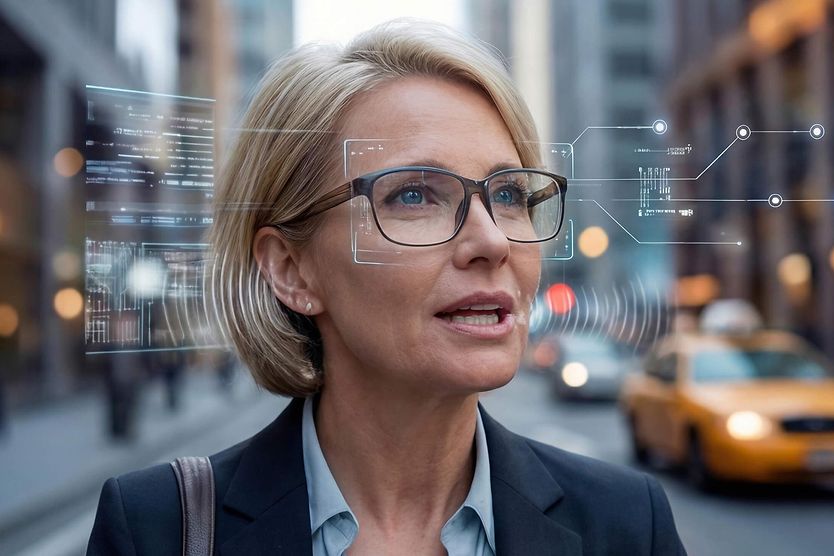
- Assisted reality (aR) – Like AR, this system projects information into a user’s line of sight but emphasizes reality over virtual information.
Chad Jackson, chief executive officer of Lifecycle Insights, a research and advisory firm specializing in engineering technologies, said XR can help industrial workers increase productivity and efficiency, improve safety and reduce costs.
“With so much digital transformation and new data in manufacturing thanks to Industry 4.0 (integration of technology to transform industry and manufacturing), having the right context to solve problems is important,” he explained. “XR can provide you with that context wherever you are — the data you need is not buried in a physical manual or somewhere on your computer’s hard drive. It’s right in front of you.”
Blending virtual and real-world information in the factory
You may already be aware of AR thanks to popular gaming apps. Users can search for and “catch” their favorite characters, which are projected onto the world in front of them.
But XR has many practical uses in industry, said Jackson. Modern factories use sensors to collect vast amounts of data from production lines. Rather than put those numbers in a spreadsheet, industrial AR glasses can help factory employees visualize temperature or energy consumption. In turn they use that data to guide actions that increase quality, lower costs and improve sustainability.
“Instead of getting lost in a sea of data, AR can provide you with a visual to tell you what it all means and what you need to do with it,” Jackson said.
For example, manufacturing engineers can use smart glasses for manufacturing to optimize production lines or repair equipment. AR can offer remote maintenance capabilities and connect technicians to equipment experts to help them better understand machinery issues. It can use the data from the sensors to provide real-time warnings about hazards. And it can provide training for new employees so they can more quickly prepare for new roles and responsibilities.
A growing number of XR use cases
Manufacturing is not the only industry benefiting from XR technologies. Logistics and warehousing use industrial smart glasses and vision picking glasses (AR smartglasses used instead of paperwork) for hands-free picking and scanning. Medical centers use AR and VR to train the next generation of surgeons on procedures. Retail outlets leverage visual technologies to offer consumers “try before you buy” options.
Fernando Moreu, PhD, associate professor of civil, construction and environmental engineering at the University of New Mexico, said AR is also used in construction. Construction engineers can project building information models, or a 3D model of complex building plans, to build and inspect everything from houses to bridges.
“Having the ability to see the model in physical reality helps you connect the dots between what you want to build and what you are actually building,” he said. “It allows different people who work on a construction site, whether it’s a quality inspector or an equipment operator, to get familiar with what’s happening and identify potential problems before they become very expensive to fix.”
Dr. Moreu and his colleagues have been using AR to make construction safer and more efficient. They use special experiments that track users’ eye movement patterns to understand how AR changes the way construction workers do their jobs. They’ve learned that AR helps workers inspect railroad tracks, bridges and other buildings more quickly.
“We see that your eyes move in a more organized pattern when you overlay the digital model over what you are inspecting,” he said. “You aren’t looking at a tablet or some plans and then back to what you are inspecting. Instead, with AR, you can better organize where to look so you can complete your inspection faster and with more accuracy.”
The future of XR at work
There's growing momentum behind XR on job sites. Immersive headsets and smart glasses are increasingly favored for hands-free, on-the-job guidance and analysts expect workplace adoption to keep climbing in the coming years.
Despite promising use cases, there are some big challenges. Premium smart glasses can be expensive. And for XR to be beneficial, it needs people who can build accurate, detailed digital models.
There are also questions about the long-term effects of XR use. Some worry they could cause accidents or undue eye strain. But because these technologies are so new, there are not many regulations to help workers.
The International Organization for Standardization (ISO) and the International Electrotechnical Commission (IEC) issued safety standards in 2024 to provide guidance on XR use in industrial settings. They emphasize the importance of minimizing physical and visual discomfort to users while ensuring XR does not lead to accidents or environmental hazards on the job.
The U.S. Occupational Safety and Health Administration (OSHA) recommends that workers be adequately trained on new technologies such as XR systems so they can perform their work in a “safe and healthful manner.”
The American Academy of Ophthalmology (AAO) notes that like any digital device, people tend to blink less while using screens. The same is true for staring at a VR or AR screen for a prolonged period, which can cause short-term eye strain, fatigue and blurred vision. The AAO emphasizes these symptoms are temporary and that VR or AR are not known to cause permanent eye damage. The organization is not opposed to VR use, having launched its own VR training program for doctors.
Experts interviewed by AAO are cautiously optimistic about an investigational system called PRIMA that pairs special AR glasses with a tiny retinal implant for people with geographic atrophy (GA), an advanced form of age-related macular degeneration. In a 2025 trial published in the New England Journal of Medicine, most participants regained some ability to read using this system. The technology is not a cure, is not FDA approved and is not yet available to patients.
Leveraging XR safely
There’s no doubt that emerging vision technologies are already reshaping industry — and these applications continue to advance at a rapid pace. You may soon find smart eyewear being used at your own workplace.
If you are using XR today, pay careful attention to how the smart glasses or headsets make you feel. If you experience motion sickness, pain in the head or shoulders, or feel like the eyewear interferes with your ability to safely work, don’t ignore it. Stop using the device and report the issues to your manager. If you experience blurred vision or dry eyes after use, talk to your eye doctor. They may offer treatment options.
Some people are more prone to discomfort than others. Much of the visual strain from VR and AR stems from what is called “vergence-accommodation conflict,” in which your eyes turn inward toward a near image while staying focused on a screen set at a fixed distance. Those with pre-existing eye-alignment or focusing problems — or uncorrected vision — may notice symptoms sooner. If you wear glasses or contact lenses, it is recommended to ask your eye doctor if prescription inserts are available for your device and whether regular XR use could be an underlying issue.
The long-term impact of XR use in occupational settings is still being studied and there is more to learn and understand. Current guidance is based on limited evidence.
Still, Dr. Moreu said that researchers and designers are already working on what will be tomorrow’s industrial eyewear. Making them better will require a multidisciplinary approach with teams of engineers, computer scientists, vision experts, occupational psychologists and biologists.
“These technologies have a lot of potential and can help people do their work more efficiently in a wide range of different situations,” he said. “But to help humans in this way, we need lots of different kinds of expertise to understand all the opportunities and challenges. Working together, we can shape these technologies in ways that will change the future of work.”