Glasses, contacts, or both? What parents need to know

Quinn’s eyeglasses bounced around his face during his tumbling routine. They threatened to slip off as he spun around the high bar. The shifting motion made it difficult for Quinn to clearly see the floor as he prepared for his dismount.
His optometrist had prescribed glasses approximately two years earlier when Quinn was 10 years old. Quinn didn’t mind using them for school or daily life, but increasingly, they were interfering with his athletic performance. So, he did what so many eyeglass-wearing kids eventually do: he asked his parents for contact lenses.
Within a few months, Quinn ditched his glasses for contact lenses, at least for competitions and gymnastics practices. At home and school, he wore glasses.
For most kids who need visual correction, the question isn’t glasses or contact lenses but when to use glasses or contact lenses. And the answer to that question depends entirely on the child, said Christina Herald, OD, owner of Fall River Vision, a family eye care practice in southeastern Massachusetts.
“It’s really a question of what’s the best fit for the individual and their lifestyle,” Dr. Herald said. “A lot of times, people come in thinking that it’s one or the other, but it’s usually not.”
Start with glasses
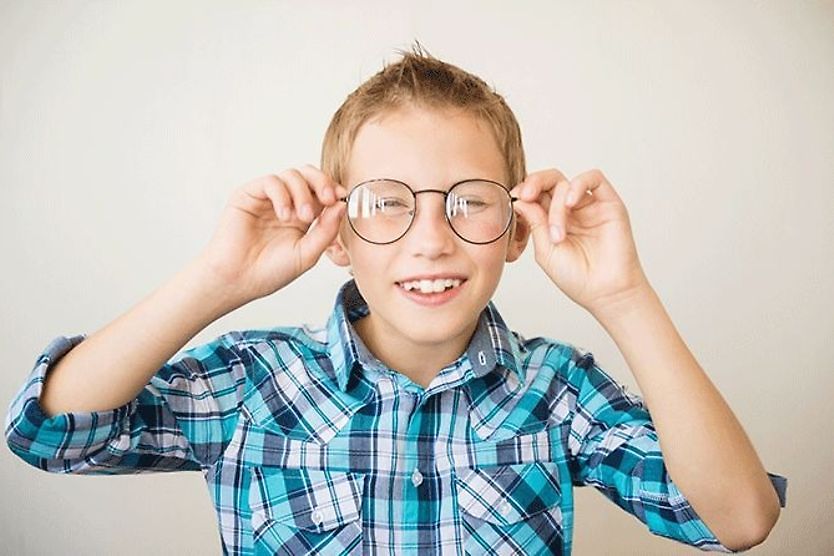
Eyeglasses are usually the logical first step for children and teenagers who need visual correction, Dr. Herald said. It’s easier for most young people to wear and care for glasses than to insert, remove and maintain contact lenses.
“I recommend starting with glasses first unless there is a medical or prescription reason that glasses would not be as effective,” she said.
Modern eyeglasses also provide a degree of protection to children’s developing eyes. Optometrists often recommend impact-resistant polycarbonate or specialized polyurethane-based lenses in glasses for children. Eyeglasses outfitted with these lens materials can help keep kids’ eyes “safer when playing outside, roughhousing or participating in other activities,” Dr. Herald said.
In contrast, contact lenses can harm eye health if a child doesn’t maintain good hygiene or follow proper care guidelines.
“There’s a risk of infection or eye damage if a child isn’t keeping their contact lenses clean or taking them out as directed,” said Erin Keim, OD, a pediatric optometrist at Everett & Hurite Ophthalmic Association in Pittsburgh, Pennsylvania.
Lost or broken eyeglasses can be a hassle. However, they don’t raise your child’s chances of having long-term vision issues. That margin of safety combined with ease of use makes glasses a smart starting point for children and teens who need vision correction.
Consider contact lenses if …
There are no fixed rules about when a child can get contact lenses. Dr. Herald typically recommends that children and teens wear glasses for about a year before opening the discussion to include contact lenses, but that’s because she believes that how children handle their glasses can offer insight into whether they’re mature enough to manage contact lenses.
“If they are responsible with them — they don’t lose or break their glasses and don’t scratch them — then we can consider contacts,” she said.
A child’s age is not as relevant as their sense of responsibility. Contact lens materials and technologies have improved a lot. Now, contact lenses are considered a safe treatment option for children of all ages, as long as they’re used correctly. Parents and eye care professionals once thought kids should wait until age 12 or 13 for contact lenses. Children as young as eight or nine can use them safely and effectively.
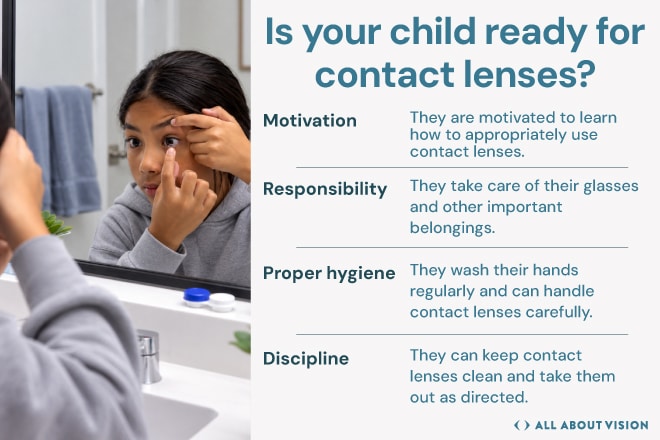
Consider contact lenses if your child:
- Really wants them. Motivation is critical for contact lens success. It may not be easy for first-time contact lens users to insert and remove contact lenses. A child or teen who wants contact lenses is much more likely to persist and practice than one who’s pressured to try contact lenses.
“Every time I’ve had a parent say, ‘I really think he needs them for hockey,’ but the kid is like, ‘I don’t want them,’ it doesn’t happen,” Dr. Keim said. “The number one thing is that the child has to want them.”
It doesn’t matter if your child wants contact lenses for cosmetic, athletic or some other reason. What matters is that your child has a specific, personal mission driving their decision to try contact lenses.
Quinn’s athletic ambitions fueled his desire and helped him keep going when putting in and taking out his contact lenses initially proved challenging.
“He was motivated because he knew it would help his sports performance, so he stuck with it and figured it out,” said his mom, Jeanette Hurt, a Wisconsin-based author.
Bottom line: a kid who wants contact lenses may be more capable than you think.
“If the child is motivated, do not underestimate that child,” Dr. Keim said. “There have been a couple of times where, even as a doctor, I’ve thought, ‘This is not going to go well.’ But then the child learns to use contacts and does well.”
- Manages their belongings and personal hygiene with minimal reminders. Most children and teens still need occasional reminders (and consequences, in some cases!) to clean their rooms or take a shower. That’s developmentally normal. Many kids simply don’t care about the cleanliness of their rooms (or bodies) as much as their parents do.
Good hygiene practices and careful handling are important for safe contact use, though, so look at your child’s habits. Do they understand the importance of washing their hands after using the bathroom and before eating and do so most of the time? How well do they care for possessions that are important to them?
A child who responsibly manages an electronic tablet and charges it as needed can probably handle contact lenses as well, Dr. Keim said. That can be true for kids who might have messy rooms or forget to bathe regularly.
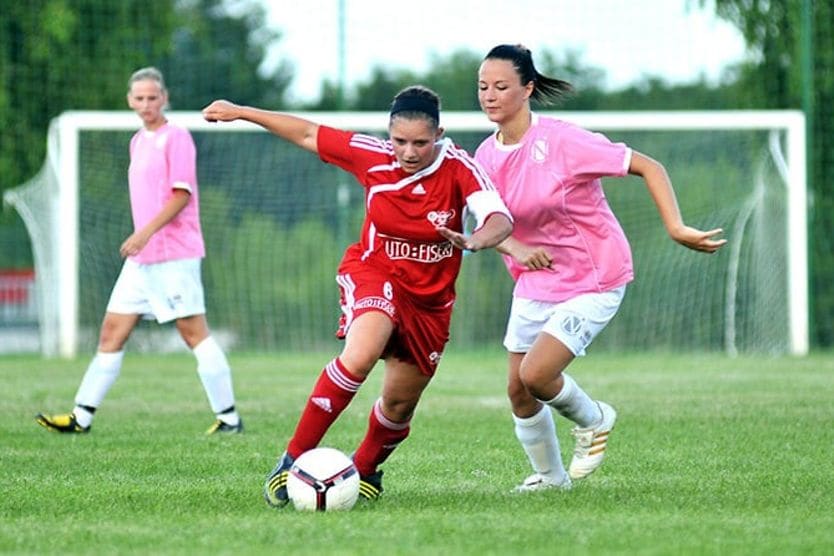
- Participates in activities where peripheral vision is important. Contact lenses tend to offer better peripheral vision, improving the ability to detect objects and movement outside of the direct line of sight than eyeglasses. That doesn’t matter much in classroom settings, but on a hockey rink, soccer field or baseball field, peripheral vision can determine whether the ball (or puck) hits your child or they make an impressive play.
Enhanced peripheral vision is also an asset when driving a vehicle – another reason Hurt is glad Quinn now has access to contact lenses.
Contact lenses may also be a good choice if your child has myopia, or nearsightedness, a condition caused by the elongation of the eye. Myopia can worsen as the eye grows and stretches. Increased myopia raises the risk of cataracts, glaucoma and retinal issues later in life, according to Dr. Keim.
The U.S. Food and Drug Administration (FDA) has approved two types of myopia control contact lenses for children ages eight to 12 and authorized other gas permeable (GP) lenses:
- Daily disposable soft contact lenses specifically designed for myopia control.
- Special GP lenses (orthokeratology, also called Ortho-K) that are worn overnight and “work much like a retainer while the child sleeps, gently reshaping the front surface of the eye,” Dr. Herald said.
FDA-authorized myopia control spectacle (eyeglass) lenses are also now available for children and families who prefer glasses.
Most other corneal-reshaping lenses are FDA-cleared only to temporarily correct nearsightedness and are used for myopia control “off-label.” This is a legal and common practice that simply means the FDA hasn’t cleared them for that specific purpose. Your child’s eye doctor can explain which option fits best.
Paying for glasses and contact lenses
Many vision insurance plans cover the cost of eyeglasses or contact lenses each year. This often makes parents feel they must choose between glasses or contact lenses for their child.
These tips may help you manage the cost of glasses and contact lenses for children:
- Reuse eyeglass frames. If your child’s vision requires a new prescription, ask if their eye care professional can order new lenses to fit your kid’s existing frames. (Assuming the frames still fit your child’s face and are structurally sound.) Keep in mind that reusing a frame is done at your own risk. If the frame breaks, it usually isn't covered, so ask about the office's policy.
- Update glasses every couple of years instead of every year. This works well if your teen prefers contact lenses and their prescription is stable. “I always tell my teenage patients, ‘I don’t care what your glasses look like as long as you have a backup pair you could wear if you need to,’” Dr. Keim said. If there is a meaningful prescription change found in the comprehensive eye examination, a new glasses prescription will be given to you.
- Ask about a glasses protection plan. Many practices and retailers offer an optional warranty about a year in length that may cover breakage or defects and could include a one-time replacement. Even if your child isn’t rough on their frames and lenses, the add-on might be helpful for peace of mind.
- Calculate your true cost for contact lenses. Daily soft contact lenses may be more cost-effective than weekly or monthly contact lenses coupled with the price of contact lens solution for care maintenance, especially if your child doesn’t wear contact lenses every day. “A lot of my families buy six months of daily contact lenses, and it actually lasts them a year,” Dr. Keim said. That’s what the Hurt family does.
- Check if there is a contact lens replacement policy. Some practices and online retail suppliers replace torn or defective lenses, and many let you return unopened, unexpired boxes if your child's prescription changes or they don't adapt to contact lenses. Terms vary, so ask what's included before buying a full supply.
Even if your child wears contact lenses most of the time, eye care professionals recommend keeping at least one pair of eyeglasses on hand.
A backup pair is necessary because contact lenses should not be worn if a child has an eye infection or an irritated eye. Eyeglasses also give the eyes a chance to “breathe,” Dr. Herald says.
“Even though today’s contact lenses are very advanced, soft contact lenses still create a barrier on the eye that reduces oxygen flow,” she said. “In general, the ideal contact lens schedule for daytime lenses is no more than eight to 10 hours per day, with the child wearing glasses the rest of the time.”
Medical disclaimer: One important note applies to children of any age interested in contact lenses. All contact lenses, even colored or costume lenses that don’t correct vision, are considered medical devices that legally require a prescription and a professional fitting in the United States. Cosmetic lenses bought without a prescription from novelty shops, beauty stores or unverified websites have caused documented cases of corneal abrasions, serious infections and even permanent vision impairment. It is recommended that children never wear colored or costume lenses that weren’t prescribed and fitted by an eye care professional.