How to read your contact lens prescription


What is a contact lens prescription?
Your contact prescription might look like alphabet soup at first glance. But the information on it shows the brand, power, material and fit for your contacts. These details help to ensure that your contact lenses are safe, comfortable and provide you with the best possible vision.
If you’re in the U.S., your contact lens prescription is yours to keep. In fact, your eye doctor must give you a copy after your contact lens exam and fitting, even if you don’t ask for it. You can use your prescription to buy contact lenses from any legitimate source, such as your eye doctor, a chain optical shop or an online vendor.
Why contact prescriptions aren’t the same as glasses prescriptions
It’s important to note that contacts and eyeglass prescriptions are not the same. So even if you already have an eyeglass prescription, you’ll need a separate contact lens prescription to buy contacts.
That’s because a contact lens prescription includes not only the correction power but also lens fit details, such as the base curve and diameter, that don’t apply to glasses. If you wear disposable contact lenses, your prescription may also include the recommended replacement schedule (once a month, every two weeks, once a week, daily, etc.). Sometimes the lens brand includes that information. But the real judge is your eye care practitioner, who knows what’s best for your eyes and lifestyle.
Understanding each part of your contact prescription
You may be wondering how to read a contact lens prescription. Eye doctors use standard terms, abbreviations and measurements to write contact lens prescriptions. It may look like a secret code, but it’s really quite simple to decipher. Read on for common terms in a contact prescription and what they mean.
OD and OS
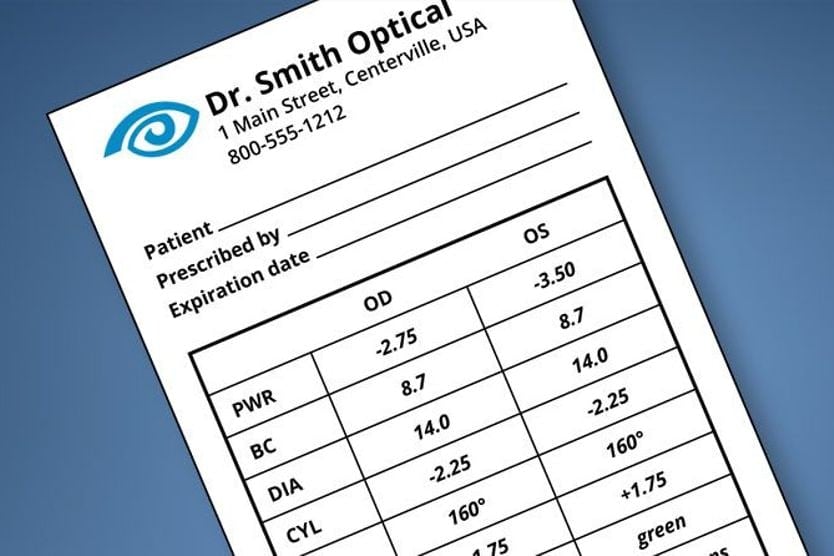
The abbreviations OD and OS may look mysterious, but they’re quite simple. OD stands for oculus dexter, which is your right eye. And OS stands for oculus sinister, which is your left eye. You may need different vision correction in each eye.
Sphere (SPH) or power (PWR)
The sphere or power listed on your contact lens prescription shows the strength of the lens required for optimal vision. This is measured in diopters (D). Your prescription will show the number of diopters with a minus sign for nearsightedness or a plus sign for farsightedness. The higher the number, the stronger the prescription. For example, +1.00 means mildly farsighted, while -6.00 means highly nearsighted.
Sometimes the power of your glasses prescription will be different than your contact lens prescription. This can be because a contact lens sits on the eye and glasses sit on the nose farther from the eye. This is normal and your eye care provider will determine what power is best.
Base curve (BC)
The base curve is a number describing the curvature of the back of the contact lens. The BC is expressed in millimeters (mm). The correct base curve helps to ensure the lens fits your eye appropriately. For example, you might see a BC of 8.6 mm, which is common in contacts.
Diameter (DIA)
The diameter shows how wide the contact lens is in millimeters. Having the correct diameter also helps to ensure a proper fit between the lens and your eye. For example, you might see a DIA of 14.2 mm, often seen in contacts.
Reading a contact prescription for astigmatism
If you have astigmatism, which causes distorted vision due to the shape of your cornea and lens, your eye care provider may prescribe astigmatism contacts to correct this refractive error. In this case, you’ll have a few additional abbreviations on your contact lens prescription, so look for the following:
Cylinder (CYL)
The cylinder shows how much astigmatism you have. The higher the number, the higher the degree of astigmatism. Astigmatism is expressed in diopters (D), just like farsightedness or nearsightedness. A person with astigmatism of 1.5 or higher typically will need contacts for astigmatism. These could be toric soft contacts, rigid gas permeable contacts or hybrid contacts.
Axis
The axis describes the location of the astigmatism on the cornea. The axis ranges from 0 to 180 and indicates where the astigmatism is, from left to right, across the eye, with 90 being right in the center.
Reading a contact prescription for presbyopia
Presbyopia is a refractive error that is common after age 40 and makes it harder to see up close. If you have presbyopia, you may want to consider multifocal contacts. If you go that route, you may see these abbreviations on your contact lens prescription, in addition to the others above.
Added magnification (ADD)
The abbreviation ADD stands for the additional power needed to help with tasks, like sewing or reading, that require sharp near vision. The additional power is typically listed in diopters ranging from +0.50 to +3.00.
Dominant or non-dominant eye (D/N)
Some contact lenses for presbyopia have a different correction for the dominant (D) or non-dominant (N) eye. The dominant eye helps with far vision, while the non-dominant eye helps with near vision.
Other important information in your contact prescription
Your contact lens prescription must include your name, contact information and all other details needed to allow any vendor to fill the prescription accurately. Here are a few more pieces of information you’ll find on your prescription:
Expiration date
Your contact prescription will include an expiration date. By law, U.S. contact lens prescriptions must be valid for at least a year unless there’s a valid medical reason for an earlier expiration date. If state law requires a prescription to remain valid for longer than a year, providers in that state must comply. And eye care providers may choose to issue prescriptions that are good for longer than a year.
Brand and lens type
Your prescription will also include the contact lens brand and lens type. Contact lens prescriptions are specific to both the brand and the type of lens. That means contact lenses are not interchangeable, either from one brand to another or from one type of contact lens to another within the same brand.
Material
A prescription may also include the material of the contact lenses. Most soft contact lenses today are made from silicone hydrogel or hydrogel (flexible plastic). But some patients wear rigid gas permeable or hybrid contacts. The material of the lenses can affect comfort, wear time and the amount of oxygen that reaches the eye.
Example contact lens prescription
Want to see what a contact prescription looks like? Here’s a sample image of a contact prescription:
How do you get a prescription for contact lenses?
You can get a prescription for contact lenses by visiting an eye care professional for an eye exam and contact lens fitting. Throughout the U.S., you can be fitted for contact lenses by an optometrist or ophthalmologist. In some states, opticians may be certified to fit contact lenses. After the exam, you will get a prescription either on paper, in digital form or both.
Does an eye doctor have to give you your prescription?
In the U.S., you’re legally entitled to a copy of your contact prescription after an eye exam and lens fitting, according to the Federal Trade Commission’s Contact Lens Rule. Your eye care provider can’t charge an additional fee for a copy of the prescription or require you to go through them to order contacts.
Can you buy contact lenses without a prescription?
No. For your safety, U.S. law requires a valid contact lens prescription written by a qualified eye care practitioner to purchase contact lenses. This includes plano, or “non-prescription,” colored contact lenses or special-effect lenses worn for cosmetic reasons. A contact lens is a medical device, and a poorly fitted lens — or one made from a material not well-suited to your eyes — can cause distorted vision, discomfort, infection, inflammation, swelling and abrasion. In rare cases, permanent eye tissue damage could result.
If a contact lens seller doesn’t require a contact prescription, that’s a red flag. Keep in mind that contacts are sometimes sold illegally online or at flea markets, gas stations or novelty shops. So make sure you get your contacts from a legitimate source.
When to update or recheck your contact prescription
Regular eye exams are important for eye health. If you wear contact lenses, you’ll typically need to see your eye care provider about once a year for an eye exam and contact lens fitting.
It’s also crucial to follow the prescribed contact lens brand, replacement schedule and wear time to protect your eye health. And see your eye doctor right away if you experience eye symptoms, such as blurry vision, discomfort, redness or dryness.
Keep in mind that some eye problems can be seen only with a slit lamp, a type of microscope used during an eye exam. It is recommended to get a comprehensive eye exam every year if you wear contact lenses, even if you haven’t noticed any changes to your eyes or vision.
Only a visit to your eye doctor can confirm that your eyes are healthy and allow you to leave with a fresh contact prescription.