Tips and advice for parents who are blind or have low vision
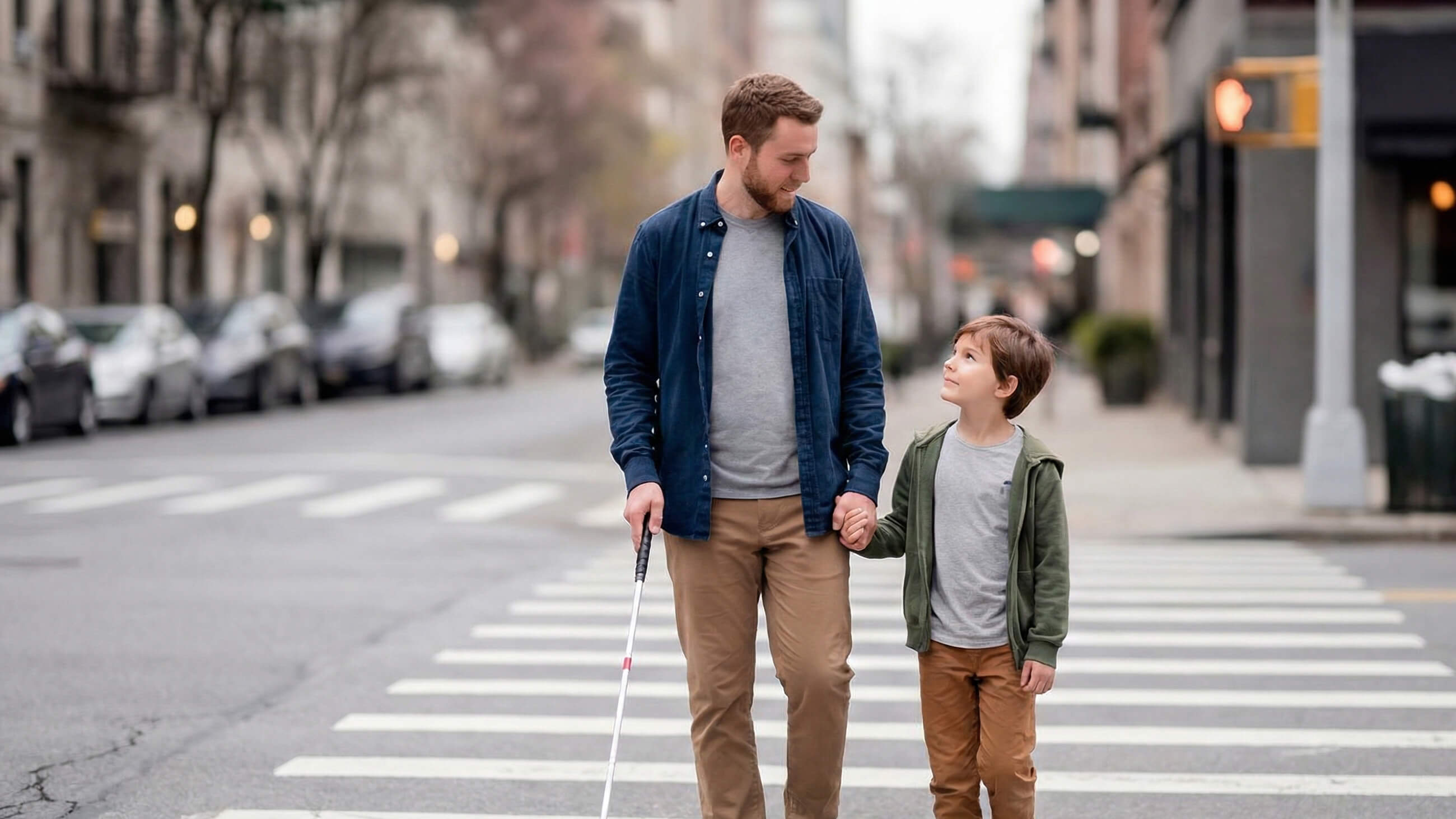
Parenting with limited sight or vision loss
It's a typical weekday morning getting kids ready for school and parents for work: eating breakfast, packing up backpacks and work bags, and ushering out the door to get everywhere you need to on time.
For many parents, these are normal activities they don't think twice about. However, for parents who have low vision or are blind, this can be a much more challenging scenario.
Many of these challenges lie with the everyday tasks and responsibilities that most parents take for granted when helping their child, says Patrick Yoshinaga, OD, MPH, FAAO, professor and chief of the Low Vision Rehabilitative Service at Southern California College of Optometry at Marshall B. Ketchum University.
"It depends on the age of the child, but if it's a young infant or toddler, then obviously making sure the child is safe, being able to watch over them to make sure they're taken care of properly," that’s critical, Dr. Yoshinaga said. "And up to grammar school age and beyond, helping them with their activities, doing homework, things like that.”
All About Vision spoke with two parents with a vision impairment about how they’ve adapted their parenting styles to meet everyone’s needs, the technologies and smartphone apps that help them on a daily basis, and their tips for parents who have low vision or blindness who may need guidance.
Low vision vs. blindness
According to the American Foundation for the Blind (AFB), about 33 million U.S. adults between the ages of 18 and 64 have some level of vision loss. An estimated 420,000 experience complete vision loss.
Low vision is a visual impairment that cannot be fully corrected with glasses, contact lenses, medication or surgery, though in some cases treatment may improve vision or make daily activities easier.
"There are different degrees of visual impairment," Dr. Yoshinaga explains. "We hear the term 20/20, which is often equated to ‘normal vision.’ However, some individuals experience low vision when their reduced vision is not correctable by traditional means such as glasses, contact lenses or surgery. This can result in difficulties in daily activities such as reading, identifying objects, watching TV, or adjusting to light or glare.”
Comparatively, legal blindness, Dr. Yoshinaga said, is a term that's used if a person can only see 20/200 or worse in their best eye with their best correction, or if they have a visual field of 20 degrees or less in the better eye.
"Visual impairment can range from anything like a person who has mild visual impairment who has trouble seeing signs or reading and may need some help with magnification, all the way to the other end of the spectrum where they can't see anything at all, including light," he said. "It’s a big range."
Challenges of parenting school-aged children
Some of the activities many parents enjoy with their school-aged children, such as reading them a book, seeing their artwork and helping them with homework, can be quite challenging for parents who are blind or have low vision.
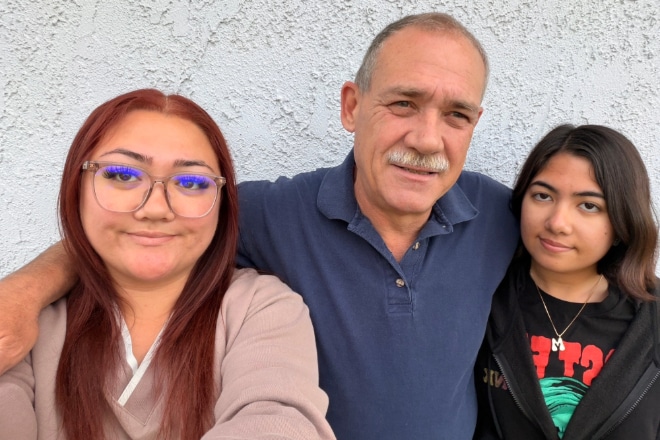
In 2012, when his two girls were in first and third grade, Mitchle Grogan received a diagnosis of retinitis pigmentosa — an eye disease that causes the breakdown of cells in the retina at the back of the eye, causing vision loss.
"When I got diagnosed with retinitis pigmentosa, I could see definition so I could see your face, your nose, your eyes, your color hair," Grogan explained. "Once I lost my vision, my doctor told me to go to the Braille Institute to get my bearings back because pouring a cup of coffee was difficult. I couldn't see when the cup was full, so it would overflow."
In the beginning, Grogan recalls it was very challenging for his young children to understand what was happening to his vision. "One day my first grader brought home a drawing. And I said, ‘Honey, I can't see that.’”
She responded, “Why, because you're blind?”
“That gave me a gut punch. I could not get mad at her because it was new to me, new to her," he said.
Grogan said certain assistive technologies helped him work with his children to be able to read to them or help them on their homework. "With my CCTV (closed-circuit television), with OCR (optical character recognition), I put The Cat in the Hat underneath the CCTV and say, this is how we're going to read books," he said.
"This is how I'm going to help you with your homework. I'm going to take a picture of your homework or your book, and it's going to explain to me, and we'll do this together because I already went through school.”
“My kids enjoyed that I took the time out to say, ‘Hey, we can do this together, even homework.’”
Grogan says he's also had access to smartphone apps since 2018, including one app that uses global volunteers to help him "see" things he needs via video and audio calling.
"Somebody from around the world will appear live and say, ‘How can I help you?’" he said. "I'm in the market, I'm looking for the hazelnut coffee creamer. So they say, okay, point the camera to the dairy case and go from the left, right, right, go down, go left, left, stop — reach straight out, there's your hazelnut coffee creamer."
The same app allows the user to take a photo of their surrounding environment and describe what's there. "So I could call a volunteer and say, ‘Can you describe what's around me, and I'm looking for this building,’ and they can direct me," he adds.
As his daughters became teenagers, Grogan said they were able to step up and give him a lot more information than they were able to when they were younger. "In high school, I got a lot more information. ‘Okay, Dad, we're going to go through the door so don't hit your eyebrows on the door jam,’” he explained. “Now that she's older, my 19-year-old understands and she helps me out as far as traveling, describing things and reading menus to me."
Infant care has unique issues
Under the best circumstances, having a newborn baby requires a lot of work, such as constant feeding, monitoring their health, keeping them safe and taking them to multiple doctor visits. For a new parent who has low vision or blindness, the complexity increases for these necessary activities.
New parent Sophia* has lived with low vision since the age of nine, when her optic nerve was damaged by a misdiagnosis of cryptococcal meningitis — a fungal infection that can cause optic neuropathy, potentially leading to some level of vision loss.
Currently the mother of a 19-month-old boy, Sophia says one of the biggest hurdles she faced in taking care of her new baby was feeding. "Everything has to be accurate with a newborn infant," she explained. "I was breastfeeding and I was also formula feeding, so everything needed to be measured out accurately and it's hard to read it and to see it."
While she found it stressful in the beginning, Sophia says family and friends helped not only with feeding her son, but also getting back and forth to the doctor’s appointments both she and her new baby needed.
Rides like the ones Sophia leaned on don't have to come only from these loved ones. Many communities offer ADA paratransit which is a shared, curb-to-curb service that by law can't cost more than twice the standard transit fare within 3/4 of a mile from a bus route or train station. Increasingly, there are ride-share companies stepping up to provide subsidized services for certified riders. A local center for independent living can help you sign up.
"I had health complications after I delivered," she recalled. "I had to go back to the hospital. So it's double appointments, me and the baby, separately. And then if I go to my appointment, I have to have someone take me, but then I also need to have someone to help me take care of the baby when I go to my appointment. I'm not going to take a newborn to my doctor's appointment."
Like Grogan, Sophia uses assistive technologies to help her, including handheld magnifiers and the camera function on her phone so she can take a photo and enlarge it. "As far as reading labels and things like that, I use my handheld magnifier and then I use my phone to help me read things for the baby," she said.
Sophia also relies on a computer screen magnifier to help her work and read documents. "If I'm able to get doctor's documents electronically, that's better, but some doctor's offices don't have that, so it helps that I can enlarge documents," she explained.
*Last name omitted for privacy.
Tools and technology
Both Grogan and Sophia use several different tools and technologies to assist them with parenting, such as:
- Closed-circuit television (CCTV) – An assistive technology device that projects an extremely magnified version of printed text.
- Optical character recognition (OCR) – Scans a printed document and converts it to digital text, which could be read aloud for the user.
- Computer screen magnifiers – Software or tools that enlarge text and graphics on the computer screen, and can sometimes enhance the contrast of text, such as changing from black text on a white background to white text on a black background.
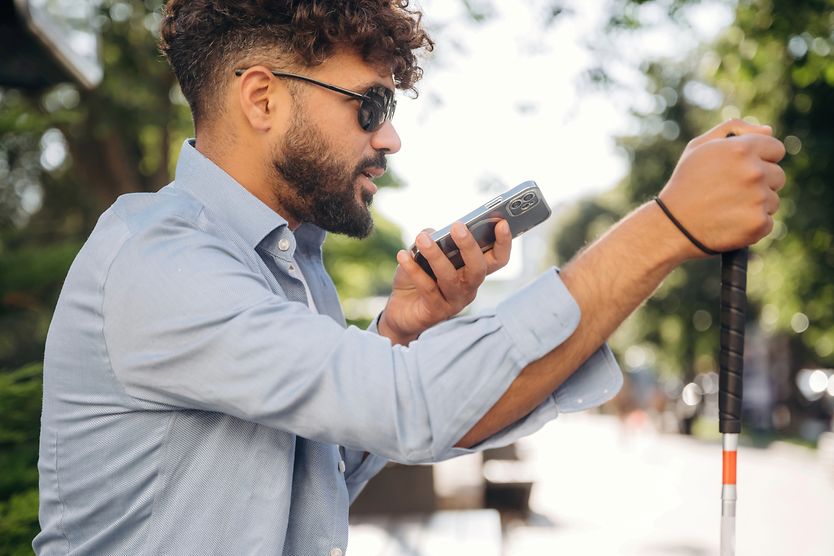
- Smartphone apps – Smartphone apps provide several necessary functions, including object and face identification, barcode scanner, text to speech capability and describing what's around the user.
Several programs offer children's books in braille, large print and audio — many of them free. These may include:
- National Library Service for the Blind and Print Disabled (NLS) – It’s part of the U.S. Library of Congress, which can lend more than 60,000 titles for young readers in braille and audio. You can download them or have them mailed to your home at no cost.
- Seedlings Braille Books for Children – An organization that can send free braille books to kids with vision loss through its Book Angel program.
- Bookshare – Supported by the U.S. Department of Education, they offer a large online library of accessible titles for readers with print disabilities.
SEE RELATED: Low vision aids: How new tech helps people with low vision
Tips for parents with blindness or low vision
For parents-to-be or other people living with blindness or low vision who may need parenting guidance, Dr. Yoshinaga advises them to take advantage of the assistive devices and technologies available and build a good support system that includes agencies whose mission is to help parents with low vision or blindness.
If parents who have visual impairment come from an inherited condition like retinitis pigmentosa, a genetic counselor can explain whether and how it might be passed to your children. In fact, the Foundation Fighting Blindness recommends counseling before any testing and offers both at no cost.
"One of the main agencies that really provides advocacy for patients and parents who have visual impairment is the National Federation of the Blind (NFB)," he continues. "They put out a lot of information for counseling and assistance for patients for all their needs for visual impairment, and they also include helping parents who are visually impaired."
Other resources that might be helpful for parents who are blind or with low vision include:
- American Council of the Blind (ACB) Parents and Teachers Resources
- American Foundation for the Blind's FamilyConnect programs
- Rutgers University’s Eye2Eye Phone-Based Peer Support Program for Vision Loss
- Foundation Fighting Blindness' Chapter Network
- Lighthouse Guild Support Services
- National Federation of the Blind's Blind Parents Connection Podcast, Blind Parents Group and Blind Parent Mentoring Program
When talking to your child about your eye condition, Dr. Yoshinaga says to use open communication with your child so they can understand what's going on. "Children are very aware — they pick up on things right away," he adds. "We've seen a lot of patients where the children are very helpful and they understand the situation."
Sophia urges parents to try to anticipate what your parenting obstacles will be, come up with options, and then be confident once you've decided on solutions. "Be realistic with what your obstacles are," she continues. "Identify them and come up with solutions. It's definitely rewarding ... It's a lot, but it's definitely rewarding. I would say having my son is the best thing that happened to me ever."
Grogan says depending on a parent's diagnosis and where they are in their journey, to not be afraid to get the assistance they may need. "Everything is a challenge to us and everything's new — just walking out your front door you may need assistance," he explains.
"And then you're going to tell yourself, I got this ... because when your children are little, they're going to adapt to you with your needs, just like my children have. From school children to college children, everybody's going to adapt. And when the children are around you, they're going to learn your needs faster. Be productive, put your best foot forward, and you're going to have a happy life, and your children are going to be happy helping you."
READ NEXT: Resources for the visually impaired