Prescription reading glasses vs. over-the-counter reading glasses


Do you need prescription reading glasses?
Nearly 128 million Americans have presbyopia, the gradual loss of close-up focus that can make everyday tasks — reading a pill bottle, checking a price tag, viewing a text message — harder than they used to be. Some people might reach for a pair of over-the-counter (OTC) reading glasses. Others may benefit from reading glasses customized for their individual prescription.
Ready-made reading glasses are widely available at a range of price points, and for some people, they meet their near vision needs effectively. But OTC reading glasses have some limitations, and relying on them without a professional eye exam could allow an underlying eye condition or other vision issue to go undetected.
Prescription reading glasses offer another option. They’re prescribed according to the specific needs of each eye and can address other vision issues that OTC readers may not.
How is presbyopia different from farsightedness?
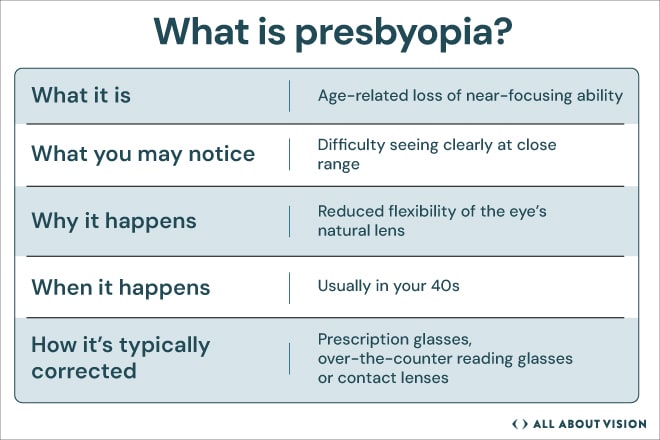
Presbyopia is an age-related vision condition. It’s classified by the National Eye Institute (NEI) as a type of refractive error that occurs when the eye’s natural crystalline lens becomes less flexible and the eye’s focusing [ciliary] muscle gradually loses the ability to reshape the lens for near activities with age. This can make it more difficult to focus on things up close. It typically becomes noticeable in your mid-40s and progresses until around age 60 to 65.
“It’s a normal part of aging,” said Michael C. Vitale, a licensed optician, National Contact Lens Examiners (NCLE)-certified with an ABO Master in Ophthalmic Optics (ABOM) from the American Board of Opticianry. Mr. Vitale is the vice president of membership, government relations and technical affairs at The Vision Council.
People sometimes confuse presbyopia with farsightedness (hyperopia), another type of refractive error. Both can make it difficult to see things clearly up close. But farsightedness is related to the shape of the eye and can affect people at any age.
It’s possible to have both conditions at the same time, and people who are already farsighted may notice presbyopia sooner.
When ready-made eyeglasses work and when they don’t
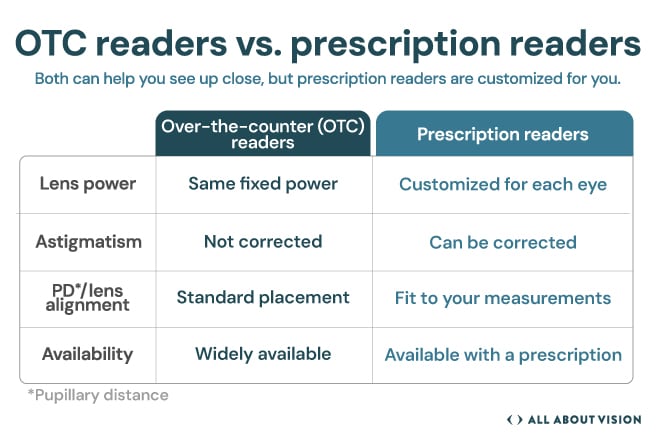
Ready-made reading glasses, also known as OTC or ready-to-wear readers, are not corrective lenses, Vitale explains. These glasses use single fixed-power lenses, typically ranging from +1.00 to +3.50 diopters (D), though some states restrict the sale of over-the-counter reading glasses above certain strengths. These lenses allow the eyes to focus at the proper distance, making it easier to see clearly up close.
A diopter measures the focusing power of a lens. The higher the number, the stronger the focusing power. A lower power, such as +1.00 D, offers a minor amount of additional focusing power for near tasks, while +3.00 D or higher provides greater assistance for near-focusing.
OTC readers are easy to find at places like pharmacies, grocery stores and online. However, they don’t correct for prescription differences between the eyes, nor do they address astigmatism or other refractive errors the way prescription glasses do. People with very narrow or wide pupillary distance (PD) may also experience eye strain or diplopia (double vision), since the optical center of the lenses doesn’t align with their eyes, Vitale notes.
“Ready-made readers are a good choice when the consumer has equal refraction error in both eyes and no or very little astigmatism,” said Vitale. For anyone with unequal prescriptions between their eyes or astigmatism, prescription readers may be needed.
If OTC readers are causing discomfort, pay attention. Symptoms including “dry eyes, itchy eyes, blurred vision, eye strain, fatigue, tension headaches and musculoskeletal pain in the neck, shoulder or back,” said Vitale, “can be related to poor visual acuity and constant repositioning to focus properly.”
Prescription readers: What makes them different
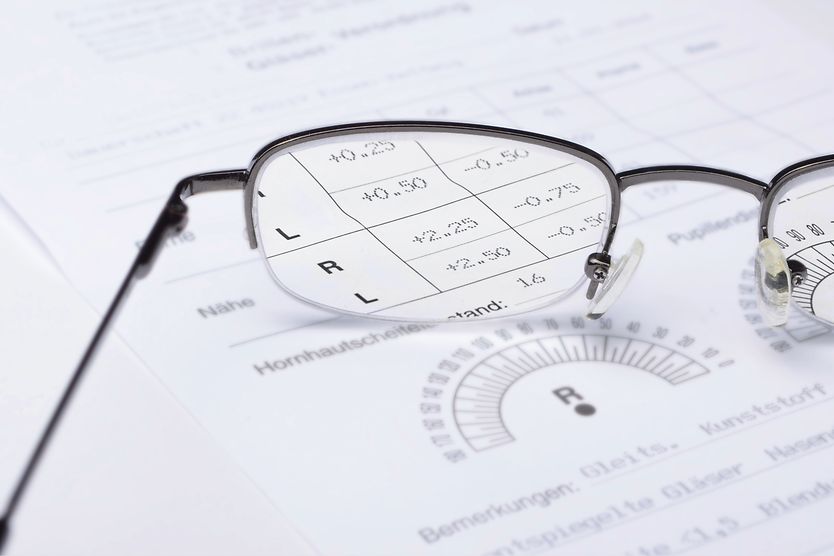
Prescription reading glasses are customized to specific vision needs, Vitale explains. An eye doctor measures each eye individually, accounting for differences in prescription power between the eyes and correcting for astigmatism. The lenses are fitted based on measurements, such as pupillary distance and fitting (segment) height. PD is the distance between the centers of the pupils. Fitting height is the distance between the center of each pupil and the bottom of each lens. While PD will remain the same, fitting height will vary according to the frames.
But having your eyes examined isn’t just about getting a lens that provides sharper vision. It’s also a chance to have an eye doctor determine what your eyes actually need. Mile Brujic, OD, an optometrist at the Premier Vision Group in Bowling Green, Ohio, says providers should dig well past “I want to see better up close” into specifics, such as: What tasks are you struggling with? Are you on a laptop all day, or working across three monitors? Are you active outdoors, or mostly indoors?
“Those needs are very, very different,” said Brujic. The right solution depends on the answers to these questions. It could be prescription readers, progressive lenses, multifocal contacts or even prescription eye drops that can temporarily improve near vision by constricting the pupil (a “pinhole” effect). The specifics are what lead to a solution that actually works, he says.
A comprehensive eye exam could also provide refractive surgery options, such as:
- Corneal procedures, such as monovision LASIK (laser-assisted in-situ keratomileusis)
- Multifocal or enhanced monofocal intraocular lenses (IOL)
An eye doctor can help you determine if you’re a candidate for any of these procedures.
Understanding your eye care team
Knowing the difference between an ophthalmologist, optometrist and optician can help you choose the appropriate provider for your eye care and vision needs:
- Ophthalmologist (MD or DO) – An eye doctor who examines the eyes, diagnoses and treats eye diseases and performs surgeries, including cataract surgery. They can also prescribe eyeglasses or contact lenses.
- Optometrist (OD) – An eye doctor who focuses on primary eye care. They examine the eyes, diagnose and treat eye conditions, and prescribe glasses or contact lenses. Some optometrists may perform laser and other minor procedures, depending on U.S. state law.
- Optician – An eye care professional who fits and dispenses prescription eyeglasses. They may also know how to make lenses or help with low vision care.
Often, these providers work together to help patients choose the ideal vision correction options and maintain eye health.
An eye exam still matters
Even if over-the-counter reading glasses seem to work well for seeing more clearly up close, they do not replace the need for comprehensive eye exams. That distinction is important.
Vitale stresses that routine eye exams should be part of every adult’s health care, not just something to be scheduled when vision gets worse. Conditions like glaucoma and age-related macular degeneration (AMD) can develop without early symptoms. Routine eye exams are the most effective way to help detect early signs of eye conditions before vision is affected.
Though rare, presbyopia can appear before age 40. Sidney Gicheru, MD, an ophthalmologist at LaserCare Eye Center in Dallas, Texas, and a spokesperson for the American Academy of Ophthalmology (AAO), says early-onset presbyopia is often linked to health issues, like diabetes, multiple sclerosis and cardiovascular diseases.
The AAO recommends that all adults get a comprehensive eye exam at age 40. After that, it’s recommended that adults aged 40 to 54 have comprehensive eye exams every two to four years, those aged 55 to 64 every one to three years, and every one to two years for those aged 65 and older.
When your eyes are telling you something
Whether you wear readers or not, some symptoms warrant prompt attention. Seek medical care right away if you experience sudden vision loss, have eye pain or injuries, have significant eye redness or notice signs of eye infection. It’s also important to visit your eye doctor promptly if you notice symptoms, such as new or an increase in floaters, blurry vision or other vision changes.
But you don’t need an emergency to justify a visit with your eye doctor. If your readers aren’t helping, your vision is changing or you haven’t had a full eye exam within the recommended time frame, those are reasons enough.
Over-the-counter reading glasses have their place, but they’re not a substitute for knowing what’s actually going on with your eyes. “Everyone should make a regular eye exam part of their wellness routine,” Vitale said.