Colored contacts: How to pick the right lenses and stay safe

What are colored contacts?
Most colored contact lenses are designed to enhance or change your eye color while you wear them. They can be purely cosmetic, but many people also choose colored corrective lenses. Often called tinted contacts, they can be a safe, easy way to change your look temporarily.
Colored contacts also have some less familiar uses. They can help reduce symptoms from iris defects, for example, or even act as prosthetic irises. Some tinted contact lenses can help boost contrast and color perception. Others can help reduce photophobia and migraine symptoms.
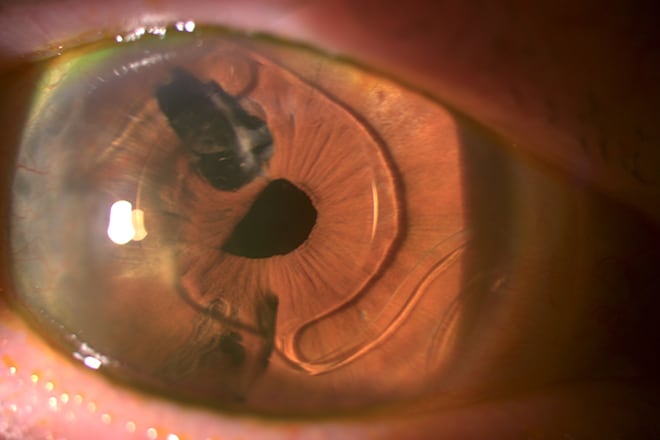
This is a patient with a surgical pupil with a large laser peripheral iridotomy (PI) who also has an anterior segment intraocular lens (IOL). This is an ideal candidate for a cosmetic soft lens to block light from entering the PI and allow for a sharper/more consistent focus. Photo courtesy of Joshua Davidson, OD, FAAO, FSLS.
Colored contact lenses always need a prescription
In the U.S., all contact lenses are considered medical devices. They all require a prescription, even if they don’t provide any vision correction. Any business selling contact lenses (colored or not) without a prescription from a doctor is breaking the law.
Of particular note is that vision correction is only one part of a contact lens prescription. The other part is fit, and it’s equally important. Wearing poorly fitted contact lenses can cause real, lasting damage to your eyes.
Types of colored contact lenses
Colored contacts can be cosmetic, therapeutic or prosthetic (or a combination of these). Cosmetic contacts are probably the most common and familiar type of colored contacts. They can be worn with or without vision correction and are what people usually think of when they hear “colored contacts.”
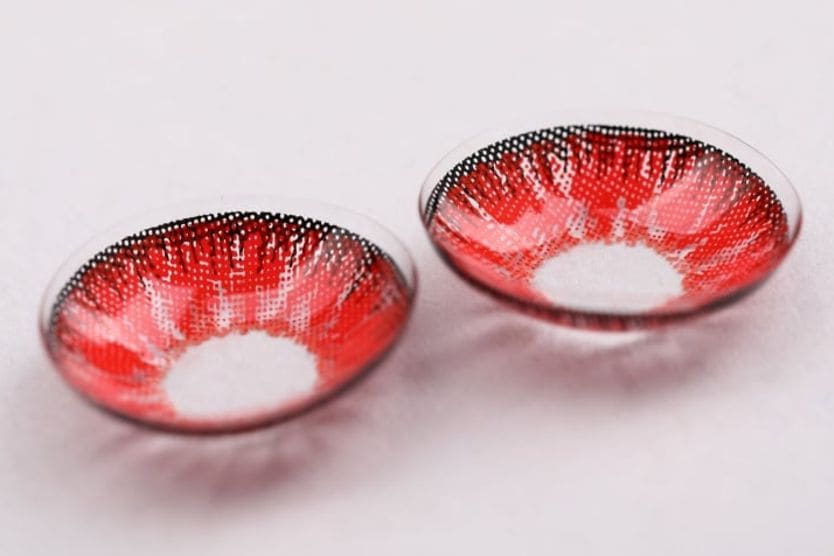
Most cosmetic contact lenses are designed to have a natural appearance. Their tints are often made up of tiny dots, lines and flecks to mimic the look of a natural iris (the colored part of the eye).
Some have only a single, subtle color, while others combine two or more shades or colors. Many brands also have color options with and without a limbal ring (the darker outside edge of the iris). The center area that lies over the pupil is clear, so you can see.
Colored contacts come in seemingly endless options and different types of tints. You can make a subtle or dramatic change to your eye color, depending on the color and type of tint you choose:
Enhancement tint contacts
Enhancement tints are translucent or semi-translucent. They’re see-through but still dark enough to make a noticeable change. Your iris is still visible underneath, so they complement and liven up your natural eye color.
Since they’re translucent, they’re more effective the lighter your eye color is.
Opaque tint contacts
Opaque tints aren’t see-through at all. They completely cover your natural eye color, so they work well for both lighter and darker eyes. Opaque tints give you a totally new eye color rather than an enhancement.
Halloween, theatrical and costume contact lenses also fall into the opaque category.
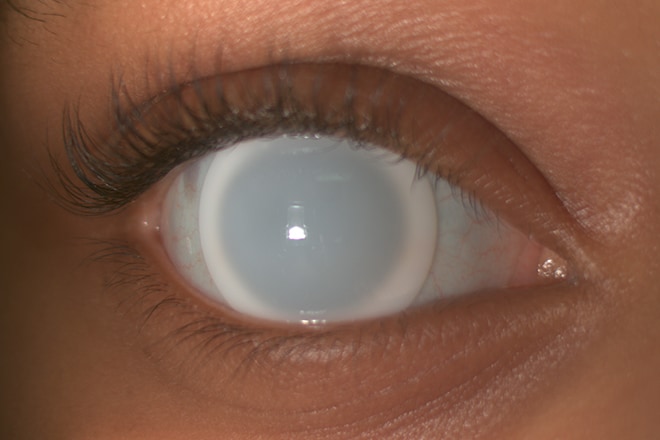
This is a cosmetic contact patient being prepped for a large-budget Hollywood movie. The eye care team was challenged by the director to make the eye look "dead with a small amount of the dark colored part of the eye still slightly visible." Photo courtesy of Joshua Davidson, OD, FAAO, FSLS.
Blending tint contacts
Blending tints are a combination of translucent and opaque. They are tinted on a gradient from opaque around the outside to more translucent around the pupil. Blending tints have a slightly bolder effect than enhancement tints while still looking natural.
Visibility tint contacts
Visibility tints aren’t the same as cosmetic color tints. They’re a very light blue or green tint added to standard contact lenses for easier handling.
They help you see the lenses better while you put them in or if you happen to drop one, but they don’t affect eye color.
Custom color contacts
A few contact lens manufacturers do offer custom cosmetic colors. But, like standard contact lenses, most colored contacts are mass-produced. Custom colored contacts usually have purposes beyond purely cosmetic.
Therapeutic contacts
These color contacts have a translucent tint similar to enhancement tints. But unlike cosmetic contacts, their tint is uniform throughout and across the center.
Therapeutic tints have a wide range of uses, depending on their exact color. Some colors can help reduce light sensitivity problems or migraine onsets. Others can help correct color vision deficiency. Some can help boost athletic performance by enhancing visual contrast or reducing glare. For example, a type of amber-tinted performance contact lens blocks 100% of UV rays, enhances contrast and helps athletes see in “high definition.”
Prosthetic contacts
Prosthetic color contacts are typically used to mask an iris or pupil defect. They may have a therapeutic or opaque tint, depending on the degree of the defect. Often, they require custom hand-painted or computer-generated coloring.
LEARN MORE: Colored contacts for astigmatism
How to choose the right colored contacts
Ultimately, choosing the right color comes down to personal preference.
Do you want a subtle change or something bold? Do you want a completely different color that still looks natural or just a hint of something vivid? Determine the kind of look you’d like to achieve and go from there.
No matter which color you choose, remember that all contact lenses require the same level of care. You should never wear colored contacts without a prescription from an optometrist or ophthalmologist. Always follow your eye doctor’s instructions carefully.
Colored contacts for a natural look
If you want a natural-looking change, you should factor in your hair color and skin tone. Choose neutral-, cool- or warm-colored contacts that complement your natural tones.
Even if you go bold with a completely new color, staying with your natural tones will help you find colors that suit you.
For a very subtle change, try a tint in your natural color but a shade or two lighter or darker.
Colored contacts for light or dark eyes
Whether you have a light or dark eye color, your options are virtually limitless.
For example, translucent enhancement tints can intensify or darken light eye colors. An enhancement tint can shift light green eyes to a warmer green or to vivid emerald. Light blue eyes can shift to deeper blue or to amethyst.
Semi-translucent and blending tints offer similar color changes for medium and dark eyes. A semi-translucent beige or honey tint can brighten dark brown eyes. A blending tint can create a smooth transition outward from your natural brown into green or blue.
Full-opacity color contacts are always popular choices for both light and dark eyes. These tints provide complete coverage, so you can choose any color you like. You don’t need to consider how they’ll blend with your natural eye color.
Browsing colored contacts
Not all colored contact brands and sellers use the same terminology to describe their tints. Some may use “semi-transparent” instead of “semi-translucent,” or they may use “semi-opaque.” Others may use these or similar terms to describe a blending tint. In many cases, you may not see “enhancement” or “opaque” at all.
When deciding which colored contacts to try, pay attention to the category you’re browsing. Be sure to read the full descriptions of each color. It’s also helpful to look at any images they provide of the actual contact lenses. Being familiar with how each brand describes tints and coverage will help ensure that you find the look you want.
Above all, be sure you only buy from reputable, authorized sellers.
SEE RELATED: What color contacts are right for you?
How much do colored contacts cost?
Colored contact lenses cost more than standard contacts. This is primarily due to additional manufacturing costs, including:
- Tint design and craftsmanship
- Pigment and material safety
The cost of colored contacts can vary a lot, depending on the brand and complexity of their designs. And, just like standard contacts, the cost of colored contacts is also affected by factors such as:
- Vision prescription
- Wear and replacement schedules
- Special features, like extra moisture or UV filtering
READ MORE about the cost of colored contact lenses
Are colored contacts safe?
Colored contact lenses are just like standard contacts. They should be safe as long as certain criteria are met:
- They are made for your current contact lens prescription.
- They are made and sold by an FDA-approved manufacturer and seller. This is very important as there are many online companies that sell cosmetic contacts illegally.
- You follow all of your eye doctor’s instructions for wearing, cleaning and replacing them.
Why non-prescription colored contacts are dangerous
Contact lens prescriptions are not exactly the same as glasses prescriptions.
Your glasses prescription is calculated for the vision correction you need. A contact lens prescription includes your fitting, as well as your vision correction. In some cases, it might also include specifics about brands and materials you can safely wear.
In the U.S., all contact lenses require a prescription. The Food and Drug Administration (FDA) regulates them as a type of medical device. In fact, it’s illegal to sell contact lenses without a prescription and FDA clearance.
This can be confusing when people use the term non-prescription colored contacts. Typically, they’re referring to contacts that do not provide vision correction. But this is a misnomer; even purely cosmetic contacts still need a prescription.
By law, a seller has to verify your prescription with your eye doctor before they can sell contact lenses to you.
Contact lenses are not one-size-fits-all. Wearing unfitted, non-regulated contact lenses for only a few hours can cause serious eye problems, including:
- Corneal abrasions
- Corneal ulcers and scarring
- Bacterial and fungal eye infections, such as microbial keratitis
- Toxicity from chemicals
- Inability to remove contacts without medical intervention
- Cataracts and glaucoma
- Possible need for corneal transplant
- Permanent vision loss and blindness
It’s essential that you see an eye doctor for a contact lens exam and fitting. Then, ensure you’re buying contact lenses from an authorized source. Never wear “off the shelf” contacts from costume or novelty shops, gas stations, beauty stores or similar places.
How to care for colored contacts
Taking care of colored contact lenses is just as important as with standard contacts. Wearing, cleaning, storing and replacing them properly is critical.
Exact care requirements can vary by brand and design and, sometimes, by prescription. Always follow your eye doctor’s instructions, even if they differ from what’s on the box. If you ever purchase a brand that’s different from your prescription, make sure to discuss their care with your eye doctor.
General safety rules that apply to all contact lenses include:
- Never share or exchange contact lenses with others.
- Never wear contact lenses if your eyes are irritated, infected or injured.
- Never clean contact lenses with water or saliva.
- Never wear contacts that are torn or damaged.
- Never wear contacts that are expired or due for replacement.
- Never wear contacts for longer sessions than they’re designed to be worn.
READ MORE about caring for contact lenses
Always talk to an eye doctor before you buy
Colored contact lenses can be a safe, fun way to change your look if you go about it the right way.
See your eye doctor for an eye exam and an updated contact lens prescription before you buy. This will ensure your colored contacts are properly fitted and comfortable.
While you’re there, tell them where you’re thinking of buying colored contacts. They can help you determine if it’s an authorized source and offer other advice as well. This will help ensure you’re buying colored contacts that are safe for your eyes and vision.