What are contacts made of?
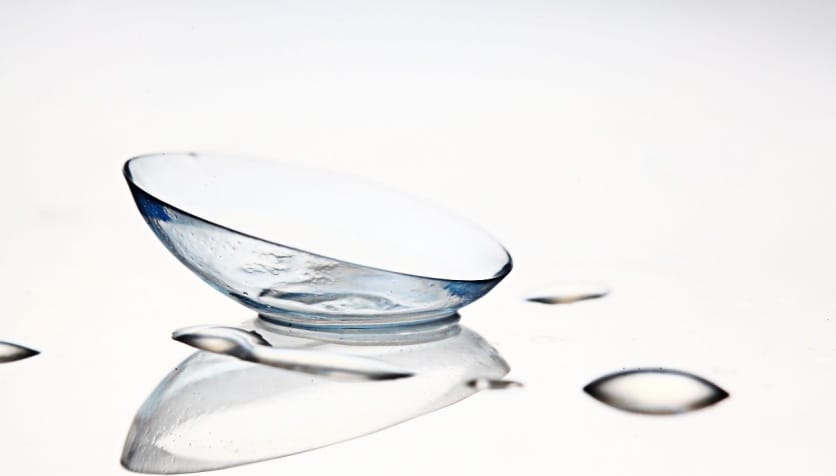

There are three main categories of contact lenses, based on the materials they are made of: soft contacts, rigid gas permeable (RGP or GP) lenses and hybrid contact lenses.
What soft contact lenses are made of
Soft contacts are made of pliable hydrophilic ("water-loving") plastics called hydrogels. Hydrogels absorb significant amounts of water to keep the lenses soft and supple.
Because of this water-loving characteristic, the water content of various hydrogel contact lenses can range from approximately 38% to 75% (by weight).
Generally, hydrogel soft contact lenses are available in these categories, based on their water content:
- Low water content (less than 40% water)
- Medium water content (50% to 60% water)
- High water content (more than 60% water)
The water content of soft contact lenses allows oxygen to pass through the lenses and help keep the cornea healthy during contact lens wear.
Different brands of soft contact lenses have different water content and lens thickness. Generally, hydrogel lenses that have a low water content are thinner than soft contact lenses that have a high water content.
There is significant variation in thickness and water content of hydrogel contact lenses because people will respond differently to the materials. Some contact lens wearers are more comfortable wearing thin, low water content lenses; others are more comfortable wearing thicker, moderate and high water content lenses.
Another feature of hydrogel materials used for soft contact lenses is their surface charge, which can affect how quickly protein deposits form on the lenses during wear.
Hydrogels are classified as either ionic or non-ionic. Ionic materials have a negatively charged surface and therefore may attract positively charged proteins in the tear film. Non-ionic hydrogels are treated to reduce this negative surface charge and therefore may be less prone to attract protein deposits.
The U.S. Food and Drug Administration (FDA) uses four categories to classify soft lens materials:
- Category 1 = low water, non-ionic
- Category 2 = high water, non-ionic
- Category 3 = low water, ionic
- Category 4 = high water, ionic
The latest soft contact lenses called silicone hydrogel lenses have become widely used. These lenses include silicone within the hydrogel material to increase the oxygen transmissibility of the lenses.
In fact, studies show that silicone hydrogel contact lenses transmit up to six times more oxygen to the cornea than regular soft contact lenses. This feature makes silicone hydrogel lenses safer for use as extended wear lenses.
Many new soft contact lenses also include surface treatments to help the lenses retain their water content and avoid drying out for greater all-day wearing comfort.
What gas permeable contact lenses are made of
Gas permeable lenses, also called GP or RGP lenses, are rigid (hard) contact lenses. Like hydrogels used for soft contact lenses, materials used to create GP lenses are also "gas permeable," allowing oxygen to pass through the lenses to the cornea.
Unlike soft contact lenses, however, rigid gas permeable lenses do not contain significant amounts of water. Instead, GP lenses rely on their microscopically porous nature to transmit oxygen to the cornea.
Prior to the development of GP lenses in the 1970s, conventional hard contact lenses were made of a hard plastic material called polymethyl methacrylate (PMMA).
Though PMMA has excellent optical qualities, durability and biocompatibility, it has no oxygen permeability, and many people could not tolerate or safely wear PMMA hard contact lenses for this reason.
Gas permeable lens materials are generally classified according to their "Dk" value, which is a measure of their oxygen permeability. Materials with a high Dk transmit more oxygen to the eye than those with a low Dk value:
- Low Dk is 100
The first modern GP lenses to gain wide acceptance were made of an oxygen permeable material called silicone acrylate (SA). These lenses were introduced in the late 1970s and had a Dk value of 12.
Since then, new gas permeable lens materials have been developed that provide greater oxygen transmissibility, enabling even overnight wear of GP lenses.
Initially, increased oxygen permeability was achieved by adding more silicone to the lens materials. However, this ultimately caused GP lenses to become more fragile and caused them to dry out and accumulate lens deposits more easily.
Eventually, fluorine was added to GP lens polymers to help solve these problems. Today's fluorosilicone/acrylate GP lenses are optimized for oxygen permeability, lens stability and surface wetting characteristics.
Because of their hardness and because they do not fluctuate significantly in their water content, gas permeable lenses generally have superior optical characteristics and provide sharper vision than soft contact lenses.
However, despite advances in GP lens technology, some people cannot adapt to wearing rigid GP lenses and choose soft contact lenses for comfort reasons.
What hybrid contact lenses are made of
Hybrid lenses have a rigid GP central optical zone, surrounded by a peripheral fitting zone made of a soft contact lens material commonly called a “skirt.”
A variety of hybrid lenses are available, including multifocal hybrid lenses for presbyopia, keratoconus and other conditions that may cause irregular astigmatism.