Green eyes: The rarest eye color
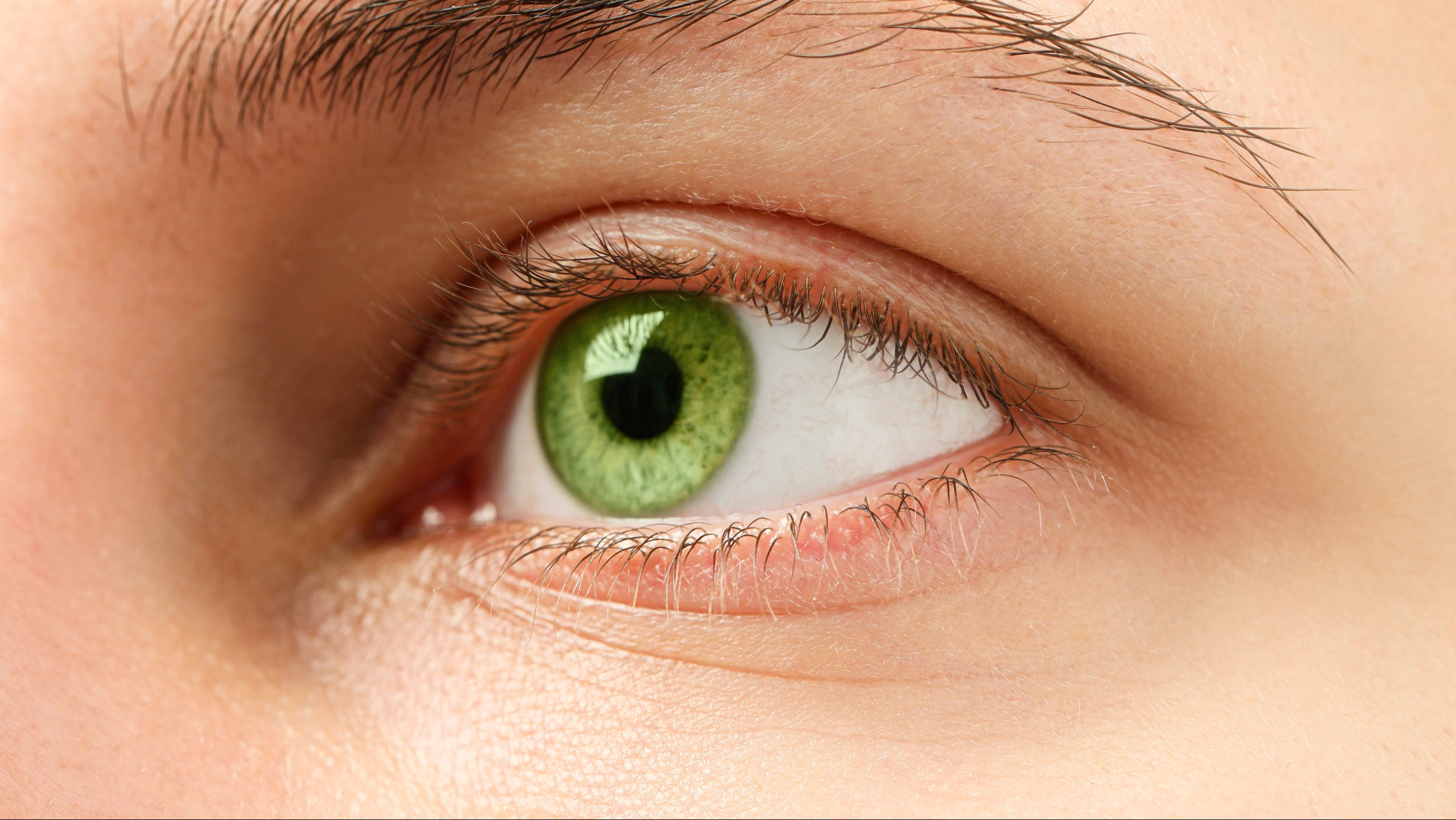

All about green eyes
Though the color green is often associated with envy (even a character in Shakespeare’s Othello refers to jealousy as “the green-eyed monster”), many people consider green eyes to be the most attractive eye color.
Green also happens to be the rarest eye color. Only about 2% of the world’s population has green eyes.
Here’s some more information about the stunning green eye color, where it comes from and what makes it so rare across populations.
What causes green eyes?
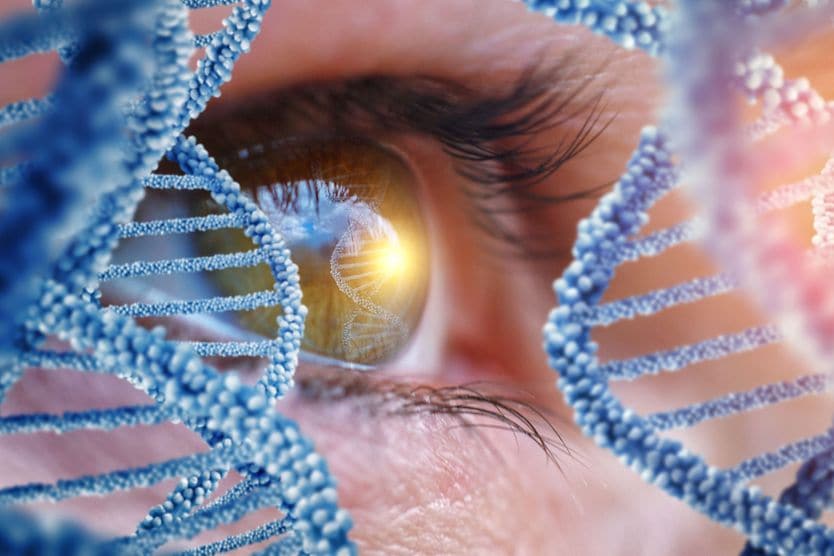
Genetics play a role in determining eye color. But it’s nearly impossible to predict with 100% certainty the eye color of a child simply by knowing the color of their parents’ eyes. There also isn’t one dominant and recessive “eye gene,” as you may have learned in high school science class. Instead, research in evolutionary biology and other fields has found that complex genetic mechanisms determine eye color.
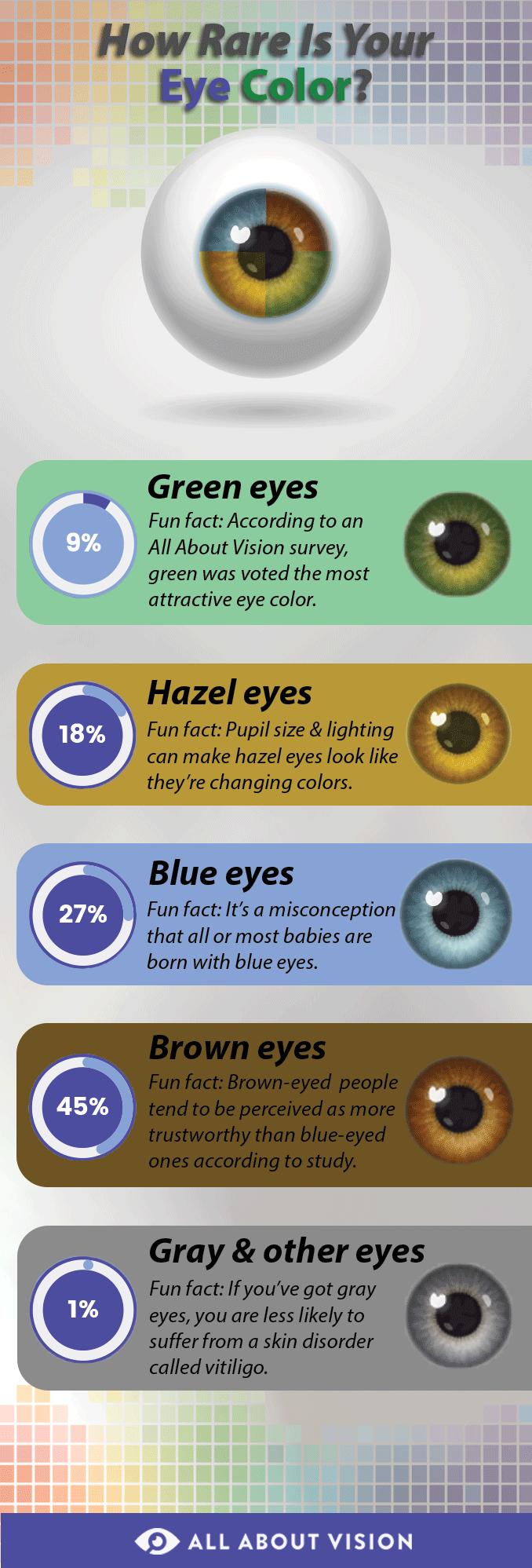
Click to read the article and view the infographic
Many different genes determine which eye color you might inherit. And different interactions and levels of expression of these genes can alter eye color outcomes in children. Some of the many genes that are involved in eye color include the OCA2 and the HERC2 genes.
The structure within the eye that is responsible for eye color is called the iris — the thin, circular structure that surrounds the pupil. The iris controls the size of the pupil (and therefore the amount of light that enters the eye). But it also contains pigmented cells that determine eye color.
Nearly all eye colors are determined by how much brown-colored pigment, called melanin, is contained in cells in the iris. That’s right; a brown-colored pigment helps determine eye color.
Though people can have green and blue eyes, there are no green or blue pigments in the iris. In fact, there are many different eye colors but surprisingly few types of eye pigments.
So how does this brown-colored pigment create green eyes — or blue eyes, or hazel eyes, or any eye color other than brown?
Differences in eye color are the result of different amounts of melanin pigment granules within cells in the iris called melanocytes. These cells acquire their genetically determined amount of melanin in early childhood. Their melanin content usually remains relatively constant throughout life.
When light strikes the iris and the pigment-containing melanocytes within the iris, this light is scattered and reflected.
This phenomenon, called Tyndall scattering, can produce different reflective colors, depending on the physical structure of the iris and the amount of melanocytes and density of melanin within the melanocytes. Tyndall scattering (which is like the Rayleigh scattering that makes a cloudless sky appear blue) can produce different shades of blue, green, hazel and so on.
A person with less melanin in the melanocytes of their irises will have a lighter eye color (blue or green, for example) than a person with a greater concentration of melanin, who will likely have brown eyes.
Why are green eyes so rare?
Part of the appeal of green eyes may be their rarity.
Reliable statistics of the distribution of eye colors can be difficult to find, but some sources put the worldwide prevalence of green eyes at only 2%.
Also, the global demographics of green eyes vary significantly by geographical region and country. The greatest concentrations appear to be in Northern, Western and Central Europe.
Green eyes appear most commonly in people of European ancestry due to population genetics, not inherent biological differences between each ethnicity. This is why the green eye color is more prevalent in European countries than it is in, say, China. They also have a long cultural history. Greek myths often associate green eyes with psychic powers. Meanwhile, Shakespeare used them to describe jealousy.
4 facts you might not know about green eyes
There’s no doubt that green eyes are unique. But there are even more interesting facts about eye color that you may not have known.
1. Many people think green is the most attractive eye color
Subjectively speaking, green is considered the most attractive eye color.
In an online survey, AllAboutVision.com asked readers which eye color they considered most attractive. Here are the preferences from more than 66,000 responses:
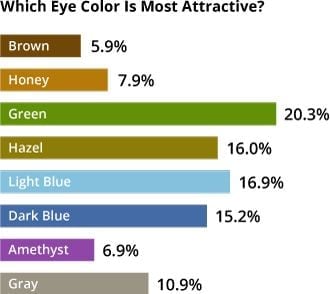
- Green: 20.3%
- Light blue: 16.9%
- Hazel: 16.0%
- Dark blue: 15.2%
- Gray: 10.9%
- Honey: 7.9%
- Amethyst: 6.9%
- Brown: 5.9%
Preferences vary for everyone, though. What you find most attractive may differ from a friend or colleague’s opinion.
2. Certain lighting can change the way green eyes look
Light is an additional factor that influences the determination of eye color, particularly in distinguishing between different shades of green eyes and blue eyes. Due to Rayleigh scattering, the colors reflected by the iris depend not only on the amount of pigment in the iris but also on the angle, color and intensity of the light rays shining on the iris.
Depending on these variables, eyes can appear to be different colors.
3. There are many variations of green eye color
“Green” is not just one color. There are several variations of green that people can have. It depends on the amount of melanin and light scattering. The more melanin you have, the darker your green eyes will appear.
Depending on the structure of the iris and the distribution of melanocytes within it, some eye colors can be difficult to categorize.
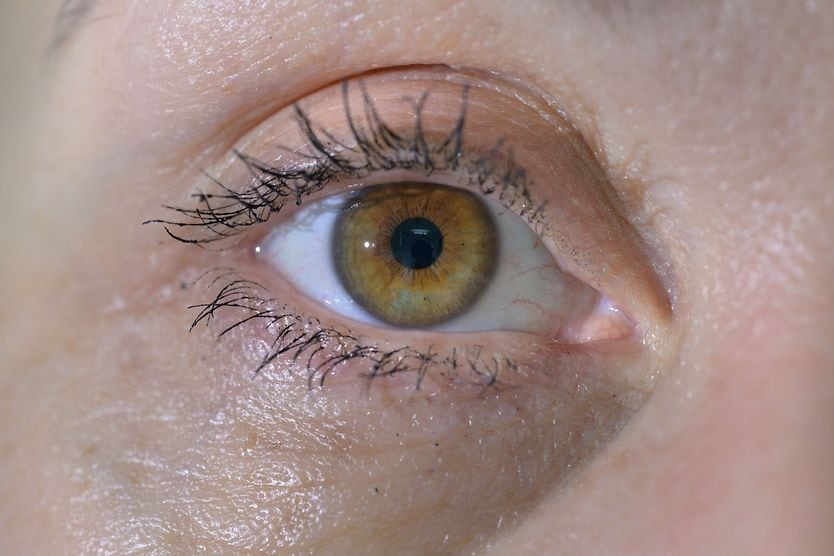
For example, some “green” eyes may have a crown of hazel or brown near the pupil, making them appear hazel at times and green at other times. It can depend on lighting, makeup and the color of clothing a person wears.
4. Green eye color can affect your eye health
Green eyes may come with some health implications.
One study found that those with lighter colored eyes may have a higher risk of skin cancer. This would include blue-eyed and green-eyed individuals. Blue-eyed and green-eyed people may also have a higher chance of developing eye cancer.
People with lighter green eyes may experience more light sensitivity as well. Green eyes have less melanin pigmentation. And with less pigmentation in your eyes, it’s harder to block bright sunlight or fluorescent light. Whether you have light sensitivity or not, wear proper sun protection outdoors. Additionally, practice good eye care by having comprehensive eye exams.
Celebrities with green eyes
Here are some actors, singers and other public figures who are known for their green eyes:
- Adele
- Daniel Day-Lewis
- Terrence Howard
- Kate Hudson
- Scarlett Johansson
- John Krasinski
- Kate Middleton (Catherine, Princess of Wales)
- Joaquin Phoenix
- Eddie Redmayne
- Rihanna
- Smokey Robinson
- Paul Rudd
- Kristen Stewart
- Emma Stone
- Channing Tatum
- Charlize Theron
Enhancing your eye color
If you have naturally green eyes and you wear eyeglasses, lenses with anti-reflective (AR) coating can help showcase your green eye color. AR coating helps to reduce distracting reflections in your eyeglasses, allowing others to see the beauty and expressiveness of your eye color.
If you really wish you had the appearance of green eyes instead of the eye color you were born with, one option is to wear color contact lenses. Several brands and shades of green contact lenses are available, including lenses without corrective power.
Be aware that colored contact lenses are medical devices, even if they don’t have any vision-correcting power. You’ll need a proper contact lens fitting and a contact lens prescription from an eye doctor to buy them. As a reminder, it is illegal in the United States to purchase color contact lenses without a valid contact lens prescription from an eye doctor.
Whatever color your eyes may be, they are truly unique and can never be replicated. Like snowflakes, the features of each and every eye are different and, therefore, magnificent — no matter what color your eyes are.
READ MORE: Amber eyes: Rare and striking