Does PMOS cause dry eye disease? What the research is telling us
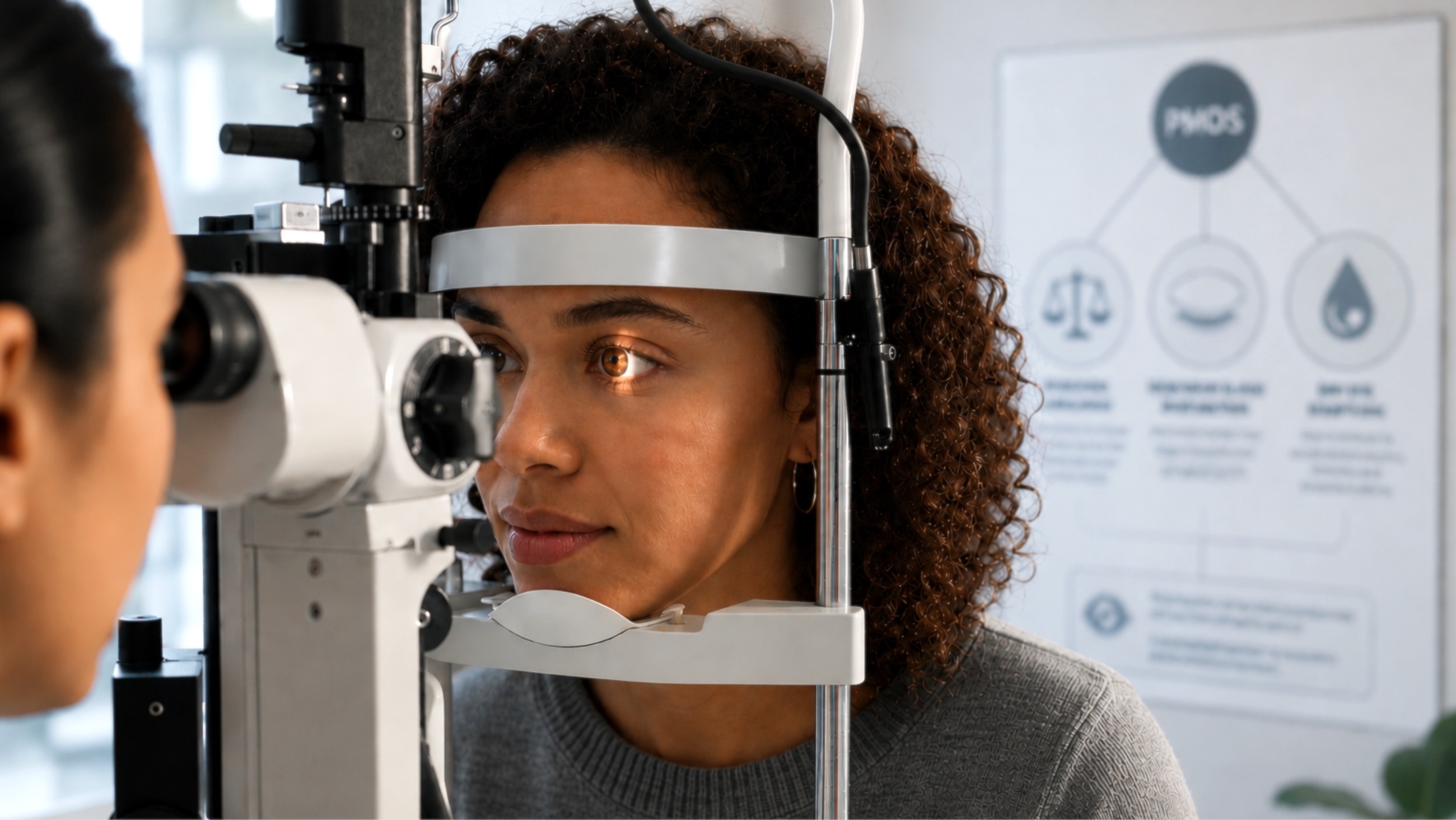

One letter made a big change in women’s health. A May 2026 landmark paper published in The Lancet officially renamed polycystic ovary syndrome, long known as PCOS, to polyendocrine metabolic ovarian syndrome, or PMOS. The new name is the result of a 14-year global effort involving 56 academic, clinical and patient organizations, and more than 14,000 patient and health professional surveys worldwide.
The old name was misleading because it focused on the ovaries and cysts, when the reality is much broader, the authors said. PMOS is a complex, long-term hormonal condition affecting metabolism, heart health, mental health and skin. Research increasingly indicates it may impact the eyes.
Specifically, the same hormonal disruption that defines PMOS appears to be linked to dry eye disease (DED), one of the most common eye conditions. Both affect women more than men and often go undetected.
A condition bigger than its name
PMOS affects about one in eight women worldwide. That’s roughly 170 million people, with an estimated five to six million women of reproductive age in the United States. But despite those large numbers, about one-third of women with the condition wait an average of two years or more before they get a diagnosis, often having to see multiple doctors along the way.
PMOS also tends to run in families. Twin and family studies point to a strong inherited component and researchers have identified gene variants involved in how the body handles insulin and androgens. Genetics alone though don't tell the whole story, since early-life and metabolic factors appear to matter too.
The old name didn’t help. Polycystic ovary syndrome implied that ovarian cysts were the problem, which defined it primarily as a reproductive condition. However, many women with PMOS don’t have cysts, and symptoms can reach far beyond the ovaries.
At its core, PMOS is a hormonal regulation problem involving androgens, often called male hormones, even though women produce and need them, too. The imbalance is typically an excessive level of androgens (called hyperandrogenism), which may affect multiple organ systems. This can result in symptoms, such as irregular or no menstrual cycles and, often, insulin resistance, causing imbalanced blood sugar. Chronic, low-grade inflammation affecting tissues throughout the body is a hallmark sign of PMOS.
The new name of polyendocrine metabolic ovarian syndrome more accurately reflects this condition. “Polyendocrine” means it involves multiple hormone systems, and “metabolic” recognizes PMOS’s impact on blood sugar, weight and heart health.
Ovarian function is still part of the picture, but no longer the whole story. Supporters say the new name will help more women get diagnosed sooner, reduce the stigma and open doors to new research, including what PMOS may be doing to the eyes.
Can PMOS cause dry eyes?
Dry eye disease is a chronic condition where the eyes either don’t produce enough tears or make tears that dry up too quickly, leaving the surface of the eye uncovered and unprotected. It might feel like you have grit in your eyes or they might get red, itchy, blurry, burn or hurt from wearing contact lenses.
People often have symptoms for years, seeking treatment only when they get worse. Beyond the discomfort caused by dry eye disease, it can interfere with everyday tasks such as reading, driving at night and heavy digital screen use. The condition can lead people to struggle with tolerating contact lenses. For women in school or early in their careers, when PMOS is often diagnosed, these effects can add up.
About 16 million Americans have been diagnosed with dry eye disease. Women are affected more than men, which is why hormones are believed to be the root cause — primarily affecting the meibomian glands. With each blink, the row of tiny meibomian glands that line the edges of the upper and lower eyelids releases a thin layer of oil that coats tears and slows evaporation.
When they work, tear film stays stable and keeps the eyes comfortable. But when they don’t (a condition called meibomian gland dysfunction), the oil layer breaks down, tears dry up too fast and the eye surface becomes dry and inflamed.
These glands are highly sensitive to hormonal signals. Research shows that androgens — those same hormones that impact PMOS — may play a role in how meibomian glands work, though it's not yet fully proven.
How PMOS may affect the eyes
With PMOS, the problem occurs when androgen activity is dysregulated. Levels may be too high, signals get crossed and the body’s systems that depend on hormonal balance, including meibomian glands, can be impacted.
A 2025 study in Scientific Reports looking at tear function in women with different forms of PMOS found that, compared to healthy women, those with PMOS had less stable tear films, higher dry eye symptom scores and more meibomian gland dysfunction. The differences were greatest in women with the most complex hormonal profiles.
Chronic inflammation in PMOS adds to the problem because the same inflammatory state that runs through the body drives inflammation at the eye’s surface, which can damage the very glands and tissues the eye needs for tear production.
Hormone-based treatments used in PMOS may themselves affect the ocular surface. Some early reports describe meibomian gland changes in women taking estrogen-progesterone therapy, so it's worth telling your eye doctor about any hormonal medications you use. The evidence is still limited, so letting your eye doctor know can help guide them in providing appropriate treatment options.
An earlier and often-cited 2007 study, published in the American Journal of Ophthalmology, reported eye surface changes in a high number of PCOS patients who already had eye symptoms. Recent research continues to build the connection case between PMOS and dry eye disease, but scientists note that more data is needed.
Giacomina Massaro-Giordano, MD, knows this subject well. She’s a professor of ophthalmology at NYU Grossman School of Medicine and director of the dry eye service at NYU Langone Health. In 2015, she co-wrote what is still considered the most direct academic paper looking at what PMOS does to the eye’s surface.
More than a decade later, Dr. Massaro-Giordano is thinking carefully about what the research does and doesn’t tell us.
“There is something to suggest that if the meibomian glands are affected over time, it creates more inflammation on the surface of the eye that starts to affect the lacrimal glands,” she explained, referring to the glands responsible for producing the water in tears.
“The tear film is very complex. It has a water layer, a mucous layer and an oil layer. The one that is believed to affect women with PMOS first is that oil layer. But over time, the oil and water layers become intertwined.”
Dr. Massaro-Giordano also raises something she says the research is just beginning to examine. It’s possible that women with PMOS may experience eye discomfort more intensely than clinical measurements alone would suggest.
“The woman’s eyes might not look dry when I examine them,” she said, “but they feel drier than what I can see. I think we need to look at whether their nerves are hypersensitized because these women are often in pain throughout their bodies. It’s my feeling from seeing a lot of patients with neuropathic pain that their actual corneal nerves may become abnormal over time.”
Dr. Massaro-Giordano said she is planning a study at NYU using wide-field microscopy to look at corneal nerve structure in PMOS patients, research that could begin to answer questions no one has formally investigated yet.
The clinical blind spot
The PMOS-dry eye disease link is a clinical blind spot that works both ways.
Women with PMOS typically see gynecologists and endocrinologists who are focused on reproductive health, hormone levels and metabolic markers. Eye health questions are not usually on their intake forms. On the flip side, eye doctors rarely ask patients about their hormonal history or menstrual cycles, even though that information could meaningfully change how they interpret what they’re seeing and help connect the dots to PMOS.
Cecelia Koetting, OD, an optometrist and assistant professor at the University of Colorado, Anschutz, focuses on ocular surface and dry eye disease and has actively been working to change that in her own practice.
“There’s a misconception that dry eye is primarily a disease of older, postmenopausal women,” she said. “Digital device use and environmental factors absolutely play a role. But when a younger patient presents with significant symptoms that seem disproportionate to what you’d expect, it prompts a broader conversation.”
That’s when Dr. Koetting says she starts thinking about their whole body health and not just the eyes. Hormonal health, autoimmune disease, inflammatory conditions, medications, gut health, sleep quality and lifestyle factors can all contribute, she said. That’s why related questions are intentionally a routine part of her intake because sometimes, the eyes are one of the first places systemic imbalance shows up.
“I ask about menstrual irregularities, pregnancy, menopause, hormone replacement therapy, acne medications, other endocrine factors and PCOS, now PMOS, specifically because hormones can significantly influence tear film stability and meibomian gland function,” said Dr. Koetting. As science has evolved, she’s added these questions to her exams. Dr. Koetting would like this to become standard for all practitioners.
Dr. Massaro-Giordano describes the gap from the other direction.
In building her interdisciplinary dry eye center at NYU, she has pulled in rheumatologists, endocrinologists, pain specialists and allergists. But the hormonal piece remains harder to bridge.
“I’ll tell patients I feel they have a hormonal component and ask them about other manifestations of PMOS,” she said. “Oftentimes, they say they haven’t seen anyone beyond their regular gynecologist. We need people who are subspecialized in evaluating the full hormonal picture for women. And that doctor, who would work closely with me to exchange information about what’s happening in the body and what’s happening in the eyes, just doesn’t exist yet.”
Treatment and what helps now
There is no established treatment path specific to PMOS-related dry eye disease. But that doesn’t mean women are without options. It means treatments have to be layered.
The first treatment approach is the same for most dry-eye patients: preservative-free artificial tears, regular eyelid hygiene, warm compresses (this helps the meibomian glands release their oils), omega-3 fatty acids supplementation and avoiding triggers, like fans, dry air and prolonged digital screen time without blinking. These simple daily habits form the backbone of managing meibomian gland dysfunction.
When those aren’t enough, eye doctors can prescribe eye drops, intense pulse light (IPL) therapy or automatic thermal expression treatments that help clear blocked glands. Several prescription therapies are also Federal Drug Administration (FDA)-approved for dry eye disease and may be considered when over-the-counter measures fall short:
- Anti-inflammatory drops – cyclosporine and lifitegrast
- Corticosteroids – loteprednol
- Enhanced lubricants – perfluorohexyloctane (a water-free drop that targets the tear evaporation linked to meibomian gland dysfunction)
- Intranasal spray – varenicline prompts the body's own tear production and can be convenient for contact lens wearers.
Unlike the compounded hormonal options discussed below, these are approved treatments, though none is a cure and the right choice depends on an eye doctor’s evaluation.
The goal is always to treat early before gland changes become permanent. Once meibomian glands are lost, they don’t regrow, which makes early detection important.
When appropriate, it’s important to treat the underlying PMOS. Keeping inflammation in check, managing blood sugar levels and balancing hormones can support eye health. Researchers are working to understand exactly how routine monitoring can help dry eye disease, specifically for women with PMOS.
Some treatments showing early promise are being studied and not yet widely available. Topical androgen therapy and compounded topical spironolactone drops (which adjust hormone activity at the surface of the eye) are showing potential for hormonally-driven dry eye. But both require special compounding by a pharmacist, are not FDA-approved treatments and are not yet considered standard care. Speak with your doctor to learn more before pursuing them.
Researchers are studying metformin and GLP-1 medications, used to treat insulin resistance in PMOS, for their possible effects on meibomian gland cells. These are not established treatments, only areas of active research.
“Early detection, imaging of those glands, early conversations with an endocrinologist, gynecologist or primary care doctor, just to make sure the body’s in an anti-inflammatory state and hormone levels are balanced – that’s where we are right now, ” said Dr. Massaro-Giordano.
What technology could make possible
Researchers are exploring whether advances in ocular imaging might serve as an early warning system for hormonal imbalance in the eye to see changes before symptoms become severe. These include AI-assisted analysis of meibomian gland structure and tear film quality.
Dr. Koetting is pragmatic about where this stands today.
“Could AI eventually help identify subtle ocular surface changes earlier? Possibly,” she said. “As these technologies improve, they may help us recognize patterns or risk factors sooner. But right now, I don’t think we’re at the stage where AI can reliably serve as an early warning system, specifically for PMOS-related ocular disease in routine clinical practice.”
Dr. Massaro-Giordano sees potential further down the road, perhaps identifying specific tear film markers or inflammatory proteins that are characteristic of PMOS-driven dry eye. It’s similar to how a blood test can flag a hormonal imbalance.
“I’m hoping that in the future, we can get a small sample of tears and find the markers for PMOS,” she said. “Maybe it can help diagnose or confirm, and then at that point, we know what to do to prevent things from getting any worse.”
The bottom line
Right now, it can’t be said for sure that PMOS causes dry eyes. Current research can only make an association. But the biological reasons are becoming clearer. The same hormonal imbalance, chronic low-grade inflammation and insulin resistance that define PMOS are being linked to impairing the glands responsible for keeping the eye surface healthy.
Whether women with PMOS are destined to develop dry eye disease is not yet known. “Many people live with their symptoms. They think they’re a nuisance,” said Dr. Massaro-Giordano. “They have larger systemic issues going on, and they think, ‘I just have to live with this foreign body sensation.’”
But she says it’s important to be aware of your eyes.
“If you’re having any of these symptoms, bring them up with your primary care doctor, your endocrinologist or your OB-GYN. And if they don’t listen, go see an ophthalmologist. We’ve come a long way with testing, and many doctors will figure out where your dryness is coming from. There are medicines to treat it. Do not live with these symptoms. It’s not normal to feel your eyes,” said Dr. Massaro-Giordano.
Dr. Koetting gives similar advice.
“Don’t dismiss the symptoms as ‘normal’ or assume it’s only from screen time. Persistent burning, irritation, fluctuating vision, excessive tearing, redness or contact lens intolerance are worth discussing with an eye care provider. At the eye appointment, patients should mention their PMOS diagnosis, any hormonal therapies, medications and any systemic symptoms they’re experiencing,” she said.
Since PMOS often affects younger women who are more likely to wear contact lenses, difficulty tolerating lenses could be an early warning sign of underlying dry eye.
Request a comprehensive ocular surface evaluation, including meibomian gland assessment. And at the gynecology or endocrinology visit, mention ongoing dry eye symptoms, said Dr. Koetting.
“Ask whether hormonal fluctuations, medications or systemic inflammation could be contributing. Even if the connection isn’t fully understood yet, bringing these symptoms into the conversation helps create a more complete picture of overall health,” she added.
Researchers and clinicians agree that change begins with important conversations about PMOS with multiple care providers. With a new name that more accurately reflects the reach of PMOS and a growing body of science to back it up, those discussions could become easier to have.