Guide to buying low vision magnifiers
It's tough enough to have low vision. But how do you decide which magnifier you need, and in what circumstances? This guide can help.
If you are among the growing numbers of people with low vision, you may find that a low vision magnifier can assist with tasks such as reading fine print, sewing or viewing classroom presentations.
Increased demand for low vision devices means many more choices are becoming available. More than 3.3 million Americans older than 40 already have blindness or low vision — and that number is expected to increase to 5.5 million by 2020.
If you need a low vision magnifier, consider visiting a low vision specialist for expert guidance in ordering just the right device for your specific needs, especially if you already have substantial vision loss.
A low vision specialist will ask preliminary questions such as:
- If you are older, do you have memory loss and a decline in cognitive function? If so, you probably need to stick with less complex devices.
- Do you drive and want to continue driving? Some states allow individuals to use a bioptic telescope for reading signs and seeing traffic lights, but an evaluation by a low vision clinician is required to see if you are a candidate for this option.
- Do you have an occupation or hobby that requires you to see fine detail? If so, devices that provide greater magnification might be more helpful for you.
Before buying a low vision magnifier or consulting with an expert, take the time to explore the array of choices available in lenses, video camera magnifiers and lighting.
Think carefully about your goals, your budget and what features various devices offer so that you can communicate your needs.
Types of low vision magnifiers
Just as some people with a disability need a wheelchair or a hearing aid, a person with low vision needs extra help beyond what ordinary eyeglasses or contact lenses can provide.
"If you have low vision, you should understand that there are no magic glasses," says vision rehabilitation specialist Mary Lou Jackson, MD, of the Harvard School of Medicine affiliate Massachusetts Eye and Ear Infirmary in Boston. Dr. Jackson also is chairperson of the American Academy of Ophthalmology Vision Rehabilitation Committee.
Eyeglasses usually can correct refractive errors such as nearsightedness and farsightedness. But, notes Dr. Jackson, ordinary lenses don't work for permanent blind spots (scotomas) in your visual field, caused by common eye diseases such as age-related macular degeneration (AMD).
Even so, different configurations of magnifiers and video camera magnifiers may at least partially compensate for the part of the visual field where blind spots have caused vision loss.
Be aware that one size does not fit all when it comes to low vision devices. Dr. Jackson says that a particular kind of magnifier helpful to someone with peripheral vision loss, for example, might not work at all for someone with central vision loss.
So avoid rushing to buy an expensive device for yourself or a family member without doing some checking first. Finding the ideal low vision device is a very individual choice, depending on specific vision loss and needs.
Low vision magnifiers are available in these general categories:
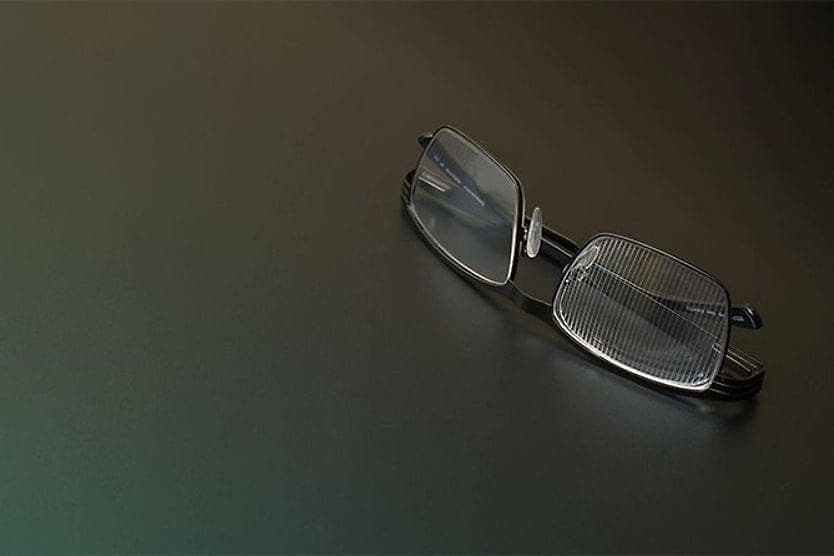
- Low vision reading glasses
- Magnifiers mounted on eyeglasses
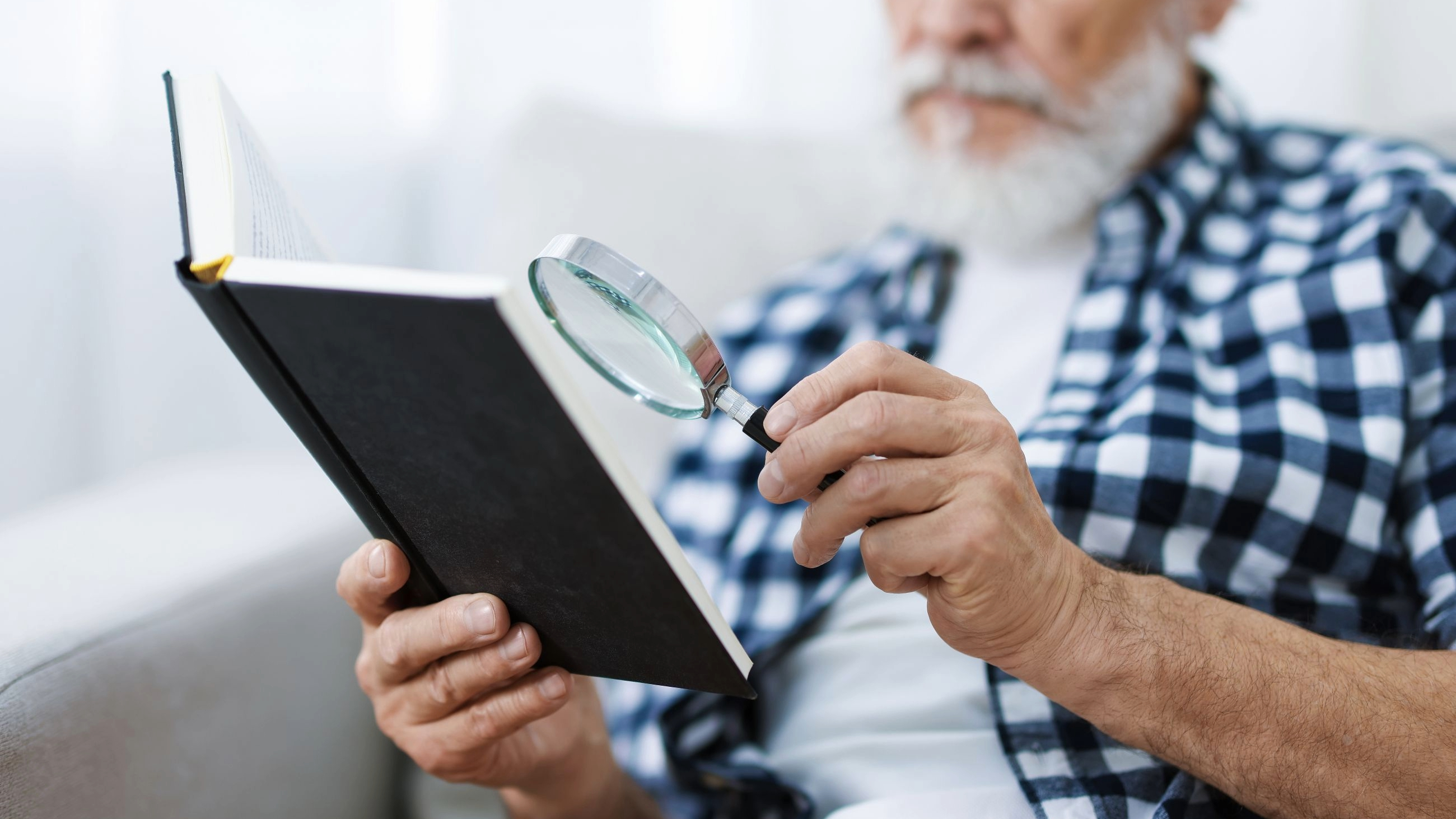
- Handheld or stand magnifiers
- Video camera magnifiers
- Telescopes
Start your search for the right device by assessing what specific types of low vision magnifiers are available and what each device can — and cannot — do for certain types of vision loss.
SEE RELATED: Magnifying glasses
How can magnifiers aid low vision?
As we grow older, some degree of low vision may be inevitable, depending on how long we live. This is because aging itself leads to slow degeneration of the light-sensitive cells in your retina, where vision processing occurs.
Magnification is needed when you start experiencing vision loss in the central part of your retina called the macula, the area of the eye capable of seeing small letters. A magnifier enables you to compensate somewhat for a damaged macula by helping you use more of the healthy retina surrounding the damaged area to create visual images.
Certain eye injuries also can permanently damage eye structures essential for sharp vision.
Advanced macular degeneration — a common cause of low vision — can create a blind spot in central vision. This means you can still see better around the edges of your field of view, but you would need a device to help magnify what you see. A video camera magnifier can be adjusted to provide just such magnification.
Also, Dr. Jackson explains that people can have blind spots in different parts of the visual field. This means a blind spot can be to the right or left, or it can be shaped like a doughnut.
"This is why the optimal magnifier is different for different people," she says. "Every device has advantages and disadvantages. We don't prescribe a device. We have people choose a device that suits their goals and their requirements. And we make sure we show them alternatives."
Your eye condition also may cause vision problems that are not detected by simply testing with a standard eye chart. This means it could be difficult for you to see objects against backgrounds of similar colors, meaning loss of contrast sensitivity. You also could develop a color vision deficiency or loss of night vision.
To enhance your ability to see in contrast, you will need to address lighting and perhaps try out different color displays on desktop video camera magnifiers. As an example, Dr. Jackson says the contrast on computer and video camera magnifiers can be modified to display white letters and characters against a black background.
Which magnifiers work in different circumstances?
Different types of low vision devices also can help in different circumstances:
- A student might need a camera-like telescopic device attached to a portable video camera magnifier to capture an image at the front of the classroom. That image then can be enlarged on a monitor on the student's desktop.
- A mechanic might benefit from a magnifier mounted on prescription eyeglasses, so that hands remain free to work.
- A handheld magnifier is portable and easy to use when needs are simple. As an example, handheld magnifiers are ideal for checking product labels at the grocery store or quickly looking over the mail.
"There is a lot of confusion about the size of devices and the power they have," says Lylas G. Mogk, MD, founding director of the Visual Rehabilitation and Research Center of the Henry Ford Health System in Detroit.
"Often people will say, 'Well, this one is a 3x and that one is a 6x. So I want the one that's a 6x.' But the disadvantage of magnifiers with higher power is that you then see a much smaller area," she says. "As a general rule, you want the magnifier with the least power you can get away with, in exchange for the largest area you are able to see."
If you are an avid reader, you will find that simple magnifiers are inadequate to help you sustain the concentration needed for an extended time period.
A small, handheld magnifier greatly enlarges a few words or sentences on a page. But reading something like a novel requires an expanded field of view and the ability to scan ahead in order to see and process information quickly.
Another limitation of handheld magnifiers is that they can't be used for task-specific activities such as knitting, which requires both hands to be free. In this case, you would need a magnifier on a stand that can be easily positioned where you need it.
If you are buying a handheld magnifier or a magnifier on a stand, you might be interested in extra features such as:
- Built-in lighting that can help you see.
- "Gooseneck" attachments in stand magnifiers that can be easily moved and adjusted to whatever position you need.
- Various lenses and powers in the same device, so you achieve just the right magnification at the precise distance you need.
Also, you may think high-powered reading glasses are the best solution for all your needs. But these types of low vision glasses limit you to seeing objects at a fixed distance that could be less than a foot from your nose.
"You need to ask yourself what you are going to do with a device," says Dr. Mogk. "For instance, you can't use high-powered glasses for seeing cards on the card table or chopping up vegetables."
Dr. Mogk says the optimal reading tool for virtually anyone with vision loss is a video camera magnifier. These devices use video cameras that focus on items of your choice and then magnify them on a screen or monitor.
Dr. Jackson also agrees that, if you eliminate the cost factor, video magnifiers using video camera magnifier technology may have the least downside of any currently available reading devices.
(Note that some manufacturers and low vision eye doctors still refer to video camera magnifiers as closed-circuit TV or CCTV devices. However, that term is increasingly associated only with security systems and is less often used now in the low vision field.)
Some features to look for in video camera magnifiers include:
- Autofocus
- Color and black-and-white displays
- Ergonomics allowing ease of use
- Glare and contrast control
- Compatibility with computers and computer screens
- Screen size that meets needs
- Portability
- Memory settings
With video camera magnifier technology, people may benefit from glasses that focus at this intermediate distance. So to enhance viewing, Dr. Mogk sometimes advises patients to try clip-on lenses with near vision correction applied to regular eyeglasses.
Bioptic telescopes require considerable concentration and quick reaction times for driving, which means they aren't for everyone. Each state specifies whether such devices can be used and — if so — what level of vision is required to be a candidate for this device.
"Some of these high-end telescopes that are commonly prescribed may be ideal for students and young people. But you are not going to put these on someone who is 85," says Dr. Mogk. "There's only a niche market for them. They are not broadly applicable, but they are sometimes marketed as being broadly applicable."
Dr. Jackson said telescopes clearly are an advantage for magnifying objects that are far away, in the same way that bird watchers and opera fans use binoculars.
"But all telescopes decrease the area you see, and they all decrease the light," says Dr. Jackson. "So if you have poor contrast sensitivity to begin with, you could have a lot of trouble looking through a telescope."
Television viewing is the most common use for telescopes, when people prefer not to move closer to the screen for a better view.
How to find low vision magnifiers
Now that you are informed and ready to buy a low vision magnifier, where can you go to see what's available?
Dr. Mogk suggests that, if you are going to spend more than $500 for a low vision device, it would be well worth your time and money to consult with a low vision expert who can advise you. Also, a specialist likely is associated with a dealer or can refer you to a reputable outlet.
With some devices, Dr. Jackson says it's essential that you get some training so you understand how to put features to their optimal use.
If you do plan a large expenditure and you are determined to do it yourself, then consider finding a low vision device outlet where you can:
- Visit and try out more expensive devices before committing to a purchase.
- Return the device for a refund within a reasonable time period if you find it doesn't work for you.
- Obtain a warranty enabling replacement or repair if something goes wrong with the device.
You also can review low vision devices by asking your eye doctor or other outlets for catalogs.
Many low vision devices also are advertised online. In this case, make sure you are dealing with a reputable outlet.
"In general, buy a magnifier from a company that has been around for a while," says Dr. Jackson.
What do low vision magnifiers cost?
In some cases such as for digital screen viewing, you may not need to make an extra investment if you already have a good computer and monitor. Depending on the software and equipment you have, you can use built-in magnification features to zoom in on text or adjust screens to increase contrast.
Also, low vision features increasingly are offered in other devices.
For example, some smartphones allow magnification, contrast adjustment and voice output. A smartphone application called "Eyeglasses" magnifies hard-to-read fine print when you hold the device against labels or other printed materials.
So if you already have a smartphone, you may already have access to simple magnification without needing to buy something else.
Dr. Jackson outlines general cost ranges for different devices (as of 2026):
- Video magnifiers, $500 to $3,500 (optimal values start at $1,500)
- Handheld monocular telescopes, $30 or more (optimal values start at $100)
- Bioptic telescopes, $1,500 to $6,000 (optimal values start at $2,500)
- Handheld or stand magnifiers, $5 to $175 (optimal values start at $30)
- Low vision reading glasses, $15 to $200 (optimal values start at $25 over-the-counter)
- Simple clip-ons, about $20
Coverage for low vision devices is limited. Original Medicare generally excludes any device that uses a lens to aid vision or provide magnification, with narrow exceptions for patients who have had a lens surgically removed.
Most private insurance plans follow a similar approach, though some Medicare Advantage plans now offer allowances toward magnifiers and other adaptive devices — check your plan's Summary of Benefits. Medicaid coverage varies by state and may cover some aids.
However, Dr. Jackson says that some programs for the financially disadvantaged sometimes will help defray the costs of an assistive device.
"All states have state societies for the visually impaired," says Dr. Jackson. "There are also a growing number of sources for secondhand devices."
Other potential sources of financial assistance for low vision devices include charitable and veterans' organizations.
Ophthalmology and optometry organizations also have membership listings that specify low vision specialists who might be available in your area.
Michelle Stephenson and Diane Donofrio Angelucci also contributed to this article.