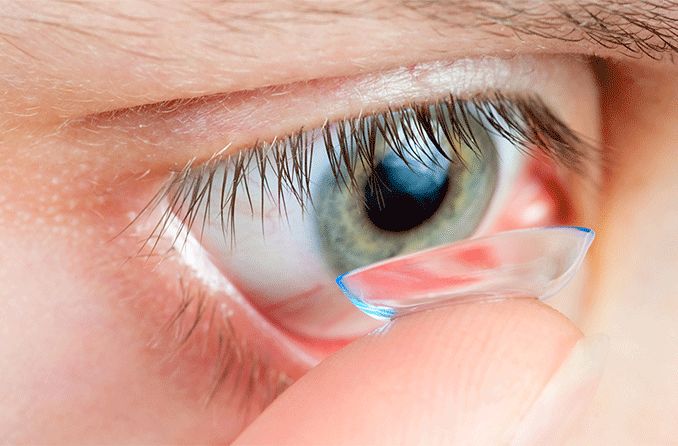
What are multifocal contact lenses?
As we age, presbyopia makes it harder to focus on close-up objects. In the past, presbyopic contact lens wearers were limited to wearing reading glasses with their contact lenses or correcting one eye for distance and one for near vision (called monovision).
Now, there are many options for multifocal contact lenses. Multifocal contacts offer many advantages — no glasses, along with a balance and smooth transition from distance to near vision.
They are available in different materials, including:
- Soft lenses – Offer comfort for part-time or full-time wear and are available in disposable options.
- Rigid gas permeable (RGP or GP) lenses – Provide sharper vision but require daily wear for comfort, and are not available in disposable options.
- Hybrid lenses – Give the clarity of gas permeable contacts and the comfort and easy adaptation of soft lenses.
Multifocal contacts are designed for daily wear or extended (overnight) wear. For the ultimate in convenience, one-day disposable soft multifocal lenses allow you to throw them away at the end of a single day. This means there’s no hassle with lens care.
How do multifocal contact lenses work?
A well-designed multifocal contact lens spreads light in a way that supports clear vision at various distances. Some multifocal contact lenses have a bifocal design. They have two lens powers — one for your distance vision and one for near.
Other lenses have a multifocal design similar to progressive eyeglass lenses. They shift lens power gradually, creating a natural flow from distance vision to close-up.
Whatever option you choose, multifocal lenses can simplify daily life. They help when switching from close-up tasks to viewing things far away.
Multifocal contact lens designs
Multifocal contact lenses have different designs. Each one helps you see at various distances.


Simultaneous vision designs
In this multifocal design, the lens has different zones. Some zones help with far vision, while others focus on near vision. Sometimes, there are also zones for intermediate vision. Full-time wear allows the brain to comfortably switch focus between near/far zones.
There are two types of simultaneous vision designs:
Concentric multifocal contact lenses
These multifocal contacts have a primary viewing zone in the center of the lens. This area is surrounded by concentric rings (circles within circles) of near and distant powers. The central viewing zone is usually for viewing distant objects. This is known as a center-distance design.
However, center-near designs are also available. In some cases, a center-distance design is used for the wearer’s dominant eye. Meanwhile, a center-near design is used for the non-dominant eye.
Aspheric multifocal contact lenses
These multifocal contacts work like concentric multifocal lenses. However, instead of having distinct rings for distance and near vision, the power shifts smoothly. It changes from distance to near (or vice versa) from the center to the edges of the lens. In this regard, aspheric multifocal contact lenses are designed somewhat like progressive eyeglass lenses.
Segmented multifocal designs
Segmented multifocal contact lenses (sometimes called translating multifocal contacts or alternating multifocal lenses) have a design that’s very similar to bifocal and trifocal eyeglass lenses. These lenses feature a distance vision zone at the top and center. The bottom half is designed for near vision. The distance and near zones are separated by a visible line in the lenses.
Segmented multifocal contact lenses are made of rigid gas permeable (GP) contact lens material. These lenses are smaller in diameter than soft contact lenses and rest on a layer of tears above the margin of your lower eyelid. When you look down to read or see nearby objects, a segmented multifocal contact lens stays put. This lets you see through the lower part of the lens, which is made for close-up vision (see illustration).
Segmented trifocal GP contact lenses are also available. They include a small, ribbon-shaped segment for intermediate vision between the distance and near zones.
Astigmatism
In the past, soft multifocal contact lenses could not correct astigmatism. If you had astigmatism, your only choice in multifocal contact lenses was rigid gas permeable lenses.
Today, soft multifocal contacts can also correct astigmatism by using a toric lens design. The lenses align on the eye by using unequal thickness zones. This creates a prism ballast effect, much like what you see in a translating GP multifocal.
Hybrid multifocal contact lenses also correct most types of astigmatism.
Monovision
You won’t know if you can adapt to multifocal contact lenses until your fitting. If multifocal lenses aren’t comfortable or don’t provide clear vision, try a monovision contact lens fitting. It might be a better option for you.