How to prevent eye injuries


Experts say more than 90% of eye injuries can be prevented by wearing safety glasses and taking other important precautions.
Eye injuries don’t just happen in “high-risk professions.” If you use a lawn mower, leaf-blower, drill or similar power tools, you need protective eyewear.
Safety glasses should have a snug, wrap-style frame. This decreases the likelihood that a small particle finds its way around the edge of the frame and into your eye. If you wear corrective lenses, hardware stores sell inexpensive goggles that will usually fit over your glasses.
Workplace eye safety programs
The Occupational Safety and Health Administration (OSHA) provides workplace guidelines. Certain professions are required to follow protective eyewear and emergency eye care recommendations.
The following video explains how to prevent eye injuries at home, at work and while playing sports:
OSHA has guidelines that could apply to your workplace, such as for:
- Eye and face protection
- General industry standards
- State plans
- State plan publications and training materials
Employers may be required to provide prescription safety glasses to employees who need corrective eyewear. They may also provide a shield that will cover and protect the employee’s own eyeglasses. It’s possible that some types of work will require safety shields, safety glasses or both.
Be sure that you understand the risks of eye injuries at your workplace. Find the most appropriate type of safety eyewear for your job, and use it. Employers should also consult with an eye doctor who is familiar with safety eyewear programs. They can give additional insight.
SEE RELATED: Eye Safety Basics
Fireworks
An estimated 14,741 fireworks-related injuries were treated in U.S. hospital emergency rooms in 2024, according to the U.S. Consumer Product Safety Commission (CPSC). Approximately 10,585 of those injuries happened between June 16, 2024, and July 16, 2024 — around the July 4th holiday.
Firecrackers were responsible for 560 emergency-department-treated injuries. Sparklers caused around 1,779 injuries.
The CPSC's “2024 Fireworks Annual Report” also included these findings for the one-month period bracketing Independence Day:
- Males sustained 73% of fireworks-related injuries; females accounted for 27%.
- Individuals 30 and older made up 42% of firework-related injuries – an 88% increase from 2023.
- Teenagers between the ages of 13 to 19 made up 16% of firework-related injuries.
- Young adults, ages 20 to 29, contributed to 22% of injuries.
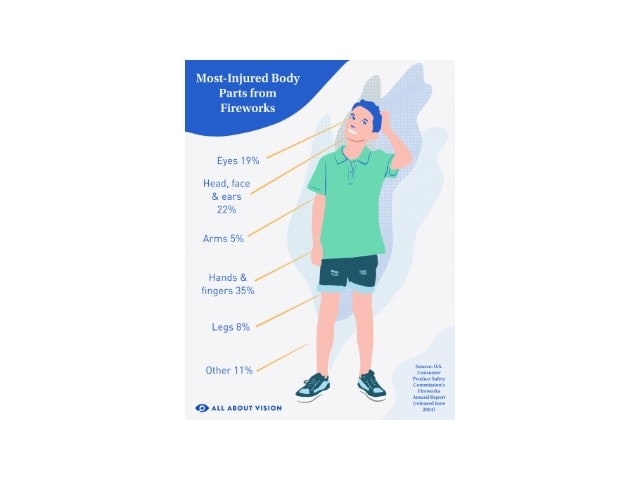
Here is a breakdown of the body parts affected by fireworks-related injuries that required hospitalization:
- Eyes, head, face, mouth and ears – 22%
- Arms and wrists – 10%
- Hands and fingers – 55%
- Legs, knees and ankles – 3%
- Trunk – 7%
- Other – 3%
The American Academy of Ophthalmology offers these safety tips for preventing eye injuries from fireworks:
- Never let children play with fireworks.
- View fireworks from at least 500 feet away.
- Only trained professionals should light fireworks.
- Don’t touch any unexploded fireworks remains. Instead, notify the fire or police department.
Eye safety and airbags
There’s no question that safety airbags in motor vehicles save lives. But some people have sustained significant injuries from them.
Though it’s possible to sustain a corneal abrasion or other eye injury from your vehicle’s airbags during an accident, you would be at risk of much more serious injuries (including eye injuries from a shattered windshield) without these safety devices when traveling at highway speeds.
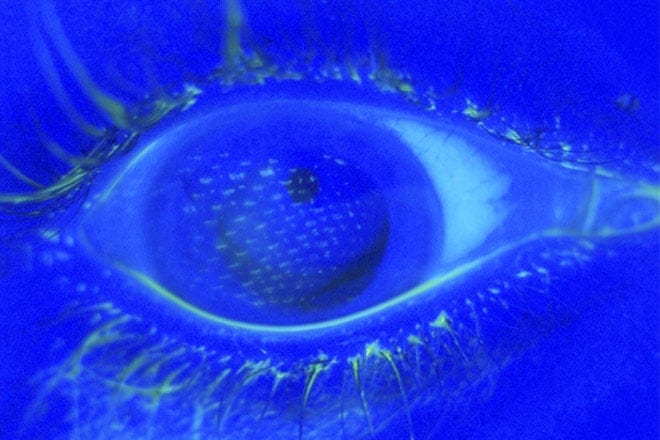
A slit-lamp exam with fluorescein dye showing corneal and conjunctival surface damage. The type of injury eye protection is designed to prevent (Image: The New England Journal of Medicine.2014).
To reduce your risk of injury to your eyes and head from airbags:
- Make sure you are wearing your seatbelt and that it’s properly adjusted.
- Adjust the headrest of your seat for proper support.
- Sit at least 10 inches away from the steering wheel.
- Don’t smoke while driving.
- Have children sit in the back seat with seatbelts and safety seats properly adjusted.
Laser pointers
Laser pointers shine a focused beam of high-intensity light. They are commonly used in presentations to highlight specific points or images.
Looking directly at the light beam of a laser pointer can cause temporary vision loss and even permanent damage to the retina. This was learned after children and young adults began purchasing laser pointers and using them as toys.
Also, laser pointers began to be used as sighting devices for paintball guns. Because of the potential for eye injuries, the U.S. Food & Drug Administration (FDA) has required laser pointers to have warning labels on packaging. The warnings must mention possible retinal damage.
SEE RELATED: Can a Flashlight Cause Eye Damage?
Champagne corks
During a celebration, you’re probably not thinking about eye damage. But a flying cork from a bottle of champagne can rupture the eye. This can cause bleeding inside the eye, a detached retina, dislocate the eye’s lens, damage the orbital bone structure and more. Serious vision loss can result from these injuries.
According to the American Academy of Ophthalmology (AAO), this happens more often with champagne and sparkling wine bottles that aren’t chilled. This is because the bubbles contain gas that expands when warm. This causes the corks to come out much faster, at speeds of up to 50 mph. It is recommended that you chill the beverages to 45 degrees Fahrenheit or colder before you open them.
To prevent eye injury, follow these instructions provided by the AAO:
- Don’t shake the bottle before opening it because this just increases the pressure inside and therefore the speed at which the cork leaves the bottle.
- Point the cork away from yourself and others while opening the bottle.
- After removing the foil, hold down the cork with your palm as you remove the wire. Do not use a corkscrew for bubbly beverages!
- Don’t push under the cork. Instead, place a towel over it, and keep your palm on the cork as you twist the base of the bottle.
Eye injuries related to paintball guns, BB guns and pellet guns
Without proper eye and head protection, people can receive devastating injuries from BB guns, pellet guns and paintball guns. Some paintball guns are capable of propelling paint pellets at speeds over 180 mph.
An important rule for paintball is this: Never take off your head shield, which should combine eye and ear protection. Commercial paintball fields require that you keep a head shield on at all times when you’re in the playing area, even when a game has not yet begun. The majority of documented paintball-related eye injuries have occurred when players removed their shields, even for just a few seconds.
Paintball injuries include traumatic cataracts, detached retinas, hyphema (bleeding inside the eye), glaucoma, orbital (eye socket) blowout fractures and rupturing of the eye. Paintball-related eye injuries can result in permanent vision loss and even blindness.
If you’re still not convinced of the importance of wearing protective gear while playing paintball, consider these statistics:
In a recent study, researchers reviewed 324 cases of eye injuries caused by non-powder toy guns, including paintball guns. Paintball-related trauma can lead to severe outcomes, often requiring multiple emergency visits per injury. Most patients were male, with an average age of 16 years, though the average age of injured children dropped to about 9 years in recent years.
The study found that paintball and similar high-pressure air guns commonly caused serious eye damage, such as bleeding inside the eye and retinal bruising. More than 6% of all cases resulted in severe vision loss, and about 8% of injuries caused the affected eye to shrink and lose function.
The common warning that you’ll “put an eye out” if you’re not careful actually can be true, particularly when you are engaged in certain types of work, home and sports activities. Unlike other parts of the body that can heal after a serious injury, your unprotected eye — and your vision — may not fully recover from certain wounds.
READ MORE: Protective sports eyewear