Color blind test: Are you color blind?


What is a color blind test?
A color blind test evaluates how well you see colors. They can help determine if color blindness (color vision deficiency) is present, but not how severe it is. Most color blind tests are for screening purposes, but more in-depth testing may be needed to determine the type or severity of the condition.
Color blind tests, also called color vision tests, can reveal if children may have trouble recognizing colors. This could be a factor in certain activities in school and at home.
These tests can also show if someone might face challenges in professions that require accurate color vision.
Screening tests for color blindness
A popular screening test for detecting the presence of color blindness is the Ishihara color vision test.
Shinobu Ishihara, a Japanese ophthalmologist, developed the test more than 100 years ago. It can quickly detect red-green color blindness (the most common color vision deficiency).
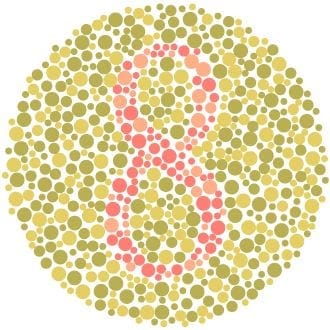
This is an example of an Ishihara plate used to screen patients for color vision problems. Someone with red-green color blindness may not be able to see the number “8” on the above plate, while someone with normal color vision would be able to see the “8.”
The Ishihara test consists of several circular images (or “plates”). Each image contains many dots of various colors, brightness and sizes.
A person who has normal color vision will be able to detect a visible number or figure “hiding” within the array of dots.
But someone with red-green color blindness won’t be able to see the number. Instead, they might see one of the following:
- A random pattern of dots
- A different figure than the one seen by a person with normal color vision
The complete Ishihara color blind test contains 38 plates. A shorter version of the test (with fewer plates) may be used during a comprehensive eye exam to screen for color blindness.
The screening takes place under normal room lighting. If you use prescription glasses, you will wear them for this test.
Once the test is complete, your eye doctor will discuss the results with you and whether a more detailed color blind test is needed.
Detailed color blind tests
A screening test may be able to detect color blindness, but a more detailed color blind test is needed to measure more accurately how severe the condition is and to test for blue-yellow deficiency (the other color deficiency). These may include ordering tests and comparison tests.
Ordering tests
Ordering tests involves arranging blocks, cards or other objects according to their colors and shades. A widely used example is the Farnsworth-Munsell 100 hue test.
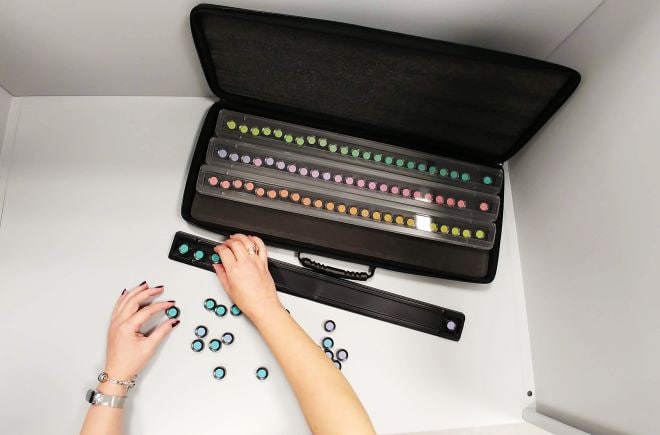
The Farnsworth Munsell 100 Hue test can be used to identify and quantify color vision problems. (Image: Gabriela P. [CC BY 4.0], via Wikimedia Commons)
This test consists of four trays containing many small disks or blocks of varying hues. Each tray has a colored reference disk on either end. You must arrange the disks in each tray to create a continuous sequence of color change.
This test should take place under room lighting that simulates natural daylight.
Each colored disk has a number on the bottom that enables the tester to compare the results against a key. This comparison helps identify the type and degree of color blindness.
A shorter version of the Farnsworth-Munsell 100 hue test — called the D15 test — contains 15 colored disks. Like the Ishihara test, the D15 test is primarily used to screen for color vision deficiencies. While the shorter Ishihara and the D15 tests are used as screening tools, both do test for severity.
Comparison tests
Comparison tests are performed with a special device called an anomaloscope. They allow for highly precise detection of red-green color deficiencies.
During this test, you will look into the device to view two fields of colored light. You will then use a knob to adjust the brightness and intensity of one field until it looks the same as the other.
SEE RELATED: What is achromatopsia?
Online color blind tests
Many color blind tests are available online. Most of these are versions or variations of the Ishihara screening test for color blindness.
Be aware that these online versions may be less accurate, depending on the color quality of your screen’s display. While they might give you a general idea of whether you have a color vision deficiency, they are not formal diagnostic tests.
For an accurate color vision testing assessment, see your eye doctor.
Who should take a color blind test?
Color vision testing may not be necessary for everyone, but it is important for certain groups of people.
Color vision deficiency is usually inherited and congenital, or present at birth. But it can also be acquired, meaning it develops later in life due to certain conditions, medications or other factors.
Color blind screening tests are especially important for young children. This is because some learning tasks in school may involve color detection or matching.
For adults, excellent color perception can be required for certain technical and manufacturing positions. It’s even more important for those considering a profession that requires perfect color vision. Possible examples include:
- Commercial artists
- Marketing professionals
- Designers
- Electricians
- Professional drivers (commercial driver’s license)
Though there’s no cure for inherited color blindness, undergoing a color blind test to screen for the condition can be very useful. Color blind tests can make you aware of any color vision problems you may have, so you can take appropriate measures to compensate for deficiencies.
In some cases, special colorblind glasses and contact lenses can help people with certain types of color blindness tell some colors apart more easily.
If you’ve noticed changes in your color vision or you believe that you or your child has difficulty seeing certain colors, contact an eye doctor to schedule an eye exam.