What to know before your first progressive lens fitting

Presbyopia: A natural part of aging
Sometime in your early to mid-40s, reading a menu or a text message on your phone may start to feel harder than it used to. The print hasn’t changed. Your eyes’ ability to focus up close has.
Presbyopia is the age-related loss of the eye’s ability to focus on nearby objects. It’s an eye condition “that everybody will develop at some point in their lives,” said Mile Brujic, OD, an optometrist at Premier Vision Group in Bowling Green, Ohio. Nearly 2 billion people worldwide are estimated to have presbyopia — making it one of the most common, and predictable, age-related vision changes adults will face.
Presbyopia is a normal, lifelong part of aging rather than a disease, and it cannot be reversed. It also tends to progress. The reading correction in your lenses usually needs to increase every few years until it stabilizes, generally by your mid-60s.
A common solution for correcting presbyopia is progressive lenses, particularly when someone also has another refractive error, such as myopia (nearsightedness), hyperopia (farsightedness) or astigmatism. Progressive lenses combine distance, intermediate and near vision correction into a single lens with no visible lines dividing the prescription zones.
Progressive lenses are one of several ways to manage presbyopia. Others include:
- Reading glasses
- Bifocal or trifocal lenses
- Multifocal contact lenses
- Monovision contact lenses
- Prescription eye drops that can temporarily sharpen near vision
- Lens-based surgery (such as refractive lens exchange or presbyopia-correcting intraocular lenses)
The optimal choice depends on your prescription, your eyes and your daily visual demands.
“Progressive lenses are by no means a ‘one-size-fits-all’ proposition,” said Viola Kanevsky, OD, an optometrist in New York City. For many first-time wearers, the outcome depends less on the lenses than on what happens before they’re ordered.
Jen Kentrup, a yoga teacher in Austin, Texas, said her transition to progressive lenses was smooth. The mild eye discomfort and headaches she experienced initially faded over several weeks. Today, she switches between her progressive sunglasses and eyeglasses without issue.
Becka Hydorn’s path was longer.
Becka wanted one pair of glasses that could handle everything, from reading a recipe on the counter to a map at a red light. Her eye doctor suggested progressive lenses.
Once she started wearing them, she noticed peripheral distortion immediately — a dizzying blur at the edges of her vision. Her lenses were remade, and she was ready to make them work. “I was hopeful,” Becka said. “I felt pretty motivated.”
She tried again for months, then switched to bifocal lenses and then to monovision contact lenses. More than six months passed before she found the right combination. Becka settled on bifocals for some situations and monovision contact lenses for others.
“Just as one might require different shoes for work and sports,” Dr. Kanevsky noted, “different lenses can be made to accommodate different tasks.”
“A lot of people buy these glasses and they don’t work on the first try,” Becka said. “It’s not cheap. It’s an investment.”
Progressive lenses: Getting the fit right
How well progressive lenses work depends on more than the lens prescription. Factors such as precise measurements, frame geometry and how you use your eyes daily all play a role.
There are also many different progressive lens designs available, ranging from basic conventional options to highly customized digital lenses. As a result, there can be significant differences not only in price, but also in technology, design features, usable viewing areas, peripheral distortion and levels of personalization.
Two roles, one outcome
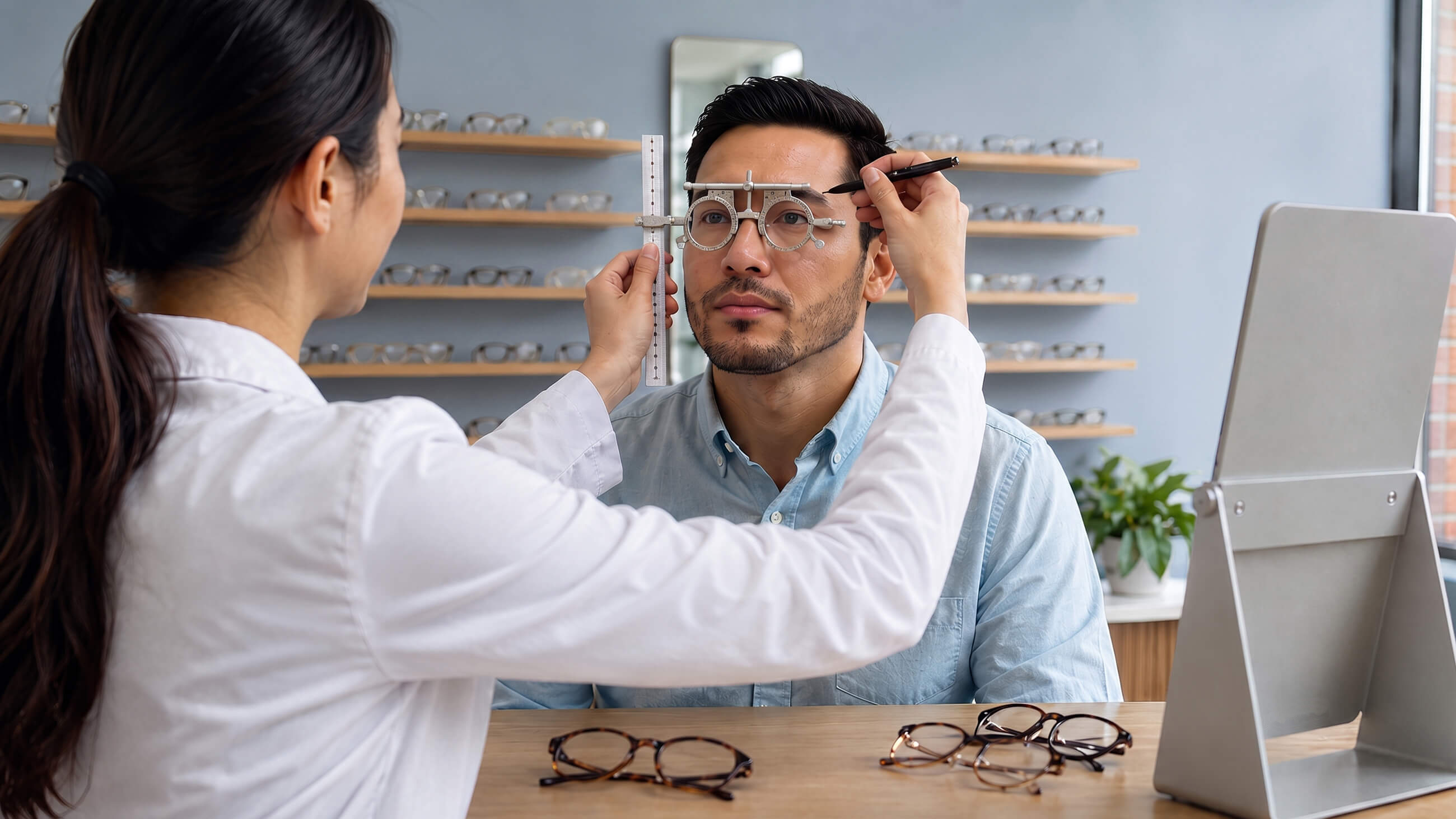
Your eye doctor examines your eyes and evaluates your vision to determine your eyeglass prescription. From there, you may work with a certified or licensed optician — a trained professional who can help you choose, fit and adjust your eyewear.
Opticians are often well-versed in lens designs, materials, coatings and current lens technologies and can help you select the options suited to your prescription, visual needs, lifestyle and frame choice. They can also explain the difference between progressive lens designs and the features offered at various price points.
The two most critical measurements for progressive lens fittings are pupillary distance and fitting height:
- Pupillary distance (PD) – The horizontal measurement from the center of one pupil to the other. For progressive lenses, PD is taken separately for each eye because the optical center must align precisely with each pupil. Even a small error here can affect visual clarity across all three viewing zones.
- Fitting (segment) height – The vertical measurement from the bottom of the lens to the pupil’s center. It helps determine where the near zone is positioned in the lens. If it’s too low, you may need to tilt your head to find the reading area. If it’s too high, the near zone may encroach upon the intermediate zone.
These measurements are best taken in person with the frame you intend to wear. Sidney Gicheru, MD, an ophthalmologist and spokesperson for the American Academy of Ophthalmology, cautioned that relying on online tools instead of an in-person comprehensive eye exam carries a broader risk. Beyond measurement accuracy, in-person eye exams can detect vision-threatening conditions, like glaucoma or age-related macular degeneration (AMD), often before symptoms appear. In rare cases, presbyopia can also develop before age 40, which may signal an underlying condition, such as diabetes or cardiovascular disease, or the use of certain medications.
Lifestyle shapes the lens
Various visual tasks demand different lens designs or geometry. For instance, a stock trader working across multiple monitors may need a wider intermediate zone. A bookkeeper might require a larger near-vision area for detailed tasks. A golfer may prefer the near-vision zone positioned lower so the ball stays in focus at address.
“For optimal success, they must be carefully prescribed after a full assessment,” Dr. Kanevsky said. “A good optician will recommend the proper type of progressive for each work or play situation.”
One common concern is whether astigmatism limits the options for progressive lens designs. In many cases, it does not. “These days, there is almost no prescription that cannot be made into a progressive lens,” Dr. Kanevsky said.
How frame size and shape affect your lenses
Frame choice matters more with progressive lenses than single-vision options. During the fitting, the optician takes key measurements, including the angle of the frame’s tilt (pantoscopic tilt) and the distance between the lens and your face (vertex distance). These measurements determine the positioning of the vision zones in the finished lens. Research has shown that even small errors in these values can reduce how well the lenses perform.
For example, frames that are too shallow may compress the reading or intermediate zone, reducing usable visual area. Your optician can check the specifications of the eyeglasses to confirm that your frame provides enough vertical space to accommodate your vision needs.
Are progressive lenses blurry at first?
It’s common for people to experience mild blur at the periphery and brief dizziness during the first days of wearing progressives as the brain learns to use different parts of the lens. “Most patients today adapt rapidly,” Dr. Kanevsky said. “Even when the patient is having trouble, waiting two weeks usually resolves the issue.”
Her guidance: as long as you can find a clear “sweet spot” by shifting your gaze and pointing your nose toward what you want to see, keep wearing the lenses.
Dr. Brujic also offers a practical rule: hold reading material and devices at a bent arm’s length — roughly 16 inches from the face. “Every measurement we take in the exam room is based on 16 inches,” he said. “If you’re holding things closer, such as a cellphone, it’s going to be more difficult to adapt.”
When to go back
If you cannot find any zone of clear vision in your lenses or blurring and dizziness don’t resolve after a couple of weeks, do not wait it out. The lenses may need to be remade or the frame may need adjustment, such as changing the tilt or repositioning the nose pads. A single change to the angle of the frame can turn unsuccessful fittings around, said Dr. Brujic.
Any vision-related symptoms, such as eye pain, seeing halos around lights or sudden vision changes, also warrant prompt attention from your eye doctor.
Questions to bring to your fitting
“It is important to think about all your visual tasks ahead of the exam,” Dr. Kanevsky said, “and come prepared to tell your doctor what you need to see.” The more prepared you are, the more precisely your optician can fit your lenses. Consider these questions before your appointment:
- What tasks do you need to see clearly for and at what distances?
- Do you spend most of your day in front of a digital screen?
- Do you drive at night or in low-light conditions?
- Do you play sports, read music or do detailed near work?
Dr. Brujic encourages patients to start with one question: “What are my options to help me see better up close?”