Can too much reading cause myopia in children?


Research suggests that frequent reading during childhood can raise a person’s risk of developing myopia. But reading isn’t the only possible culprit. Those same eye muscles are used for other types of “near work,” including tablet use, drawing and any other sustained task performed within arm’s length.
Some near work, such as studying and doing homework, cannot be avoided. However, there are steps you can take to help lower your child’s risk of myopia development.
How excessive reading can lead to myopia
The difference between an eye with myopia and one without is the length of the eyeball from front to back. Myopic eyes can be a little longer than normal, which affects how light enters the eye and where an image falls in regard to the retina. Ultimately, this causes a person to have blurry vision when trying to focus on faraway objects.
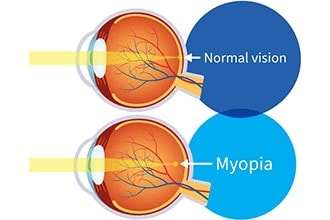
Myopia occurs when light focuses too far in front of the retina.
A study found that kids who spend more time doing near work, such as reading or studying, are more likely to become nearsighted, especially if they spend little time outdoors.
Research has also shown that spending long periods focusing on close-up tasks can change the shape of the cornea in ways related to how the eyelids narrow while reading in people with myopia, particularly when looking down to read. The effects are made stronger with longer reading sessions and can be influenced by pupil size and the amount or quality of surrounding light.
Additional findings suggest that the gene APLP2, known for its link to myopia, interacts with environmental factors, such as reading time. People who carry a rare variation of this gene and spend longer periods reading are more likely to develop myopia. This supports the idea that both genetics and near work can contribute to the condition and that limiting prolonged close-up activities may help reduce risk.
SEE RELATED: Is myopia more genetic or environmental?
Lowering your myopia risk
Reading, studying and doing homework are near work tasks that contribute to a child’s academic success. Luckily, there are some tips to add to your child’s routine that can help lower their risk of developing myopia. You can:
Encourage your kids to play outside
Studies have found that spending time outside during the day reduces myopia risk. In fact, spending just 30 minutes outdoors each day over the course of a year helped slow the development of myopia.
Whether it’s participating in sports, playing with friends or taking the dog for a walk, you should encourage your child to spend at least two hours outside each day. This is especially important during elementary and middle school, as these are critical ages for myopia development.
Take breaks from near work
It’s common for kids to relax by scrolling through social media or playing games on a phone or tablet. While this may seem to give their brain a break, it doesn’t allow their eyes’ focusing muscles to relax.
Have your child take breaks from reading, scrolling and other near work every 20 minutes or so. If possible, have them go outside during this time to stretch or take a lap around the block. At a minimum, you should have your child look up and into the distance for one minute twice an hour. Not only will this keep their eyes from getting tired, but it may refresh their focus as well.
READ MORE: Are people who wear glasses smarter than people who don’t?