Adjustable Glasses: The Future Of Multifocal Lenses?


Are you over age 40 and unhappy with your current glasses for presbyopia correction?
Generally, people who need prescription lenses for nearsightedness, farsightedness and/or astigmatism can attain clear, comfortable vision at all distances with progressive lenses when they become presbyopic. But some are frustrated by the relatively limited field of view these and other multifocal lenses (bifocals and trifocals) provide for intermediate and near vision.
And people who have clear distance vision without glasses and need only reading glasses when presbyopia occurs may have problems, too. They might feel frustrated by forgetting to bring their reading glasses with them or needing to put them on and take them off to see clearly at different distances.
If you're in either of these groups, here's some good news: there are multifocal eyeglasses available that can help solve these problems with just a simple turn of a dial inside the eyeglass frame.
These potentially game-changing glasses for presbyopes are called adjustable focus glasses (also called adjustable focus reading glasses and variable focus eyeglasses).
Adjustable focus glasses
Adjustable glasses are available in a few different designs. One common design is a frame and lens combination with a compound lens system that enables the wearer to focus on objects at any distance.
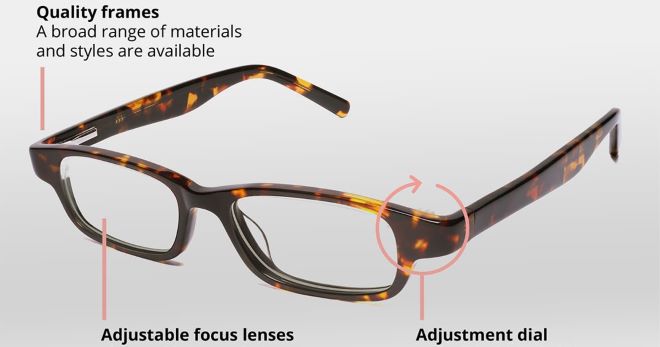
This lens system features two thin, wave-shaped polycarbonate "plates" that slide across each other by means of a small knob on the frame. The position of the two plates relative to each other determines the power of the overall lens system.
Adjustable eyeglasses are generally designed for use as a temporary or spare pair of glasses. The power of the lenses can usually be customized to correct from -6.00 diopters (D) of nearsightedness to +3.00 D of farsightedness with the simple turn of a dial. They also can be adjusted for special visual needs, including reading and computer use, or used to manage fluctuating vision for people with poorly controlled diabetes or after eye surgery.
SEE ALSO: How To Clean Glasses — Without Scratching Your Lenses! >
Adjustable focus reading glasses
Another common design is adjustable focus reading glasses. They also work via a two-lens system but for adjustable degrees of magnification.
Adjustable focus reading glasses enable the wearer to dial the proper amount of magnification for seeing objects from arm's length to very close-up.
For many people with presbyopia, a single pair of reading glasses isn’t ideal for all the different activities they are faced with every day. This includes reading, checking texts on our phones, hobby work, using electronic tablets and viewing computer screens — because all these devices and objects are at different distances from our eyes.
Adjustable focus reading glasses could help overcome this problem with two small, hidden adjustment dials (one for each eye) on the inside of the hinge of the eyewear frame. By turning these dials, the wearer can adjust the power of the lenses for any reading distance.
The two separate adjustment dials allow even people with different-powered eyes (one eye a little more nearsightedness than the other, for example) to attain the proper, balanced focusing power they need for the task at hand.
Typically, each lens could be adjusted from a power of +0.50 to +4.00 diopters (D) for a wide range of near vision tasks.
Adjustable focus glasses and adjustable focus reading glasses are both available over the counter in a variety of frame designs, colors and materials.
Adjustable Focus Glasses — Humanitarian Efforts
Much of the philanthropic work to correct preventable vision impairment in disadvantaged areas of the world has been done through an organization called the Centre for Vision in the Developing World. (CVDW).

Self-adjustable eyeglasses. (Image: Centre for Vision in the Developing World)
The adjustable glasses developed by CVDW are called "Adspecs," short for adaptive spectacles. They’re only distributed for humanitarian efforts, so they aren’t available for retail purchase.
These glasses work via a “fluid-filled lens” or “liquid lens” design. To change the power of the lenses, the wearer turns a wheel on syringes temporarily attached to the sides of the frame. This pumps more or less silicone oil into a chamber formed by two flexible lens membranes that are protected by a rigid outer lens made of plastic. Once the lenses are adjusted for the best vision possible, the user tightens the screws on each side of the frame and removes the syringes.
These adjustable glasses can correct nearsightedness, farsightedness and presbyopia (but not astigmatism).
You can learn more about the Centre for Vision in the Developing World by visiting their website.