What every parent needs to know about the rising rates of childhood myopia


Modern childhood and the developing eye
You walk into a birthday party to drop off your child and pause. The room is everything you'd expect. Restless energy, sugar-fueled chaos and wide-eyed eight-year-olds gleefully ricocheting off one another. Then something catches your eye. Almost without meaning to, you start counting. Nearly half the children in the room are wearing eyeglasses.
Once you see it, you can’t stop: at school pickup, at the soccer field, in your own yearly family photos. You aren’t alone in noticing. Across the world, in classrooms and pediatric clinics, researchers are documenting the same pattern. Myopia, the clinical term for nearsightedness, is rising in ways that research scientists believe are happening too fast and too widely to be a coincidence.
Something in the way children grow up today is changing how their eyes develop. The evidence is becoming clear enough to trace the patterns and, for the first time, offer families something beyond a stronger pair of glasses.
By the numbers
The scale of myopia’s increase is difficult to absorb. One of the most comprehensive analyses of childhood myopia found that the number of children with nearsightedness rose from roughly 24% around 1990 to approximately 36% by 2023. If current trends hold, nearly 40% of the world's children could be affected by 2050. By midcentury, it’s expected that 5 billion people will be myopic, roughly half the world’s population.
What is less understood is what myopia, particularly at moderate to high levels, means for a child's eye health decades later. Children with medium to high myopia face about two to three times the likelihood of developing either earlier-onset cataracts or glaucoma compared to children without the condition. The odds of retinal detachment are roughly four times higher for children with mild myopia and more than 10 to 20 times higher for those with high myopia. Structural changes in the elongated eye also make myopes vulnerable to retinal bleeding and tearing, which, in severe cases, can sometimes result in permanent vision loss.
The consequences reach beyond the clinic. Prevent Blindness and its National Center for Children's Vision and Eye Health estimate that roughly 1 in 4 school-aged children has an undetected or unaddressed vision problem that may be impacting their ability to learn, keep pace academically or reach developmental milestones on time.
Understanding why so many children are affected, and why the numbers keep climbing, requires a look at how the modern world shapes the developing eye. Major scientific bodies, such as the National Academies of Sciences, Engineering, and Medicine (NASEM), have concluded that while heredity plays a role, environmental and behavioral factors are important drivers of the rise in myopia in this generation.
The geography of myopia
The story of myopia follows the geography of where children grow up, and just as closely, how they spend their days. So while the numbers are striking, the pattern behind them is important. Myopia is not rising everywhere at the same rate or in the same way.
Myopia is climbing fastest in East Asian populations, in cities rather than rural areas and among adolescents more than younger children. In some areas across East and Southeast Asia, the majority of children and young adults are myopic.
That regional concentration raises an obvious question. Is this simply genetics? While genetics play a role — a child with two nearsighted parents is significantly more likely to develop myopia — they don’t account for the rapid and uneven increase happening across certain regions. For example, rates approach 90% among teenagers in South Korea and Singapore but remain at or below 5% in much of sub-Saharan Africa.
The rates seem to have risen most sharply in the places where indoor educational time grew and outdoor time shrunk. The children at highest risk appear to share certain environmental factors. They engage in significant, sustained near work (such as screen time, reading and writing) and begin to do so at a younger age. They also spend less time in natural light during the years when the eye is still developing.
More sunbeams, fewer screens
Time spent outside during the day benefits a child's physical and mental health and may also play an important role in how their eyes develop. Outdoor light is brighter and more variable than anything most indoor environments offer. Being outside also demands something indoor life rarely requires: a constantly shifting focus between near, distant and peripheral objects.
One leading theory is that natural light triggers the release of dopamine in the retina, the light-sensitive tissue at the back of the eye. This chemical acts as a signal that research suggests could slow the eye growth that drives myopia. Scientists are working to identify which specific elements of outdoor exposure matter most, and the full picture is not yet complete.
Additionally, children who spend time outdoors tend to spend less time on screens, which compounds the benefit by replacing the habits that carry the most risk.
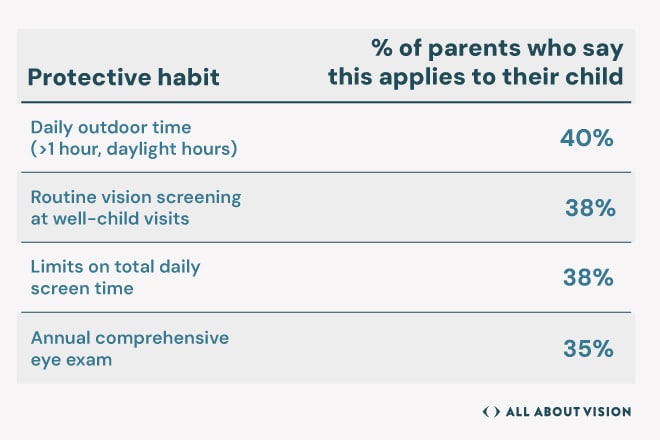
Source: The Harris Poll Myopia Survey. Conducted on behalf of All About Vision. July 2026.
Mark Bullimore, FCOptom, PhD, a research professor in vision science at the University of Houston College of Optometry and co-author of landmark research on myopia progression, points to work by Karla Zadnik, OD, PhD, professor and dean at The Ohio State University College of Optometry. Dr. Zadnik’s research was foundational in establishing outdoor time as one of the most significant protective factors against myopia development.
"The single biggest factor is time spent outdoors," Dr. Bullimore says. "More time outdoors is associated with a lower incidence of myopia and current recommendations are at least two hours a day. Research from China and Taiwan has shown that increasing time outdoors during recess can have an effect on the incidence of myopia."
These findings may help explain why rates are climbing fastest in some densely populated parts of Asia and other urban centers, where indoor, screen-heavy days are common and open outdoor spaces can be difficult to find.
Where the blur zones begin
Genetics, time spent outdoors and extended near work appear to be shaping this generation's eyes. But myopia develops one child at a time. The question that matters is what this means for yours.
Myopia is no longer considered just a refractive error, a problem with how the eye bends light. It’s increasingly regarded as a structural eye condition. The structure of the eye determines more than whether distant objects look blurry.
During the first years of life, children’s eyes are actively calibrating. The eyes grow in length, fine-tuning the distance between the lens at the front and the retina. When that calibration works as it should, light lands precisely on the retina and vision is sharp.
In a nearsighted eye, the eye lengthens beyond what its optics can compensate for. This process is called axial elongation. As a result, incoming light focuses in front of the retina instead of on it.
Glasses and contact lenses correct this by bending that light so it lands directly on the retina. But they do nothing to change the shape of the eye itself. The axial elongation remains. That is where the long-term risk begins.
When elongation becomes severe, reaching what eye doctors define as high myopia (a prescription of -6.00 diopters or greater), the stretching begins to compromise the delicate structures inside the eye. Over time, serious conditions can develop slowly and without early warning signs.
The retina may develop holes or tears as it stretches across a longer eye. Left undetected, these can progress to retinal detachment. Beneath the retina, abnormal blood vessels can grow in ways that threaten central vision, one of the changes associated with myopic maculopathy, a condition affecting the central retina.
The risk of glaucoma, a group of conditions that damages the optic nerve connecting the eye to the brain, also rises with increasing myopia. And the gel-like substance that fills the interior of the eye can begin to change earlier in highly myopic eyes than it would otherwise, compounding these risks.
In light of this, NASEM has concluded that the evidence supports classifying myopia as a disease rather than just a refractive error.
The arithmetic of risk
Earlier onset of nearsightedness is consistently associated with higher levels of adult myopia and a greater lifetime risk of complications. Research shows that the earlier myopia is slowed down, the lower the possible overall risk of lifetime complications. A child does not need to avoid myopia entirely for the intervention to matter. Every diopter prevented reduces their risk of potential complications.
In a large-scale analysis of over 20,000 people, Dr. Bullimore and his colleague Noel Brennan, PhD, found that each additional diopter of myopia is associated with a 67% increase in the prevalence of myopic maculopathy.
Slowing a child's progression by just one diopter is associated with a 40% reduction in the likelihood of developing this condition. This research has helped shift how many eye doctors think about childhood nearsightedness, and how parents might think about it too.
The most sensitive measurement
Passing a school vision screening is reassuring, but it’s not enough. Screenings are designed to identify children who need glasses right now. They aren’t designed to assess a child’s vision in the same detail as a comprehensive eye exam.
Myopia most commonly develops between ages 8 and 12, during a period of rapid eye growth. The younger a child is when they develop myopia, the more years of potential progression remain before the prescription stabilizes. This makes trajectory, not only current vision or prescription, an important metric to track.
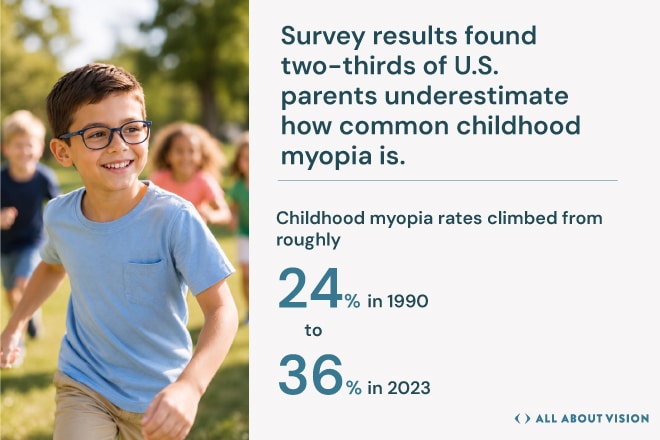
Source: The Harris Poll Myopia Survey. Conducted on behalf of All About Vision. July 2026.
A comprehensive pediatric eye exam is designed to do that. It typically includes cycloplegic refraction, a measurement taken after eye drops temporarily relax the muscles that control focusing, which allows a more accurate reading of a child's true prescription. The full exam also assesses binocular vision (how well both eyes work together) along with overall eye health.
Increasingly, these exams also track axial length, the front-to-back measurement of the eye itself. "It's the most sensitive measure, much more so than any kind of refraction," Dr. Bullimore said. "It also doesn't require cycloplegia, so it can be measured much more often without the use of drops. The best way to track axial length is to compare it against population norms for average elongation in myopic children of the same age and ethnicity."
Research identifies axial length as a more precise predictor of long-term visual risk than refractive error alone. Tracking it over time gives eye doctors a clearer picture of whether and how quickly a child's myopia is progressing.
Dr. Bullimore notes that in some cases, successful interventions can stop axial elongation or even shorten axial length, but this should never be the expectation. "Some growth is to be expected," he said.
The intervention window
In many eye doctor offices, myopia management has shifted from simply correcting blurred vision to actively reducing the risk of long-term myopia progression. Families can take steps on both fronts: increase daytime hours outdoors for children and, where myopia is progressing, seek help from a specialist.
Outdoor time
It can't be stated enough how important something as simple as time outdoors can be. A recent review of more than 10,000 children found that school-based programs designed to increase time outdoors may reduce the risk of children developing myopia. A separate analysis found that increasing outdoor time from roughly 3.5 hours per week to about 16 hours was associated with a more than 50% reduction in the risk of developing myopia.
The protection appears to come from exposure to bright natural light, particularly during the years when the eye is still growing.
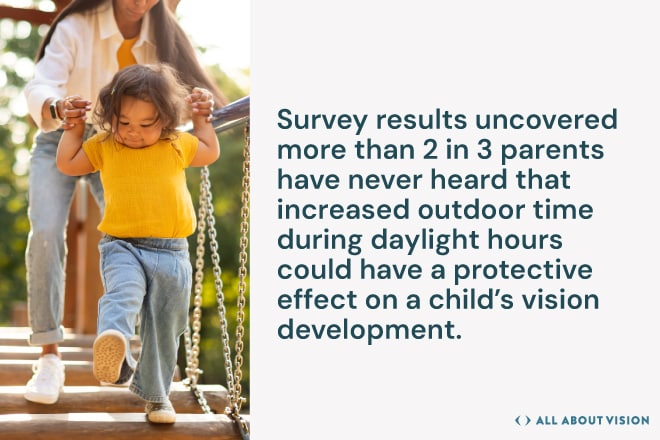
Source: The Harris Poll Myopia Survey. Conducted on behalf of All About Vision. July 2026.
Clinical options
For children who are already nearsighted, several clinical options are now available, though access varies by country.
Specialized eyeglasses designed for myopia control look like ordinary glasses but use a lens design that may reduce the stimulus for eye growth. Certain designs have received regulatory authorization in the United States and approval in Canada, Europe and other international markets specifically for this purpose in children.
Soft contact lenses designed for myopia control work similarly. These are approved and available in multiple countries, including the United States, Australia and across Europe.
Low-dose atropine is an eye drop placed in a child's eyes at bedtime. Some research shows that it can slow the rate at which myopia worsens. These drops do not correct blurry vision, and a child using them would still need glasses to see clearly. This strategy is available in parts of Asia, Europe and other regions. It is considered an off-label treatment (not specifically labeled for myopia control) in the United States.
Orthokeratology uses specially designed rigid contact lenses worn overnight to temporarily reshape the cornea. Commonly known as ortho-K, it corrects myopia during the day and may slow its progression over time. Ortho-k lenses are FDA-approved in the United States for overnight wear to nonsurgically manage refractive conditions. There are certain designs approved for myopia management. They are also widely used internationally.
Repeated low-level red-light (RLRL) therapy is a non-pharmacological and non-optical emerging approach. Early results from studies in Asia are promising for slowing myopia progression, but questions about long-term retinal safety and durability remain unresolved.
No single treatment is right for every child. An eye doctor who specializes in myopia management can help determine which approach or combination of approaches makes sense based on a child's age, prescription, rate of progression and family history.
Out of the blur zone
The question is no longer only whether a child needs glasses. It is whether their prescription has changed since last year, by how much, and how close they are to the two hours of daily outdoor time that researchers now recommend.
For children whose myopia is progressing, a growing number of evidence-based interventions are becoming available that did not exist a generation ago. Myopia management, Dr. Bullimore explains, is “a holistic, evidence-based approach including risk assessment, early detection through screening, appropriate optical correction, interventions to control progression, lifestyle recommendations (outdoor time, reduced screens), ongoing monitoring and long-term complication management.“
Not all the forces shaping myopia development are within a parent's control, but some are. Genes are a starting point. Screens are negotiable. And sunbeams, the intervention with the most consistently supported evidence, require no appointment, no prescription and no out-of-pocket cost.