Curious about 3D glasses? Here's what you need to know


Picture this: The next time you select glasses, instead of staring at rows of frames, you sit down and an optician scans your face with a tablet. The device captures your face’s exact dimensions, including the contours of your nose, the shape of your ears, and all those other particularities that make your facial features unique.
Next, you design a set of glasses exactly the way you want. A size that’s just right. A color scheme that is understated enough. Finally, that geek chic look is yours.
This is the kind of customization that 3D printing could provide. Right now, the technology is mostly niche, with specialty and luxury brands leading the innovation. Along with the promise of a bespoke look, 3D printing may support more sustainable manufacturing processes in eyewear production.
However, there are still hurdles to 3D printing becoming a more widely available option. And eyeglass wearers should evaluate claims carefully and always work closely with eye care providers to choose the best option.
How 3D-printed glasses are made
For over a quarter-century, 3D printing has had wide application to medical device manufacturing, with uses ranging from dental prosthetics to hearing aids. The technology’s ability to deliver a precise, patient-specific fit is key. For eyewear, it gives manufacturers a way to build frames from a custom digital file containing a patient’s unique measurements.
Manufacturers also use 3D printing to quickly prototype new frame designs before committing to full production, testing fit and appearance at a fraction of the cost of traditional tooling.
Several 3D-printed methods are used to make eyewear. The most common is selective laser sintering, or SLS. This process uses a laser to fuse powdered nylon into the solid layers that make up the components of the eyeglasses. Stereolithography uses light to solidify liquid resin, and fused deposition modeling melts plastic and builds up the frame layer by layer.
The most common material used is PA12, a petroleum-derived nylon that is generally durable and strong enough for daily eyeglass wear. Some brands, however, are implementing more sustainable alternatives, such as PA11, which is derived from castor beans.
After printing, frames typically go through finishing steps to achieve the final look and feel expected of traditional commercial eyewear. The surface quality of 3D-printed frames has improved substantially in recent years, moving from a rougher, more industrial appearance to fashion-forward looks.
Creating a custom fit
The core promise of 3D printing is customization. The typical experience of walking into an optical shop means confronting multiple frame choices, many of which are available in only a few sizes.
"So many frames today are only made in one size, or maybe two sizes, and may not be a good fit for everyone," said Michael Vitale, a licensed optician and the vice president of membership, government relations and technical affairs at The Vision Council. "I've got a large head and certain styles just don't work for me because the temples flare out too much."
For some patients, the challenge goes beyond preference, according to Karl Citek, OD, PhD, a professor of optometry at Pacific University College of Optometry.
"If someone has a facial deformity or atypical anatomy where there's no way to adjust a standard frame to fit properly, you can certainly address that with 3D printing," he said. "That will probably be fairly rare, but it's good to have the capability."
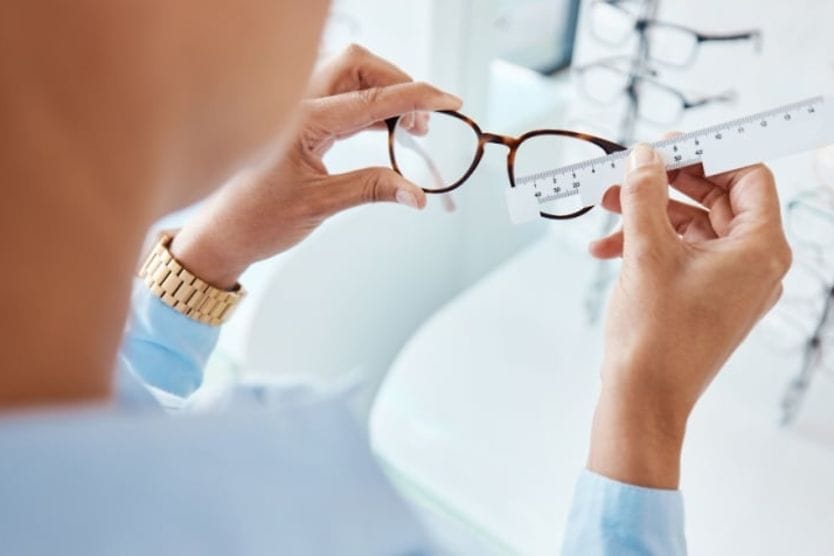
Selecting 3D-printed glasses is a more personalized, technology-driven experience. An optician or an optical staff member uses a tablet or another scanning device to capture the exact dimensions of a patient’s face. In some scenarios, a full 3D model of the patient’s head is produced, serving as the digital foundation for creating the glasses.
The tradeoff is that the precision that 3D printing promises depends on getting those measurements right. The amount of room that exists for correction after delivery varies by the materials used. Some materials, such as nylon-based sources, are typically more difficult to adjust. Other designs, however, combine printed frame fronts with conventional hinges, temples and/or nose pads, leaving room for further adjustment once they’re shipped to the optician’s office.
"Positioning is going to be very critical," Dr. Citek said, "because, depending on the material, there might not be much room to bend and adjust the frame after it is printed."
Experts noted that 3D printing does not improve the performance of a prescription. Visual clarity depends on the quality and positioning of the lens. The manufacturing process remains unchanged and follows its own set of industry standards. Any 3D-printed frame must incorporate the lens with the same accuracy as traditional eyewear to ensure the wearer can experience the benefit.
“The lens has to be made very precisely, and it has to be positioned very precisely — cut to the proper shape for the eye wire and positioned perfectly so it doesn't induce any optical problems,” Dr. Citek said.
Making 3D-printed eyewear more sustainable
As sustainable eyewear gets more attention, 3D-printed eyewear offers environmentally conscious patients another option.
The traditional eyewear manufacturing process is built for repeatability and scale, but this leaves room for waste. Acetate, a plant-based plastic derived from cotton or wood pulp, is one of the primary frame materials. When building acetate frames, manufacturers usually use large sheets of material and cut the frame front and temples out of them, shaping and polishing the pieces through a series of steps. Any remaining materials typically go unused.
Similarly, metal frames produce waste when machined and shaped during manufacturing.
In comparison, 3D printing builds frames in layers from a digital design, using only the materials needed for that specific model.
Inventory management is another sustainability challenge. In traditional manufacturing, brands must commit to production decisions six to 12 months before frames reach a shelf, with no reliable way to know what will actually sell. Custom 3D-printed glasses frames can typically be produced and delivered in a much shorter timeframe compared to traditional manufacturing. In theory, frames could be made in response to demand, minimizing waste.
But there’s room for even greater sustainability within 3D printing that could have significant environmental impact. The most widely used material in 3D-printed eyewear is PA12, valued for its durability and impact resistance.
Some manufacturers are using PA11, considered a more sustainable alternative. It’s also credited with offering higher impact resistance, particularly beneficial for children’s eyewear and sports.
What consumers need to know
It’s important to remember these are the early days of 3D-printed eyewear. Most opticians do not yet offer digital fitting or 3D-printed frames, and the range of available styles remains narrower than that offered by conventional manufacturing. People interested in exploring 3D-printed frames may ask their eye care provider for an expert perspective.
Expense is another consideration, as a professionally printed custom frame can cost more than many standard frames, particularly when scanning and customized fitting are involved. For some people, the higher price tag may be worth it if conventional sizing hasn’t allowed for a good fit.
Regardless of how a frame is manufactured, it must still meet the regulatory and industry requirements that apply to conventional eyewear. In the United States, eyeglass frames are regulated by the Food and Drug Administration (FDA).
"It doesn't matter what the manufacturing process is. All ophthalmic frames are governed by the FDA. Frames are Class I medical devices, as are the lenses,” Vitale said.
Dr. Citek notes that ensuring a frame is well-built and in alignment with global safety standards is the first priority before making an investment in any new eyewear.
"You don't want to put something on your face that is inherently unsafe," Dr. Citek said. "Make sure that whatever template design is used has been vetted and should pass all the safety requirements for standard spectacle frames."
Working with a licensed optician or optometrist remains the most reliable way to assess whether 3D-printed frames are appropriate and to ensure that any frame chosen meets the standards that apply to all eyewear.