A history of glasses
If you’re looking for your glasses today, you may find them sitting on the table, on the kitchen counter or on top of your head. But 600 years ago, it was easier for someone searching for their glasses to find them. Historians recently found a book with a lens holder built right into the binding. Whether these glass-in-book offerings were common or rare is still up for discussion – it’s one of many mysteries in the history of corrective lenses.
A blurry start to a history of eyeglasses
While humans have been on Earth for more than 300,000 years, corrective lenses are relatively new to the scene. Lenses were only invented between 600 and 800 years ago, depending on who’s telling their origin story. Before that, weakening eyesight was largely accepted by people as a sign of growing older since there was no known way to correct it.
That began to change as the science of optics spread through Europe. After the Arabian mathematician Ibn al-Haytham’s Book of Optics was translated into Latin in the 13th century, scholars such as Roger Bacon recognized that a curved, polished lens could magnify text. This simple shift allowed the use of technology and engineering to create one of our most important inventions.
The first written mention of glasses (or spectacles as they were called) was in a sermon. It was delivered in 1305 by an Italian Dominican friar named Giordano da Pisa. The friar, who was also known as Giordano da Rivalto, referred to spectacles, mentioning they had only been around for less than 20 years, explains Neil Handley, PhD, the curator of the London-based British Optical Association Museum at The College of Optometrists in London.
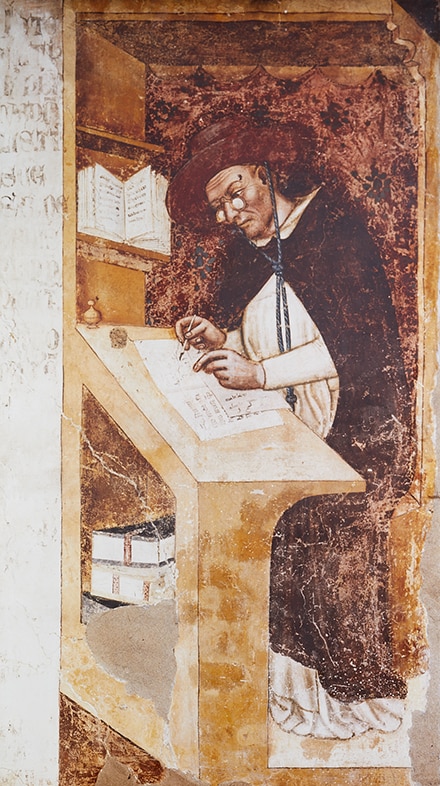
“That causes some sources to be as precise as to say that spectacles were invented in 1286, but that really is pushing it,” he said. “Any serious historian is going to say that mention is too insubstantial to draw any particular conclusion from.”
There’s just as much mystery surrounding who was the first person to develop corrective lenses or where they lived. “It’s been said – mostly during the 13th century – that the guy who invented eyeglasses was Salvino degli Armati,” said Benoît Giraud, an art historian and a heritage project manager for EssilorLuxottica.
However, that story turned out to be made up. It traces back to a 1684 writer who wanted to credit a fellow Florentine, and to a tomb that was later found to be fake. “But actually, we have no proof that one person in particular invented eyeglasses. What we know is that they probably appeared in Italy and at more or less the same time in England as well.”
One name does endure: Brother Alessandro della Spina, a friar in Pisa in the late 1200s. The story goes that when the true craftsman who first made eyeglasses kept his creation a secret, della Spina figured it out on his own. Instead of guarding it, he decided to show everyone how it was done. He isn’t remembered as the inventor, but as the person who helped glasses catch on.
What we know is who used them first: monks and literate elites, such as kings and noblemen. They were the only ones who had access to books and libraries.
A singular focus
While we may never know the exact date that corrective lenses were created or who created them, we do know that eyewear in the 13th century didn’t look like today’s trendy glasses. Instead, people used a single, round lens – often called reading stones – that were handheld. They had no nose or arms. People moved the lens closer or farther away from the eye, depending on their vision needs.
Soon after, spectacles were introduced. These were two mounted lenses that were “riveted together at the handle ends,” according to the British Optical Association Museum. People wore them by squeezing their nose between the two lens rims. This meant the connection to the face was limited. If the wearer moved too much or too quickly, the spectacles would fall off their face.
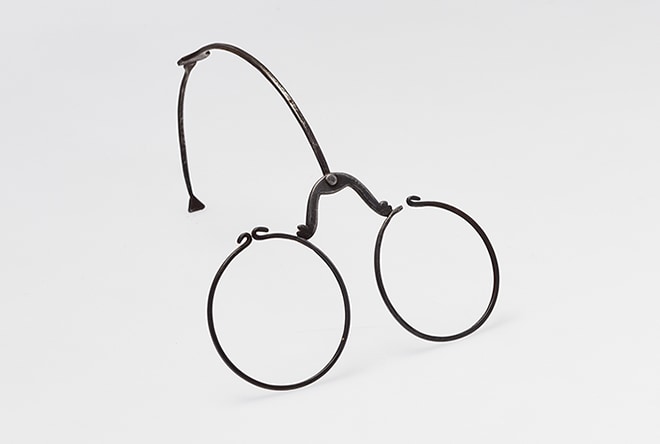
Monks made the first reading stones using a natural mineral called beryl, or in some cases, rock crystal which is a clear form of quartz. Historians say the monks looked for the clearest stones that they could find. They cut, ground and polished them, much like someone polishes any other type of gem. Later versions were made of soft glass that could be shaped into lenses.
“Every lens [was] made by hand on a grinding wheel,” Dr. Handley explained. “The person making them could be some sort of jeweler, for example, because they certainly ground glass as coverings for jewelry items. But it's just as likely that they were based in a monastic workshop because that’s where spectacles were needed.”
Spectacle frames were made of leather, animal horns, cow bones or wood, which is why few of these early specimens remain, says Dr. Handley. “The problem with these organic materials is, of course, they’ve all rotted away, so there are very, very few surviving examples,” he added.
Unfortunately, in both cases, these lenses only corrected for presbyopia or age-related vision changes. People with nearsightedness were still left uncorrected. That would not change for roughly 200 years. In the 1500s, a German scholar named Nicholas of Cusa is credited with the development of concave lenses (curved inward in the middle like an hourglass). This wasn’t a huge problem, though, since those with extreme nearsightedness found employment that played to their strengths.
“If you were highly [nearsighted], you might actually end up, for example, working in a monastery as an illustrator of books,” said Dr. Handley. “Some of the illuminated pages in Bibles and prayer books have extreme miniature detail in them … it seems likely that they actually employed people whose vision made it totally suitable for that and totally unsuitable for almost any other role.”
Glasses get a glow-up
It would take another 300 years before glasses evolved again. In 1604, astronomer Johannes Kepler wrote what would lay the foundation for modern eyeglass lenses. He is credited as the first person to figure out exactly how the eye works.
In his writings, he suggested that the pupil – the dark part in the middle of the eye – opens and closes, placing light onto the front surface of the natural lens which then focuses it on the retina at the back of the eye.
In what essentially was a research paper, A Supplement to Witelo, he explained that the eye was like the camera of the time, projecting “a real, reversed and inverted image (or “painting” [pictura] in Kepler’s terminology) of the objective source on the retinal screen.”
While Kepler’s research helped create the telescope, it would also shape – literally – the way glasses would be made. His theory explained the cause of some vision issues. If the eyes were too long or too short, the image would miss the retina. Since the retina takes light and turns it into signals that your brain can understand, even a millimeter off turns vision blurry.
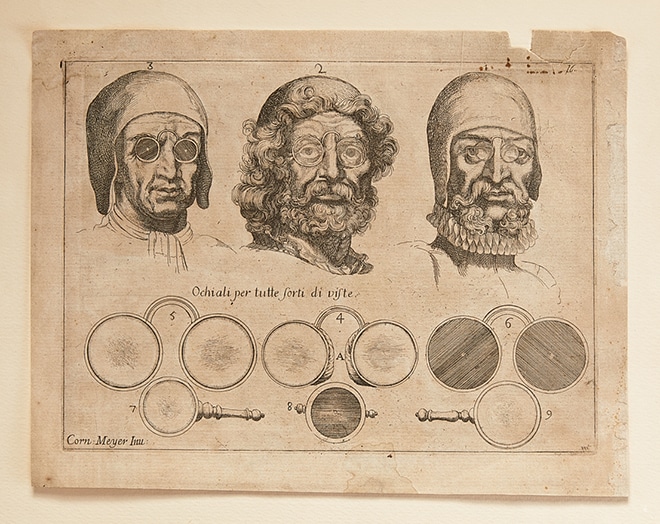
Even though Kepler explained how vision worked, glasses as we know them were still years away. The options that were available in the early 1600s were still one-off, hand-tooled lenses with little precision. Glasses were created, and those who needed them would try on many until they found one that was close enough to be helpful. Eye exams didn’t exist.
“You would have peddlers going to the countryside and selling some eyeglasses to anybody who needed them, but there were no prescriptions,” said Giraud. “People would try a few and say, ‘Okay, with this one, I’m seeing a bit better, so I will take it,’ but it was not scientific at all.”
The turning point for corrected vision
A major production shift came in 1693. That’s when London-based optician John Marshall invented a machine that allowed you to grind 12 lenses at once, all roughly to the same power. For the first time, glasses could be made quickly and uniformly, but there was still work to be done.
These mass-produced glasses were like the fast fashion we see manufactured today, Dr. Handley said. People held these options and used them occasionally when they had to read, but the quality was lacking. “It was all about making more lenses to make it a more profitable manufacturing concern rather than about the accuracy of the results,” he said.
Demand was growing, even more than after the introduction of the Gutenberg printing press in the mid 1400s. As more people had access to books, they realized their vision wasn’t good enough to read.
There is some evidence that during this time, eyeglass frame temples (arms) were occasionally worn by people using silk or string to tie to the frames and loop the silk or string over their ears, according to Dr. Handley. Adding arms (temples) to the frames didn’t happen until the first half of the 18th century. While many people give credit to the prominent London optician Edward Scarlett, there is no evidence that points to just one inventor.
The glass lenses were fitted into a frame that sat on a person’s nose with two arms pressing the wearer’s temples. These glasses were made of wire; however, spectacles made of natural materials such as leather and bone were still produced. In the decades that followed, the design evolved. The arms lengthened, became pliant and landed directly on the ears at the end of the 18th century. It took a century before the arms curved to wrap around the ears as we know them today.
“The number of circumstances in which you can have vision correction is greatly increased,” Dr. Handley said. “It's the first time that somebody thinks, ‘Oh, I’m going to put my glasses on when I get out of bed, and I’m going to keep them on all day, and I’ll wear them indoors, as well as outdoors. I’ll wear them when I’m sitting down but also when I’m walking about.’”
Once people could walk around with glasses, professionals took on the challenge to personalize them. One example is the bifocal, created in 1784 by United States founding father Benjamin Franklin, for people who struggled with both nearsightedness and farsightedness.
“We always say that Ben Franklin is the father of the bifocal. We often refer to the Franklin lens or the executive bifocal, and that’s the bifocal where the line goes across the entire length of the lens,” said Megan Piller, ABO-C, MHSc, the assistant clinic director and manager of the eyewear gallery at the Ohio State University College of Optometry.
Bifocals were an important milestone because they included two corrections in the same pair of glasses. Using them, people could see close, as well as distance, and didn’t have to switch between two pairs of glasses. Progressive lenses, which blend near, intermediate and distance vision with no visible line. were introduced much later in 1959.
The shift to modern lenses
The next major milestones for glasses came during the 19th century. By then, commoners – not just the rich and royal – were going to school. Newspapers and books were widely available, and people read during their daily lives. At the same time, the Second Industrial Revolution ushered in better mass production of glasses and a shift from one-lens-for-all to custom-fit lenses.
In addition to hardware stores, glasses started to become available in jewelry stores where jewelers and opticians custom fit patients. Professionals offered eye exams and manufactured glasses that people needed rather than what they had on hand. Glasses finally got shapes at this time, too, since opticians weren’t stuck using a round wheel to create lenses, said Dr. Handley.
“In the 19th century, they started with other shapes,” he said. “Particularly in America, they were more interested in things like hexagons and octagons. [These shapes] were less popular in Europe, but this just gave you a greater variety of choice. It’s one of the first design differences that hit the market.”
In the late 1800s, Charles Prentice, the first person to charge patients for an eye exam, wrote a book. Metric System of Numbering and Measuring Prisms introduced the prism diopter. Today, this system of measurement endures, helping eye doctors correct vision for people whose eyes don’t work well together. The 19th century also brought the first correction for astigmatism, the blur caused by an unevenly curved cornea. In 1825, British astronomer Sir George Biddell Airy designed a cylindrical lens to correct the astigmatism in his own eye.
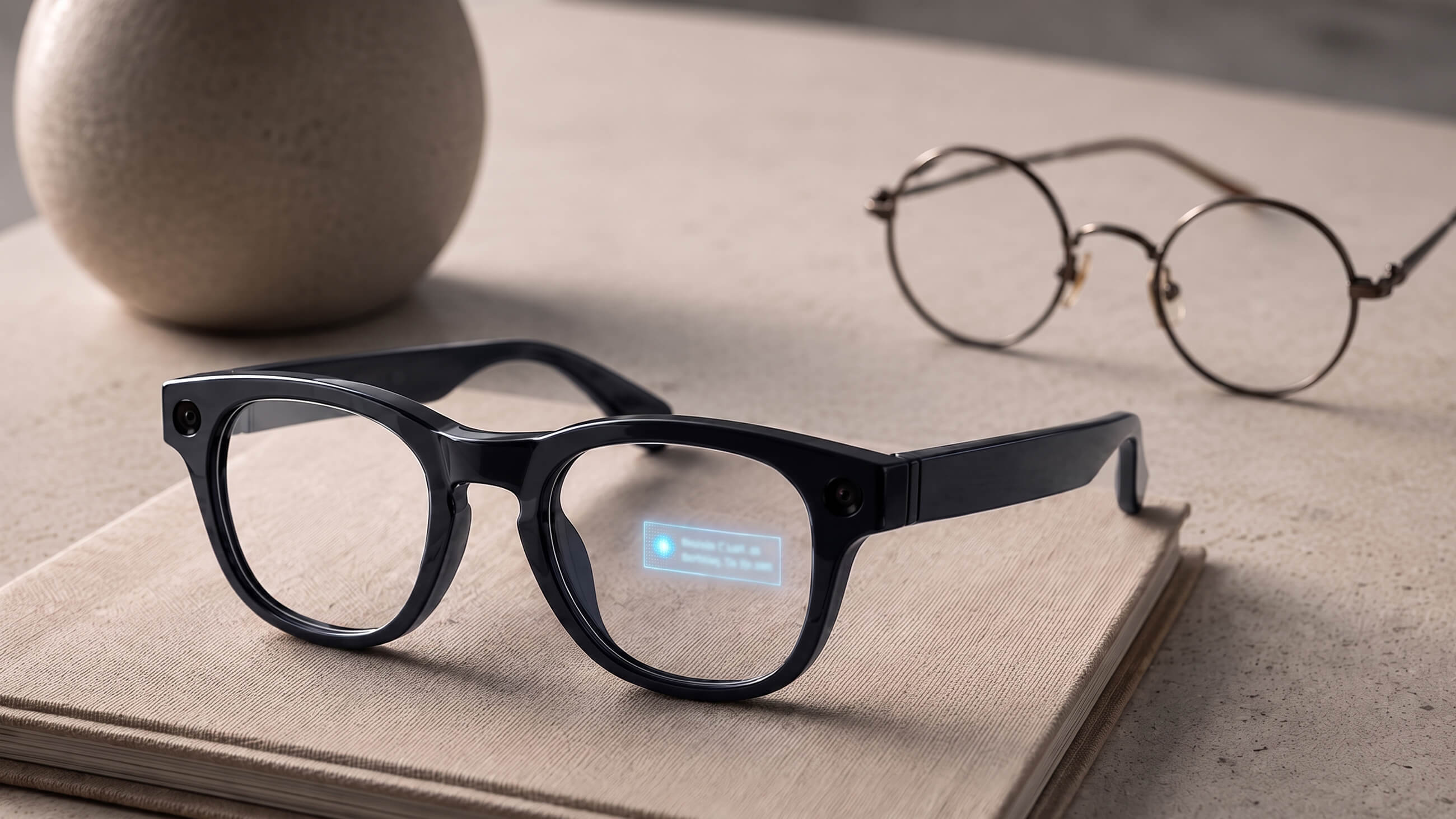
In the centuries since bifocals were invented, glasses have continued to evolve. Eyeglass frames are now made of plastic, metal and titanium. Lenses have become lighter and thinner with the introduction of polycarbonate and high-index materials. The advent of artificial intelligence (AI) may put us on the edge of another huge jump forward, Piller said. Lenses are designed digitally using measurements of a person’s eyes, head position and gaze. Some frames even include cameras, speakers or other smart technology.
“Everything now, as far as prescription eyeglass lenses, is digital. Everything is made by a computer. We’re even using AI technology now to help create a lens and map a patient’s visual gaze to completely customize a lens. We’ve gone from magnification to completely digital now,” she said.
So much has changed since the 1300s, but the goal remains the same: helping people to experience their world with clear vision.