Why artificial tears may not be enough for dry eye (and what to do next)

When artificial tears aren’t enough
If you keep bottles of artificial tears in your car, at your desk and beside your bed, you’re not alone. For many people with dry eye disease, these drops provide temporary relief. But for some, the burning, grittiness or blurred vision returns a short time later.
It’s easy to assume the solution is to use eye drops more often or switch to a different brand. But dry eye isn’t simply a matter of adding moisture. The condition can develop for several different reasons, and the treatment that works best depends on what’s causing your symptoms in the first place.
Tears do more than keep your eyes wet
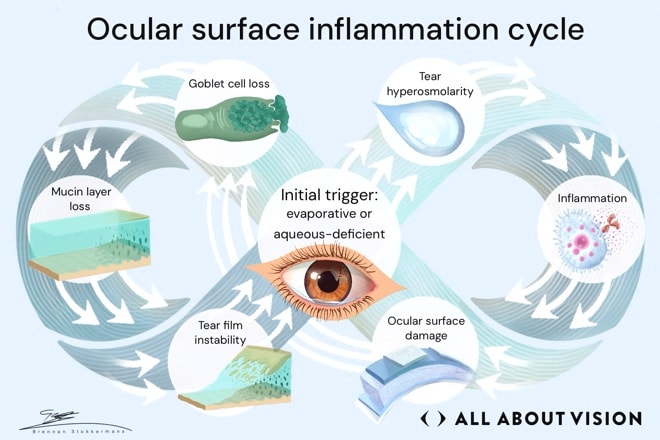
If dry eye were simply a lack of moisture, artificial tears would solve the problem for almost everyone. But healthy tears do much more than keep your eyes wet. They form a complex barrier that protects the surface of the eyes.
Every time you blink, a thin coating called the tear film spreads across the eye’s surface. Made up of three layers (oil, water and mucin), it helps keep the eyes comfortable and healthy while helping maintain clear vision. When any part of that system breaks down, symptoms like fluctuating vision, burning, stinging, watery eyes and irritation can follow.
Dry eye is not a single disease
For years, dry eye was often described as a problem of making too few tears. Today, eye doctors recognize that dry eye disease can develop in several different ways, and many people have more than one underlying cause.
That helps explain why two people with similar symptoms may need completely different treatments. One person’s eyes may not produce enough tears, called aqueous-deficient dry eye. Others may have inflammation, eyelid disease or a combination of several factors contributing to their symptoms.
For example, some people’s tears evaporate too quickly because the oil glands in the eyelids aren’t working properly, known as evaporative dry eye.
The most frequent reason for this type is meibomian gland dysfunction. This condition results when the tiny oil-producing glands along the eyelid margins become blocked or stop releasing enough healthy oil. Without that protective layer, tears disappear faster than they should, leaving the surface of the eye exposed between blinks.
When people experience both types of dry eye at once, it is referred to as mixed dry eye.
Ocular surface disease
Dry eye disease is one of the most common forms of what doctors broadly call ocular surface disease, an umbrella term for conditions affecting the surface of the eye. This includes the:
- Tear film
- Cornea (the clear dome structure)
- Conjunctiva (the thin membrane over the whites of the eye)
- Eyelids
Because these structures function as a unit, a problem affecting one often disrupts the others.
One thing that often surprises people is that watery eyes can actually be a symptom of dry eye disease. When the surface of the eye becomes irritated, it may trigger a burst of reflex tears. These tears help flush away irritation, but they don’t stay on the eye long enough or contain the right balance of oils and other components to restore a healthy tear film. As a result, your eyes may water excessively while still feeling dry.
Conditions that can contribute to dry eye
Dry eye disease often develops alongside other eye or health conditions. These can include:
- Blepharitis (inflamed eyelids)
- Ocular rosacea (rosacea that affects the eyes)
- Thyroid eye disease
- Sjögren’s syndrome (an autoimmune disorder)
Dry eye disease can also be associated with poorly controlled diabetes or a side effect of a medication you’re already taking.
Although dry eye is usually a chronic condition rather than a medical emergency, it shouldn’t be dismissed as a simple inconvenience. Ongoing inflammation can damage the surface of the eye over time if it isn’t properly managed.
Fortunately, understanding the underlying cause also makes treatment much more targeted. Instead of trying one bottle of eye drops after another, your eye doctor can recommend therapies that address the specific mechanism driving your symptoms.
The best treatment option may not be the newest
The ideal treatment for dry eye isn’t necessarily the newest medication or the most advanced procedure. It’s the one that can address why your tear film has become unstable.
During your examination, an eye care professional will ask about your symptoms, general health, medications and daily habits. They’ll also examine your eyelids, tear film and the surface of your eyes.
Depending on your symptoms, additional tests may:
- Measure tear production
- Evaluate how quickly the tear film breaks up after a blink
- Assess the health of your meibomian glands
- Look for inflammation on the ocular surface
No single test diagnoses every case of dry eye, so these findings are interpreted together with your symptoms and medical history.
Once your eye doctor understands what’s driving your symptoms, treatment can be much more effective. Strategies vary, but most therapies target three zones: the tear film, the eyelids and the surface of the eye.
A stepwise treatment approach
Doctors typically take a stepwise approach, starting with the least invasive options, such as artificial tears and lifestyle changes. If symptoms persist, they will progress to prescription medications, in-office procedures or more targeted therapies.
Lifestyle modifications
Many of the simplest treatments are the most effective at helping your tear film stay stable. Eye doctors usually begin with the basics: reducing tear evaporation, improving tear quality and protecting the eye’s surface. That may include:
- Redirecting fans and air vents away from your face
- Adding humidity to the air
- Using lubricating drops
- Improving your diet
- Practicing eyelid hygiene with warm compresses and gentle lid cleaning
Long stretches in front of a screen reduce how often, and how completely, you blink, which destabilizes the tear film faster than almost anything else. Practicing deliberate, full blinks during screen time can ease symptoms on its own. Sometimes, simply blinking more completely is enough to noticeably improve comfort.
Certain work and daily environments tend to make dry eye worse. Low-humidity offices, air travel, and jobs around wind, fans or air conditioning all speed tear evaporation. Dry eye may also affect everyday functions, such as comfortable reading, night driving and productivity at work. It is recommended to talk with your eye doctor about your work setting and daily demands during your comprehensive eye examination.
A diet high in processed foods and low in omega-3 fatty acids may also contribute to dry eye, while getting enough sleep and avoiding smoking can help improve symptoms. A small desktop humidifier or wraparound glasses that trap moisture near the eyes can reduce evaporation and ease symptoms.
For people whose eyes dry out overnight or who don’t fully close their eyes during sleep, nighttime strategies, such as lubricating ointments, moisture-chamber goggles or sleep masks designed to seal in humidity, can protect the eye’s surface until morning.
Prescription treatments and office procedures
If self-care measures and artificial tears aren’t providing enough relief, your eye doctor may recommend prescription treatment. These medications don’t all work the same way. Some reduce inflammation, some help your eyes produce more natural tears and others improve the stability of the tear film by slowing evaporation.
Advanced therapies
For more severe cases, treatment may expand to oral medications, specialty contact lenses or therapies, such as autologous serum eye drops, which are made from a patient’s own blood. The goal is always the same: restore a healthier tear film while protecting the surface of the eye.
Established prescription options
Several treatments have a long track record of proven benefit. These treatments are well-established, guideline-backed and have been shown to work over many years.
Cyclosporine
For people whose dry eye is driven by inflammation, cyclosporine has been a standard treatment for many years. It comes in different concentrations and works by calming an overactive immune response on the eye’s surface, allowing the eye’s natural tear-producing system to recover over time. It can take several months of steady use before the full benefit becomes apparent.
Lifitegrast
Lifitegrast also targets inflammation, but in a different way. This anti-inflammatory treatment blocks a specific molecular interaction that drives inflammation on the eye’s surface. Some people notice improvement within a few weeks, although the full effect may take longer.
Varenicline
Dry eye treatment does not always come in the form of an eye drop. Varenicline is a nasal spray that activates a nerve pathway, signaling the tear glands to produce more of your own natural tears.
Newer prescription options
Newer prescription medications take an even more targeted approach, with each designed to address a different contributor to dry eye disease.
Perfluorohexyloctane
If your tears evaporate too quickly because the oil layer is unstable, perfluorohexyloctane may be what your eye doctor recommends. Instead of adding moisture, it’s designed to reduce tear evaporation by stabilizing the tear film’s oily layer.
Lotilaner
If tiny Demodex mites around the eyelashes are contributing to inflammation, your eye doctor may consider lotilaner. Most people naturally carry small numbers of these mites, but when there is overgrowth, they cause inflamed, itchy, crusty eyelids, a condition called Demodex blepharitis. Unlike treatments that simply reduce inflammation, lotilaner targets the mites themselves.
Water-free 0.1% cyclosporine
For inflammation affecting the eye’s surface, a water-free 0.1% cyclosporine formulation is available. It was developed to improve comfort while helping more medication reach the eye.
Acoltremon
If your tear glands aren’t producing enough tears, your doctor may prescribe acoltremon. Rather than replacing tears or suppressing inflammation, it stimulates nerve endings on the cornea, signaling your body to make more tears.
Loteprednol
For short-term flare-ups rather than ongoing dry eye, doctors may prescribe the steroid eye drop called loteprednol. Because prolonged steroid use can raise eye pressure and increase the risk of cataracts, it’s intended for temporary use rather than long-term treatment.
In-office and procedural treatments
If medication isn’t providing enough relief or if blocked oil glands are driving your symptoms, your eye doctor may recommend an in-office procedure instead.
Punctal plugs and inserts
Punctal plugs are small inserts, about the size of a grain of rice, placed into the drainage holes in your eyelids that normally carry tears into your nose. By slowing tear drainage, they allow your natural tears to remain on the eye longer. If punctal plugs repeatedly fall out, an eye doctor can permanently close those drainage channels using heat, a simple in-office procedure.
For eyes needing longer-lasting lubrication than drops provide, a dissolvable insert placed in the lower eyelid can slowly release lubricant throughout the day.
Warming blocked glands
Several in-office devices combine controlled heat with gentle pressure or massage to improve oil flow from the meibomian glands.
If an individual gland remains blocked, eye doctors may use a thin probe to clear the duct directly or a rotating brush to clean debris from the lash line. Both procedures remain less well studied than many other dry eye treatments.
Intense pulsed light (IPL) therapy delivers pulses of light near the eyelids to warm and loosen blocked oil glands.
A related treatment, low-level light therapy (LLLT) uses red or near-infrared light and has been shown to improve tear film quality in small studies, alone or paired with IPL.
Some clinicians also may use radiofrequency devices, which apply heat from radio waves to soften blocked glands, although this use is considered off-label. It has also been studied less extensively than IPL.
Once the eyelids have been warmed to soften the oil, your eye doctor may manually express the meibomian glands by applying gentle pressure to the eyelids to push out the thickened oil clogging them.
Clearing debris
Lid wipes or cleansers containing tea tree oil, hypochlorous acid or other antimicrobial ingredients can reduce bacteria and Demodex mites.
For thick, stringy mucus on the eye’s surface, a doctor might recommend acetylcysteine, a medication that helps break down mucus.
Biological treatments
Some of the most advanced treatments take a different approach altogether using the body’s own healing properties rather than traditional medications.
Autologous serum eye drops come from a patient’s own blood, spun down to a serum rich in substances called growth factors found in natural tears.
Platelet-rich plasma (PRP) therapy uses the same principle but with a concentrated portion of blood components called platelets.
Another option, amniotic membrane treatment, places a thin layer of donated tissue over the eye, like a bandage, to calm inflammation and encourage healing.
Contact lenses
For severe or hard-to-treat dry eye, including cases associated with autoimmune conditions, your doctor may recommend scleral lenses. These are large, rigid lenses that arch over the entire cornea and hold a reservoir of saline against the eye all day. Soft bandage contact lenses are another option for protecting the cornea while helping retain moisture.
Do supplements help?
If you’ve searched online for dry eye treatments, you’ve probably come across claims that fish oil, vitamins or other supplements can relieve symptoms. Omega-3 fatty acids, commonly obtained from diet, various fish oil or flaxseed oil supplements, have been the subject of much research.
The results on omega-3 supplements for dry eye are mixed. The National Eye Institute’s DREAM study, a trial of people with moderate to severe dry eye, found that a high dose of omega-3 fatty acids worked no better than an olive oil placebo after a year. Both groups improved, making it difficult to know whether omega-3s themselves were responsible.
Other studies have found that people taking 2,400 milligrams of omega-3 fatty acids daily experienced significant improvement in symptoms compared with placebo.
Researchers have also studied nutrients, such as vitamin D and vitamin B12, because low levels have been associated with dry eye symptoms in some people. Correcting a true deficiency may help, though neither is a stand-alone treatment.
Overall, the evidence suggests omega-3s and certain vitamins may benefit some people with dry eye, but the right dose, source and combination remain uncertain. If supplements are taken, they should complement, not replace, other treatments recommended by your eye doctor.
What treatments are being studied?
The number of dry eye treatments has grown rapidly over the past couple of decades, and researchers continue to develop new therapies. While not every experimental therapy reaches pharmacy shelves, several are showing promise in clinical trials.
For example, reproxalap is an anti-inflammatory eye drop formulation awaiting approval. It targets molecules called reactive aldehyde species (RASP) that can trigger inflammation on the eye’s surface.
Another experimental therapy focuses on improving meibomian gland function. This ointment contains selenium sulfide and is applied to the eyelid twice a week to soften and clear blocked oil glands.
Researchers are also studying laboratory-made versions of two naturally occurring tear proteins, lacritin and lubricin, which help support a healthy tear film.
A lotilaner gel is also being tested for ocular rosacea, a related eyelid condition. If approved, it could expand treatment options for managing blocked oil glands.
Some people experience eye pain that seems far worse than the amount of surface damage doctors can see. This is known as neuropathic corneal pain (NCP), and urcosimod is being investigated to address this pain.
Another candidate, licaminlimab, is an eye drop designed to reduce persistent eye discomfort in people with dry eye disease.
For the most severe and stubborn cases, scientists are also exploring regenerative medicine, such as stem cell therapy. It aims to repair or replace damaged tissue rather than just manage symptoms.
Although this research is encouraging, it’s important to remember that investigational treatments haven’t yet demonstrated the same level of safety and effectiveness as approved therapies.
When to stop treating yourself and see an eye doctor
The issue often isn’t choosing the wrong artificial tears. It’s trying to treat a symptom before understanding what’s causing it. Once your eye doctor identifies what’s causing your dry eyes, treatment can become far more targeted and often far more effective.
Occasional dryness often responds well to artificial tears. But chronic symptoms should be evaluated with a comprehensive eye exam.
Most cases of dry eye disease are just that, but sometimes, it can be an early sign of an underlying condition. An eye doctor can identify the type of dry eye you have, determine what’s driving it and build a treatment plan that goes beyond adding another bottle to the collection in your car, your desk drawer or beside the couch.