How to enroll in an FSA: A step-by-step guide

Understanding FSA enrollment
A flexible spending account (FSA) is a type of job-based savings plan for medical expenses. It can allow you to put aside pre-tax money to pay for certain things that aren't covered by health insurance. Many employers offer FSAs, but they typically aren't available for people with marketplace health plans.
After you enroll in an FSA, funds are added to your account via payroll deductions throughout that year. For 2026, the IRS guidelines set the maximum contribution at $3,400. In some cases, your employer may also match a certain percentage of your contributions.
With FSA:
- You can save on out-of-pocket medical expenses by using your pre-tax earnings.
- The whole amount you've planned to contribute for the year is available right away. You don't have to wait for it to accrue.
However, some plans don't allow carryover of unused funds into the next year. For those that do, the IRS guidelines limit that amount to $680 for 2026. Also, unused funds typically won't go with you if you leave that employer.
Determine your eligibility
Flexible spending accounts are employer-sponsored plans. This means they are only available through employers who offer them.
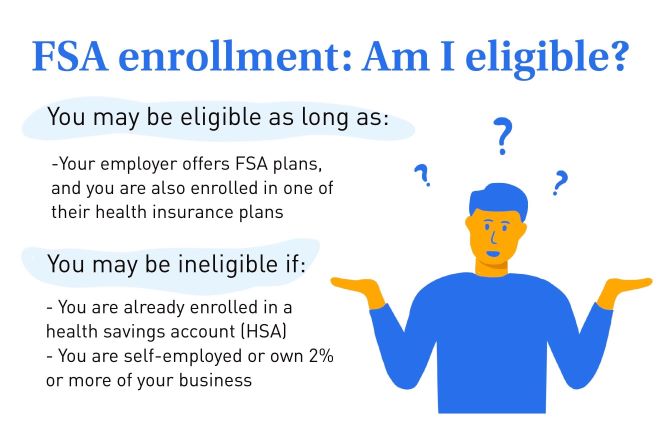
If your employer offers FSA plans, you are eligible to enroll as long as you are also enrolled in one of their health insurance plans. Other than that, there aren’t any special eligibility criteria. However, you likely won't be eligible to enroll in an FSA if you:
- Are already enrolled in a health savings account (HSA)
- Are self-employed or own 2% or more of your business
Enrollment periods
The enrollment periods for FSA plans are usually the same as enrollment for health insurance. In many cases, there are three types of enrollment periods:
- During open enrollment
- After qualifying life events
- When enrolling in health insurance for a new job
Open enrollment periods happen once a year, often from October to December. Employees can make any changes they need to their health benefits, including enrolling in an FSA, during open enrollment.
Employees can also make updates after a qualifying life event. These are events that can impact your coverage needs, such as marriage, divorce or having a baby. With many plans, you can enroll in an FSA when you make these updates. The enrollment period for a qualifying life event is usually within 30 to 60 days of the event.
Steps to enroll in an FSA
The exact steps for enrolling in an FSA will depend on your employer. In many cases, benefits enrollment is all done online through an employee portal. There are usually prompts to guide you through the whole process.
However, there are some earlier steps you can take to ensure you’re ready at enrollment time. The first step is to ask your employer if they offer FSA plans. If they do, other important questions to ask them include:
- What types of FSAs do they offer?
- Do they make contributions to their employees' FSA accounts?
- Do their plans allow carryover or have end-of-year grace periods for unused funds?
Choosing the right plan
Some employers may offer more than one type of flexible spending account. Understanding all your options can help you choose the right FSA plan and think about how to set it up.
A standard FSA is called a health care FSA (HCFSA). This is a general-purpose FSA that covers the widest range of out-of-pocket medical expenses. For example, you can use it to pay for co-pays, deductibles, and dental and vision exams. You can also use it for things you may not typically think of as medical, including:
- Contact lenses and solution
- LASIK
- Non-prescription reading glasses
- Hearing aids
- Immunizations
- Over-the-counter (OTC) pain relievers and other medicine
Many employers also offer other types of FSAs, sometimes called specialty FSAs. Unlike with standard plans, you can enroll in both an HSA and a specialty FSA. If available, they may suit your and your family's health care needs better than a standard plan.
- Limited Purpose (or Limited Expense) Health Care FSA – This plan only helps cover dental and vision medical expenses, including certain OTC items.
- Dependent Care FSA – This plan doesn't cover any medical expenses. Instead, it helps cover costs such as day care and elder care for your dependents while you're at work.
How to set up your FSA
After you've chosen an FSA type, it's time to start thinking about your contribution amount.
First, make sure you have a good idea of all the different eligible medical expenses. These can change from time to time, so check with your employer or account administrator for the most up-to-date list.
Think about which expenses you and your family are likely to have during the plan year. You'll likely want to put enough in your FSA to cover those without having too much left over.
Also, remember to factor in any contributions your employer will make. An FSA is a "use it or lose it" account, so there is a risk of forfeiting the unused funds if you over-contribute.
LEARN MORE: How to use your FSA funds
Managing your FSA
Once you've enrolled in an FSA, you won't be able to make any changes for the year (except for with qualifying life events).
However, there are a couple of important things to be mindful of:
- Keeping track of your receipts
- Keeping an eye on your FSA balance
Around half of those enrolled in FSA plans end up losing unused funds.
Aside from careful planning, the ideal way to avoid this common FSA pitfall is to stay on top of your receipts and balance.
If you make any FSA-eligible purchases out of pocket, you'll have to submit the receipts for reimbursement. And staying aware of your balance can help ensure that you can take advantage of any funds that won’t carry over.
Making the most of your FSA
An FSA can be a preferred way to supplement your health insurance as well as save some cash.
On average, FSAs can make it possible to save around 30% on eligible medical expenses.
Before you enroll, understand your options. Learn about all the FSA-eligible vision expenses, and then estimate your ideal contribution amount. Once you're enrolled, remember to keep your receipts and check on your balance.