SMILE laser eye surgery

On this page
What is SMILE eye surgery?
SMILE benefits and advantages
Limitations of SMILE eye surgery
SMILE eye surgery cost
Is SMILE right for you?
On this page
What is SMILE eye surgery?
SMILE benefits and advantages
Limitations of SMILE eye surgery
SMILE eye surgery cost
Is SMILE right for you?
What is SMILE eye surgery?
SMILE laser eye surgery is an alternative to LASIK surgery for the correction of nearsightedness. In some ways, SMILE eye surgery is similar to LASIK and it may offer advantages over LASIK for some patients. SMILE is an acronym for *SMall Incision Lenticule Extraction.*
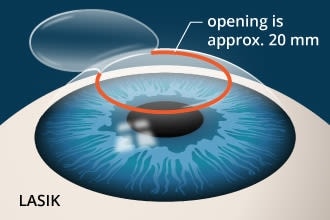
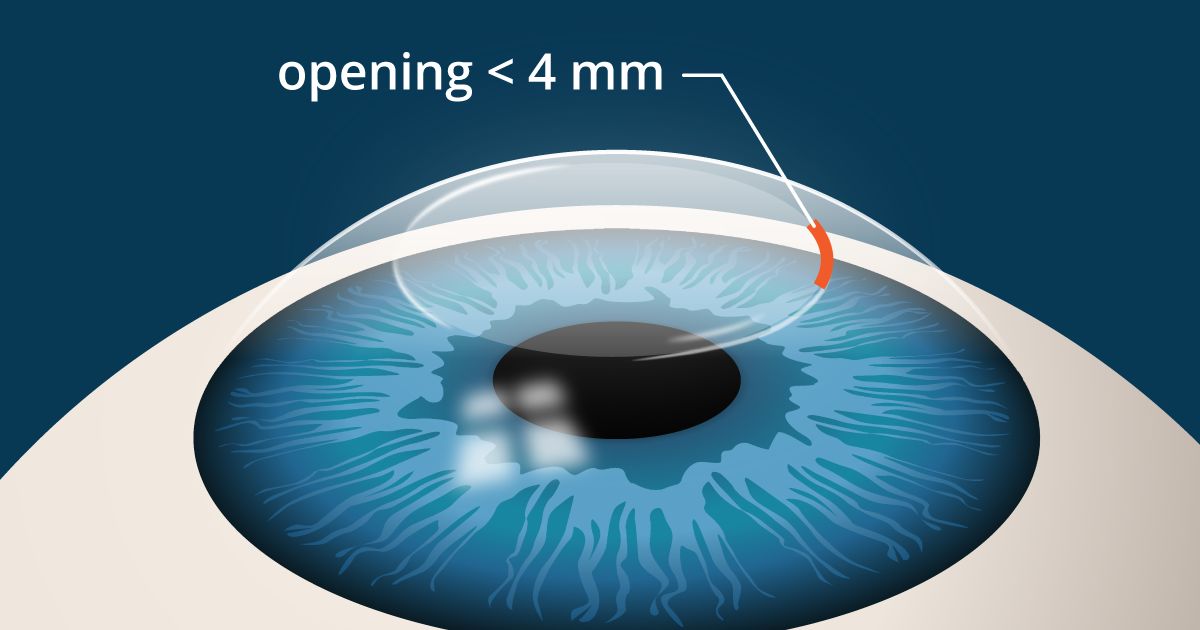
In LASIK, a large opening is required to enable the excimer laser to reshape the underlying cornea.
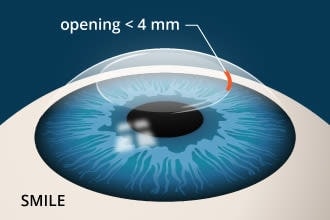
In SMILE, a small opening is needed (often less than 4 mm) to facilitate removal of the lenticule.
In the SMILE procedure, the surgeon uses a femtosecond laser to create a small, lens-shaped bit of tissue (lenticule) within the cornea. Then, with the same laser, a small arc-shaped incision is made in the surface of the cornea. The surgeon extracts the lenticule through this incision and discards it.
With the lenticule removed, the shape of the cornea is altered, correcting nearsightedness. The corneal incision heals within a few days without stitches with rapid visual recovery of functional vision typically within 48 hours.
SMILE laser eye surgery can correct up to -10.00 diopters (D) of nearsightedness.
Candidates for SMILE:
- Are at least 22 years old
- Have no more than -3.00 D of astigmatism
- Have had no changes in their eyeglass prescription for at least 12 months
SMILE benefits and advantages
Research is showing SMILE produces similar visual acuity outcomes as LASIK for the correction of nearsightedness, without the need to create a LASIK-style corneal flap.
In one study of 328 people who underwent the SMILE procedure, all but one had uncorrected visual acuity (UCVA) of 20/40 or better after surgery, and 88% had UCVA of 20/20 or better.
Also, it appears there may be less risk of dry eye symptoms after SMILE, compared with LASIK. SMILE does not require a large corneal flap like LASIK, meaning fewer corneal nerves may be affected by the procedure.
The small SMILE incision may also enable the cornea to maintain more of its strength and resistance to traumatic injuries after the procedure, compared with LASIK.
Research suggests SMILE may produce better refractive outcomes than LASIK for patients with high myopia, including less regression and less under-correction. However, both procedures have similar enhancement rates in recent studies.
Limitations of SMILE eye surgery
Are there any downsides to SMILE when compared with LASIK or PRK ?
For starters, SMILE can only correct nearsightedness. LASIK and PRK can also correct farsightedness and astigmatism.
Also, LASIK and PRK can treat higher-order aberrations (HOAs) that can affect night vision, whereas SMILE cannot.
And if you have residual refractive error after SMILE eye surgery, PRK usually is used for the enhancement procedure.
SMILE eye surgery cost
Most U.S. refractive eye surgeons charge about the same price for SMILE eye surgery as they do for all-laser LASIK — somewhere in the range of $2,000 to $3,000 per eye.
Factors that may contribute to the surgeon fees for SMILE include:
- The surgeon's experience
- The practice location
- Whether follow-up exams and enhancements (if needed) are included
Is SMILE right for you?
If you are nearsighted and meet the other criteria stated above, you might be a candidate for SMILE laser vision correction.
The next step is to have a comprehensive eye exam with your eye doctor and a consultation with a refractive surgeon.
On this page:
What is SMILE eye surgery?
SMILE benefits and advantages
Limitations of SMILE eye surgery
SMILE eye surgery cost
Is SMILE right for you?
On this page:
What is SMILE eye surgery?
SMILE benefits and advantages
Limitations of SMILE eye surgery
SMILE eye surgery cost
Is SMILE right for you?