7 ways to keep your glasses from fogging with a mask
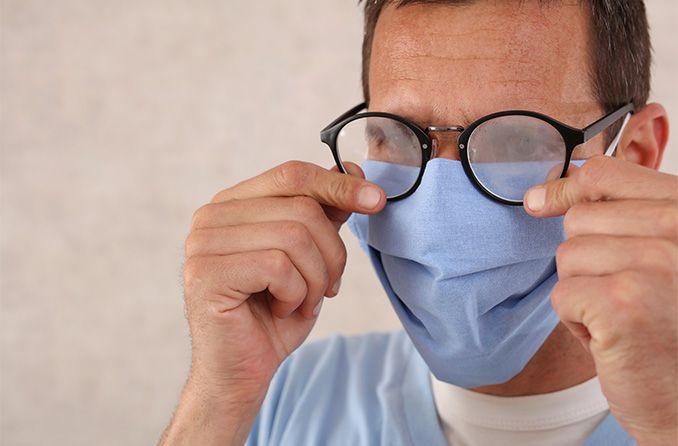

How do you prevent your glasses from fogging up?
Six years into the pandemic, there’s one thing that still puzzles eyeglass wearers: How to put an end to mask-induced foggy glasses once and for all.
The answer may depend on the glasses, the mask, or both.
Here are a handful of things you can try to reduce the fog on your lenses — or even get rid of it altogether:
- Wash your lenses with soapy water
- Seal the mask around the edges
- Make sure the mask fits well
- Adjust your glasses
- Use de-fogging products
- Try to breathe downward
- Use anti-fog lenses
1. Wash the lenses with soapy water
Before you put on your face mask, try this:
- Wash your glasses or sunglasses lenses with soapy water.
- Shake off the excess moisture.
- Let the glasses air dry or gently dry them with a clean microfiber cloth.
Using this method, the lenses shouldn’t fog up once you put on the mask and glasses, according to one study.
Cleaning the lenses with soapy water leaves a thin film that reduces the “inherent surface tension” and prods the water molecules to form a transparent layer.
To avoid damaging your lenses, don't clean them with household products such as baby shampoo, toothpaste or shaving cream.
2. Seal the mask
A common trick employed by doctors involves sticking a piece of double-sided tape across the bridge of the nose before putting on a mask.
Placing the double-sided tape between the inside of the mask and the bridge of your nose can help create a better seal.
3. Make sure the mask fits well
A loose-fitting mask aims exhaled air directly toward your glasses, but a snugly fitting mask directs air out of the bottom or sides of the mask — away from your glasses.
Masks with certain features can help achieve a better fit:
- Masks with foldable pieces around the nose (such as a metal strip)
- Masks that come in various sizes
A well-fitted mask can dramatically help to prevent the amount of hot air that can reach the lenses.
It's important that your face mask has a snug fit around the nose bridge. The more conformed the mask is around the bridge of your nose, the less of that hot air will end up hitting your lenses.
If you’ve crafted your own cloth mask, create a seal around the nose by inserting a moldable item into the upper part of the mask. This could be a paper clip, pipe cleaner, twist tie or a folded piece of aluminum foil.
4. Adjust your glasses
If your glasses have nose pads, you can tweak the pads so that the frames sit slightly farther from your face.
This will allow that hot air to escape instead of getting trapped between your face and the lenses of the glasses.
However, altering the nose pads may slightly change your vision if you wear glasses withprogressive lenses, or lenses with a strong prescription.
If that happens, you might need to hold your head at a different angle to compensate for the vision change.
5. Try de-fogging products
Applying over-the-counter anti-fogging sprays, waxes and gels to your lenses before putting on your glasses can help to quickly disperse tiny fog droplets when you’re wearing a mask.
However, it is not recommended to use anti-fogging products designed for cars or other purposes, as they might ruin your prescription lenses.
6. Breathe downward
It might be awkward, but breathing downward can be a quick anti-fog fix. This sends more air away from your glasses.
How do you breathe downward? Hold your upper lip over your lower lip. Then blow air downward, as if you’re playing a flute.
7. Consider anti-fog lenses
This won’t fix your foggy-lens problem right away, but you might want to consider buying lenses with ananti-fog coating.
An anti-fog coating gives you a hassle-free answer to foggy lenses, regardless of whether the obstructed vision is triggered by a face mask or something else.
Why do my glasses fog up in the first place?
Body heat and air flow lead to foggy lenses.
When you’re wearing a face mask, you repeatedly breathe out warm air. This air then can sneak out of the top of your mask and steam up the lenses of your glasses. Of course, this can make it difficult to see.
A face mask directs much of the exhaled air upward.
The “misting” of lenses happens when warm water vapor from your breath lands on the cooler lenses, producing tiny droplets that scatter light and reduce the lenses’ ability to transmit contrast (when light colors remain light and dark colors remain dark).
For the latest information on masks and mask guidelines, visit the CDC’s webpage on Masks and Respiratory Viruses Prevention.