What is an accommodating (IOL)?
An accommodating IOL (intraocular lens) is an artificial lens used in cataract surgery to replace the eye’s clouded natural lens. Accommodating IOLs are different from standard IOLs because they are able to change focus distances. This decreases the need for reading glasses after cataract surgery.
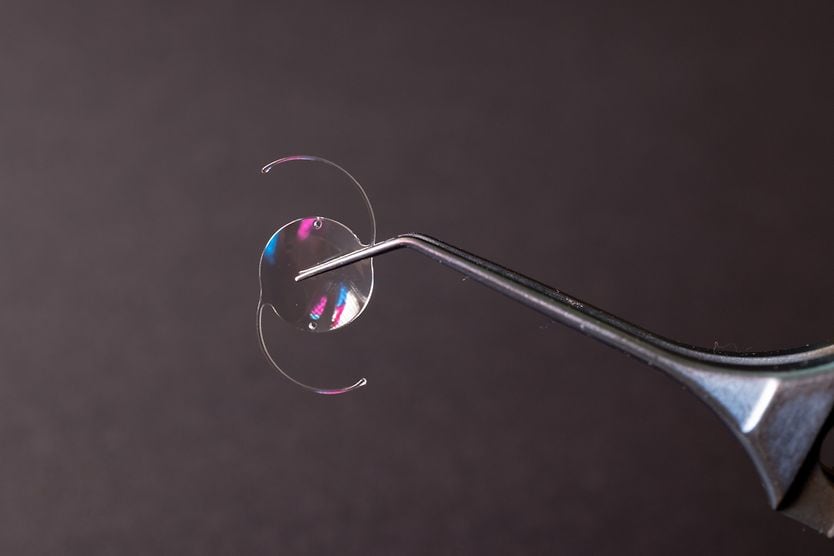
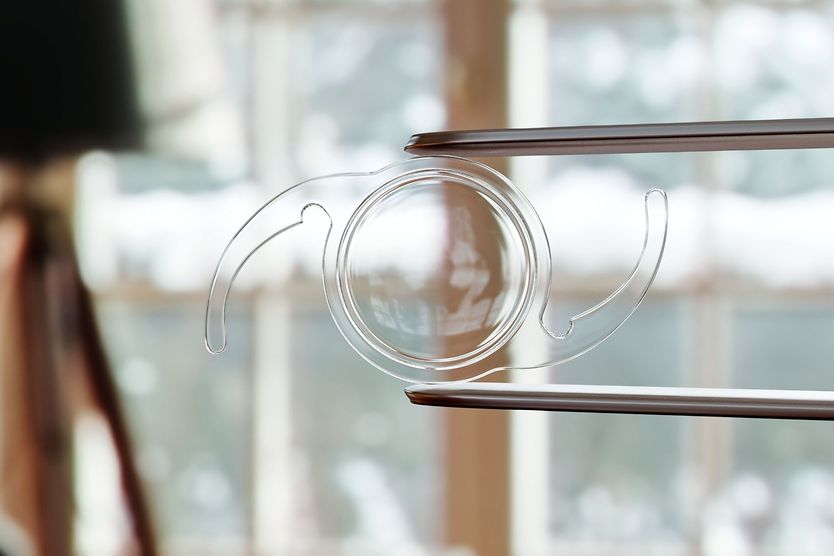
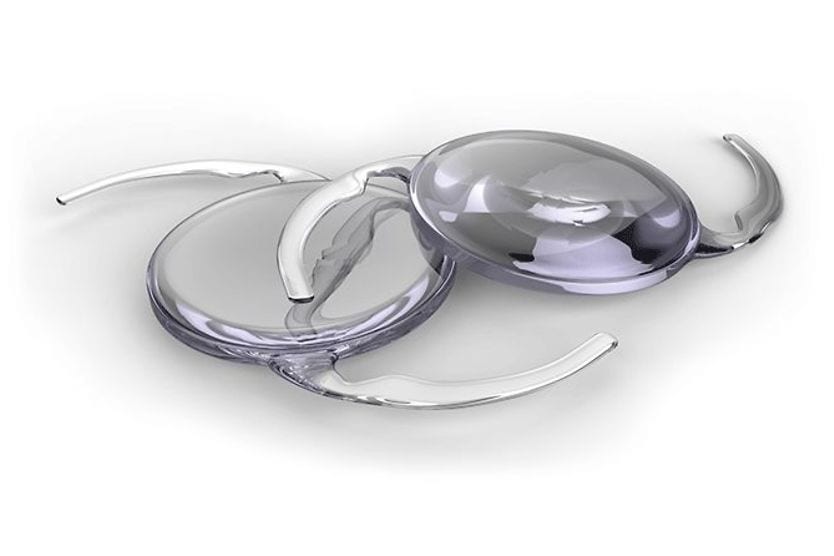
Accommodative IOLs have flexible “arms” called haptics. These haptics use the movements of the eye’s muscles to change focus from distance to near.
A standard IOL has a more basic design and is not able to work with the eye’s muscles. It has a single focus distance, usually far away, so reading glasses are still needed to do near work.
What is accommodation?
Accommodation is a process that enables the eye to adjust its focusing power. Focusing power is necessary for clear vision at all distances.
The accommodation system of the eye adapts to changing viewing distances. This allows incoming light rays to focus properly on the retina. The system includes the lens, the circular ciliary muscle that surrounds the lens, and the ciliary zonules. Ciliary zonules are like tiny fibers. They connect the ciliary muscle to the lens capsule that encloses the lens.
In a young eye, accommodation is essentially instantaneous and effortless. As the eye ages, the lens becomes less flexible. This causes the loss of near vision that is the hallmark sign of presbyopia in people over age 40.
How does the eye’s accommodation system keep our vision clear?
The eye’s accommodation system makes small adjustments to the curvature of the lens. Clear vision at different distances requires light to pass through the lens at different angles to hit the retina correctly. Accommodation adjusts the lens to help produce these angles.
For distance vision, the ciliary muscles relax, and the curve of the lens flattens
When the eyes gaze at an object at a distance, the ciliary muscles relax. This causes the zonules to become taut, which causes the lens to have a flatter curve. A flatter curve is better able to focus incoming light rays from distant objects onto the retina.
For near vision, the ciliary muscles contract, and the curve of the lens steepens
When the eyes gaze at a near object, the eye accommodates. During accommodation, the ciliary muscles contract, causing the zonules to relax. This allows the shape of the natural lens to thicken.
The thicker lens has a steeper curvature. A steeper curvature is better able to focus incoming light rays from the near object onto the retina.
How does an accommodating IOL work with the accommodation system of the eye?
An IOL is placed inside the lens capsule that held the original, natural lens. It is held in place by "haptics," which are arm-like structures on each side of the IOL.
A conventional IOL has stiff haptics
A conventional IOL has stiff haptics that hold the IOL in place. The area of the IOL responsible for focusing does not move when the ciliary muscles contract.
An accommodative IOL has flexible haptics
An accommodating IOL has flexible haptics that work with the eye’s accommodation system. When the gaze shifts to a near object, the ciliary muscles contract. This results in the bending of the flexible IOL haptics.
This causes the focusing area of the IOL to move forward. The forward position provides some added ability to focus at near, or "to accommodate."
How does a surgeon implant an IOL in the eye?
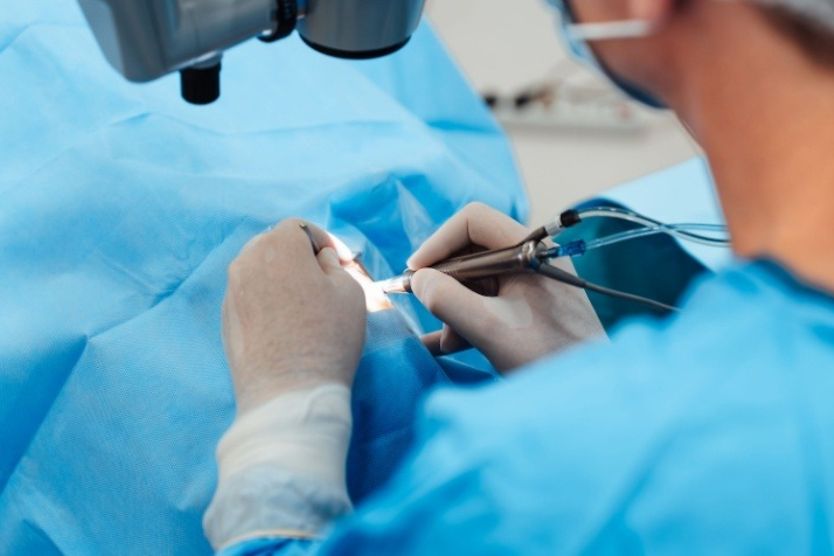
During cataract surgery, the surgeon creates an opening in the front (anterior) of the lens capsule. The opening is usually only about 2mm.
Then, using ultrasound or a laser, the surgeon breaks up the clouded natural lens. This makes it much simpler and quicker to then remove the lens through this opening. This step is called an anterior capsulotomy.

Crystalens is designed to move within the eye, to provide focusing at all distances. (Animation: Bausch + Lomb)
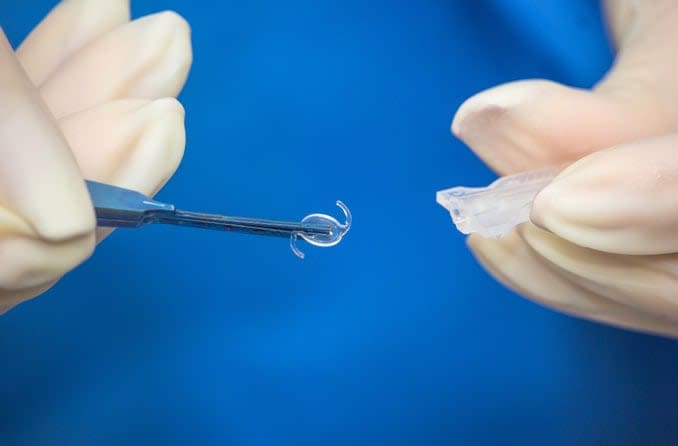
The sides and back of the lens capsule remain intact. This allows the surgeon to securely position the IOL in the place of the removed natural lens. The IOL is inserted into the lens capsule through the same tiny opening using a special type of cannula (or "injector").
All IOLs have a central optical zone (focusing area). Outside this zone, in the periphery, the haptics secure the IOL inside the lens capsule.
Advantages and limitations of accommodating IOLs
Crystalens and Trulign Toric accommodating IOLs do provide an expanded range of clear vision. But some people may still need reading glasses to see small print and perform other near vision tasks.
Even so, most people who choose one of these accommodating IOLs are very pleased with their results. They have much greater freedom from eyeglasses after cataract surgery.
Another type of presbyopia-correcting IOL is the multifocal IOL category. Like multifocal contact lenses, these premium IOLs have more than one power. They provide added magnification in certain zones of the lens to improve near vision.
Both categories of presbyopia-correcting lenses — accommodating and multifocal IOLs — have advantages and limitations. Generally, both designs expand the range of clear vision compared with standard IOLs.
But accommodating IOLs tend to provide sharper distance vision than multifocal lenses. Multifocal IOLs tend to provide more magnifying power than accommodating IOLs. This is helpful for seeing fine print.
Types of accommodating IOLs
Crystalens and Trulign Toric are both premium intraocular lenses (IOLs). They are both FDA-approved and are very similar in design. They can both correct presbyopia, nearsightedness or farsightedness. The main difference between these two accommodating IOLs is that the Trulign Toric IOL can also correct astigmatism.
Crystalens and Trulign Toric are the only FDA-approved IOLs for correcting presbyopia that work through accommodation. This is why they are classified as "accommodating IOLs."
Both lenses are manufactured and distributed by Bausch + Lomb.
Cost of accommodating IOLs
Premium IOLs like Crystalens and Trulign Toric cost more than monofocal IOLs. Also, they are typically considered an elective addition to cataract surgery. So the added cost of these presbyopia-correcting IOLs is not covered by Medicare or private health insurance.
You can expect an additional out-of-pocket cost of $1,500 to $3,000 or more per eye if you choose an accommodating IOL. This is especially true if you decide to upgrade to a laser cataract surgery procedure. Many surgeons recommend this to achieve the best possible vision with a presbyopia-correcting IOL.
The future of IOL technology
The Crystalens IOL has been around since 2003 and has been extensively used. However, some patients have experienced complications over time. In some cases, patients may develop fibrosis (scarring and thickening) of the lens capsule. This can result in the IOL being less effective.
Researchers are investigating how to keep the lens capsule more elastic over time. New IOL technology under development uses the power of the ciliary muscles to directly change an IOL’s shape (without the zonules). Technology that will allow an accommodating IOL to function as well as the natural lens is still several years away.
How do I know if an accommodating IOL is right for me?
Accommodating IOLs are one of many premium IOLs that can provide glasses-free vision after cataract surgery. Many people find that an accommodating IOL is well-suited for their lifestyle. Your cataract surgeon can help you decide if accommodating IOLs are the right choice for your particular needs. You'll be able to discuss all types of IOLs and any other questions during your preoperative eye exam and consultation.
Vance Thompson, MD also contributed to this article.