FAQs on Dry Eyes and Watery Eyes

Questions were answered by Dr. Burt Dubow and Dr. Charles Slonim

Q: I have dry eyes. I want to know if insurance will pay to have the implants put in the tear ducts? I am 22 years old. — R.W., Tennessee

A: Depends on your insurance. Usually yes, as it is a medical procedure to correct a medical condition. Usually works great, also! — Dr. Dubow

[Read more about dry eyes and lacrimal plugs.]


Q: My wife has rheumatoid arthritis, and from this very dry eyes. What are the best eyedrops to use? — K.M., Canada

A: There are a variety of over-the-counter artificial tears. There are proprietary brand names and generic brand names. Try them one brand at a time and see which works for her. After a while, if one stops working, switch to a new one. An artificial tear preparation that works for one person doesn't necessarily work for the next. Trial and error is the best way to go. — Dr. Slonim


Q: What can I do for excessively dry eyelids? They are cracking open. Also, I am experiencing a good bit of puffiness under my eyes. — J.W., Georgia

A: Cracking eyelids can be a sign of a staphylococcal blepharitis (inflammation of the eyelids), especially when the cracking occurs at the outer corners of the eyelids. If the cracking is really scaling, this could represent a type of psoriasis of the skin of the eyelids. If it is just dryness, try an eyelid moisturizing cream found at a makeup counter. If none of this describes the condition, see your eyecare practitioner. — Dr. Slonim


Q: I have been diagnosed with dry eyes but would still like to continue wearing contacts from time to time. Is it true that a lens lower in water content is better for me? — J.S., New York

A: Some contact lens practitioners find that, in fact, lenses with lower water content can sometimes be better for people who have dry eyes. But some patients actually do better with high-water content lenses. It has long been felt by some practitioners that the thicker the lens, the better, as well.

But why not try and alleviate the dry eye condition itself? My recommendation is to ask your doctor about the possibility of lacrimal or punctal occlusion, which plugs up the tear drainage system to keep more moisture in your eyes. — Dr. Dubow

[Read more about dry eyes and punctal occlusion.]


Q: I wore contact lenses about four years ago. I have dry eyes from prescription Premarin, which I must take for the rest of my life. Have there been any updates since that time to ensure a longer contact lens wearing period? — J.A.

A: You bet! There are several dry eye lenses on the market. Ask your eyecare practitioner to try Proclear Compatibles or Preference lenses from CooperVision, or Extreme H20 from Benz. These are the dry eye lenses I am familiar with. They can really expand your comfortable wearing time. I highly recommend you also use non-preserved contact lens care products. Ask your practitioner about the Purilens system.

There is also a procedure called lacrimal occlusion or punctal occlusion whereby your eye doctor can block some of your tear drainage, keeping more tears in your eyes. This is a simple procedure taking only a few minutes and done right in your doctor's office. It can work wonders for folks with dry eyes. — Dr. Dubow

[Read more about dealing with dry eyes.]
 

Contact Lenses

LASIK & Vision Surgery

Eyeglasses

Sunglasses

Eye Exams

Problems & Diseases

  Cataracts

  Glaucoma

  Macular Degeneration

  Other Diseases

Vision Insurance

Low Vision

Computer Vision

Sports Vision

Nutrition & Eyes

Buy Smarter

Vision Over 40

Vision Over 60

Children's Vision

Teens

Resources

Home

The patented electrolyte balance of TheraTears precisely matches the human tear film for dry eye relief. Save $1.00!

Tears Again advanced Liposome Eyelid Spray is ideal for patients who have trouble using eye drops

Tears Again Hydrate gels contain omega-3 fatty acids to treat dry eyes

Daily disposable contacts from CooperVision: healthy, convenient & affordable


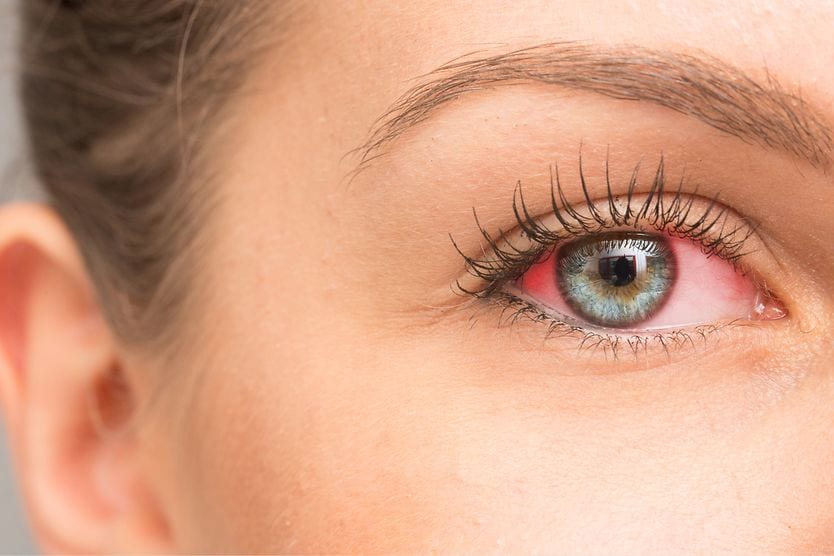
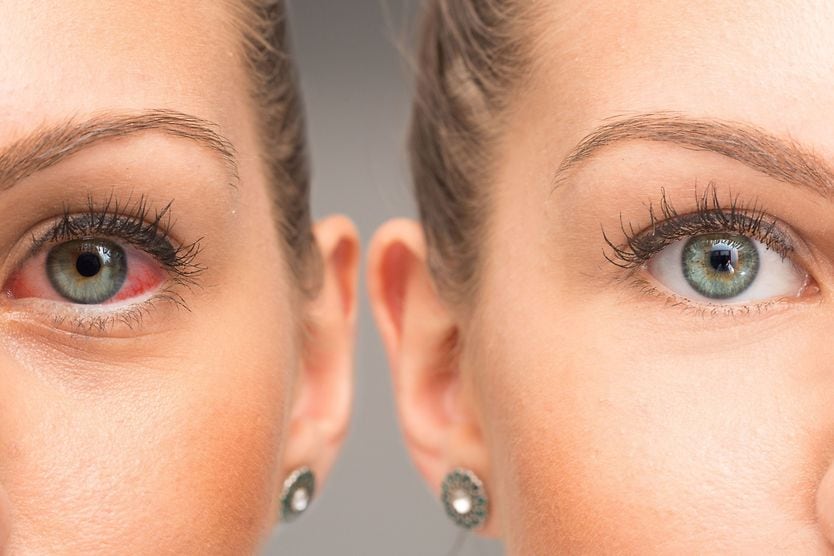
Q: I have worn soft contact lenses on and off for 15 years, and I chronically have red, bloodshot eyes. I've gone for periods of weeks and months wearing only my glasses and avoiding contacts, but honestly my eyes seem less bloodshot when I wear my contacts.

What can I do to clear up my eyes so they are not bloodshot? And does the fact they are chronically bloodshot indicate any eye health problems or disease? — M.A., Georgia

A: The known causes of red eyes take up volumes in the ophthalmic literature. It sounds like you need to obtain a diagnosis for your condition so that the appropriate treatment can be prescribed.

Allergies and dry eye syndrome are probably the two most common causes of red eyes. Wearing contact lenses on top of an already inflamed eye can only lead to further problems. A thorough examination to determine the etiology of your bloodshot eyes is needed. — Dr. Slonim

[Read more about allergies or dry eye syndrome.]


Q: Why do some contact lenses feel more dry than others? Is it better to go with lower water content or higher? — R.D., Georgia

A: This is a very technical question. What are you, an optometrist looking for some free clinical advice? What the heck... Contact lenses are made from different plastics and silicones that have different characteristics. Some have more water content than others. All contact lenses are subject to evaporation while on the eye — in other words, the environment sucks the water out of the lenses. The rate of this happening depends on many factors: humidity, wind, temperature, your health, what medicines you are taking, how much you blink, the care system you use, how clean the lenses are, etc.

Some eyecare practitioners believe that high water content lenses perform better for those with dry eye, while others believe just the opposite. A few lenses are now available that are made from plastics that resist dehydration and evaporation. They include Proclear Compatibles from CooperVision and Extreme H20 from Benz. The Preference line of lenses from CooperVision also has been touted for dry eye patients.

An in-office procedure is also available that blocks some of the tears from draining away. Tiny plugs are inserted into the tear drainage holes in the eyelids. This is called lacrimal occlusion. It is very safe and very effective for those with clinically dry eyes, and can really help with comfortable contact lens wear. — Dr. Dubow


Q: Why do my eyes water all the time, especially my left eye? — Susie, California

A: This is actually impossible to know without examining you. But you should consider two major things: your tear drainage system may be plugged, or you may have dry eyes. Although this seems contradictory, these two conditions are the most common for causing watery eyes.

If your eyes are constantly watery, with tears dripping onto your face, I would suspect a blockage in your drainage system. This can usually be alleviated by flushing out the tiny tubes that drain the tears.

If your eyes water primarily when you are in wind or cold or when your eyes are irritated, I would suspect dry eyes as the cause. This can be helped by actually blocking the tear drainage system to keep more tears in your eyes.

I recommend you see an eye doctor who is familiar with lacrimology and can test you for these two problems, along with considering other factors such as your lids and how their shapes interact with your eyes. — Dr. Dubow

[Read more about dry eye syndrome.]


Q: I have a tear duct that leaks on regular basis. My doctor recommends surgery. What does this entail? — C.K.

A: Sounds like you need a dacryocystorhinostomy (DCR). This is usually done under local anesthesia as an outpatient through a small incision on the side of the bridge of the nose. It is a type of bypass surgery where the blockage inside the duct is bypassed and a direct re-routing of the tears is done through a man- (or woman-) made opening in the nose.

Typically the procedure has a 94 percent success rate. Rarely some post-op discomfort might occur. Seek out an oculoplastic surgeon with experience in performing this procedure. — Dr. Slonim

[Read more about tear duct leakage and dry eye syndrome.]


Q: Lately I have been experiencing excessive tearing from both eyes, but with no eye allergy symptoms (no red, swollen, or itchy eyes). I am five months pregnant — could excessive tearing be a symptom of pregnancy? What can I do to stop the tears? — E.R., Virginia

A: Excessive tearing can be one of the many symptoms of pregnancy. You can't stop them, just wipe them. There could be a problem with the outflow mechanism (tear ducts) that drains the tears away from the eyes and into the nose. As long as there is no infection or other symptoms that you mentioned, wait until after the delivery to see if the tearing goes away. If you are concerned, check with your eyecare practitioner. — Dr. Slonim

[Read more about tearing and dry eyes.]

Do you have a question about dry eyes? Ask Dr. William Trattler, our dry eye expert. He will answer selected questions, which we will publish on this website.

Please note: If you have an urgent question regarding your eye health, please call your eye care practitioner immediately! This page is designed to provide general information about vision, vision care and vision correction. It is not intended to provide medical advice. If you suspect that you have a vision problem or a condition that requires attention, consult an eye care professional for advice on the treatment of your own specific condition and for your own particular needs. For more information, read our Terms of Use.

[Page updated February 2006]

The patented electrolyte balance of TheraTears precisely matches the human tear film for dry eye relief. Save $1.00!

Tears Again advanced Liposome Eyelid Spray is ideal for patients who have trouble using eye drops

Tears Again Hydrate gels contain omega-3 fatty acids to treat dry eyes

Daily disposable contacts from CooperVision: healthy, convenient & affordable

Reproduction of any images or text from this website is prohibited by copyright law. Please read our copyright infringement policy.

Link Colors: Green = glossary terms, Blue = other pages
 
All About Vision is a registered service mark of Access Media Group LLC.
Copyright 2000-2008 Access Media Group LLC.

This website is accredited by Health On the Net Foundation. Click to verify.

We comply with the
HONcode standard for
trustworthy health
information:
verify here.