Our eyes exhibit age-related changes in performance as we age — particularly as we reach our 60s and beyond.
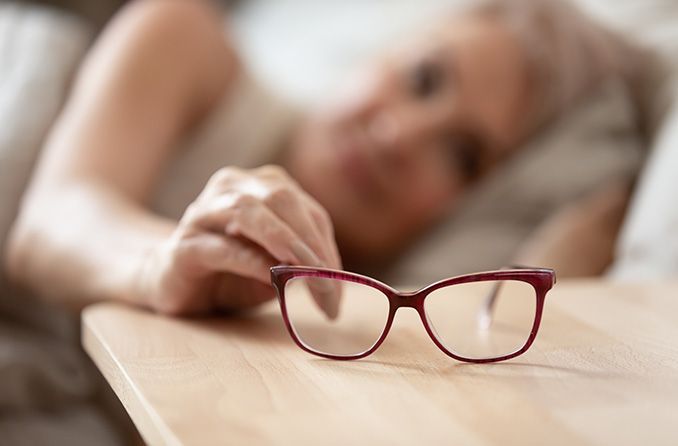
Some of these changes, such as presbyopia, are perfectly normal and don't signify any sort of disease process. Reading glasses are a good solution for these conditions.
And though cataracts can be considered an age-related disease, they are very common among seniors and can be readily corrected with cataract surgery.
Some of us, however, will experience more serious age-related eye diseases that have greater potential for affecting our quality of life as we grow older. These conditions include glaucoma, macular degeneration and diabetic retinopathy.
Common age-related vision changes
Presbyopia
After you pass the milestone age of 40, you'll notice it's more difficult to focus on objects up close. This is because the lens inside the eye begins to lose its ability to change shape — a process called presbyopia.
For a time, you can compensate for this gradual decline in focusing ability by holding reading material farther away from your eyes. But eventually you will need reading glasses, progressive lenses or multifocal contact lenses.
Some corrective surgery options for presbyopia also are available, such as corneal inlays, monovision LASIK, conductive keratoplasty and refractive lens exchange.
As you continue to age through your 50s and beyond, presbyopia becomes more advanced. You may notice the need for more frequent changes in eyeglass or contact lens prescriptions. You may also find that a single prescription is no longer the best solution for all your visual needs.
As an example, you may need one pair of eyeglasses for normal tasks and another that emphasizes intermediate ranges for working more comfortably at the computer.
Cataracts
Even though cataracts are considered an age-related eye disease, they are so common among seniors that they also may be classified as a normal aging change.
According to Mayo Clinic, about half of all 65-year-old Americans have some degree of cataract formation in their eyes. As you enter your 70s, the percentage is even higher.
Thankfully, modern cataract surgery is extremely safe and so effective that 100 percent of vision lost to cataract formation usually is restored.
If you are noticing vision changes due to cataracts, don't hesitate to discuss symptoms with your eye doctor.
It's often better to have cataracts removed before they advance too far. Also, you do have options now for trying multifocal lens implants or accommodating intraocular lenses that potentially can restore all ranges of vision, thus reducing your need for reading glasses.
Major age-related eye diseases

Despite some age-related vision changes that are inevitable, you may be able to keep your eyes healthy for a lifetime.
Macular degeneration
Also called age-related macular degeneration or AMD, macular degeneration is a leading cause of blindness among seniors. According to the National Eye Institute (NEI), more than two million Americans currently have age-related macular degeneration. And due to the aging of the U.S. population, that number is expected to more than double to 5.4 million by 2050.
Glaucoma
Your risk of developing glaucoma increases with each decade after age 40, from around 1 percent in your 40s to up to 12 percent in your 80s.
Diabetic retinopathy
More than 10 million Americans over age 40 are known to have diabetes. Among known diabetics over age 40, NEI estimates that 40 percent have some degree of diabetic retinopathy that could lead to permanent vision loss.
Other age-related eye changes
While we often think of aging as it relates to conditions such as presbyopia and cataracts, more subtle changes in our vision and eye structures also take place as we grow older.
These changes include:
Reduced pupil size
As we age, muscles that control our pupil size and reaction to light lose some strength. This causes the pupil to become smaller and less responsive to changes in ambient lighting.
Because of these changes, people in their 60s need three times more ambient light for comfortable reading than those in their 20s.
Also, seniors are more likely to be dazzled by bright sunlight and glare when emerging from a dimly lit building such as a movie theater. Eyeglasses with photochromic lenses and anti-reflective coating can help reduce this problem.

As we age, we naturally lose some of the visual abilities we had when we were younger.
Dry eyes
As we age, our bodies produce fewer tears. This is particularly true for women after menopause. If you begin to experience a burning sensation, stinging, or other eye discomfort related to dry eyes, use artificial tears as needed throughout the day for comfort, or consult your eye doctor for other options such as prescription dry eye medications.
Loss of peripheral vision
Aging also causes a normal loss of peripheral vision, with the size of our visual field decreasing by approximately one to three degrees per decade of life. By the time you reach your 70s and 80s, you may have a peripheral visual field loss of 20 to 30 degrees.
Because the loss of visual field increases the risk for automobile accidents, make sure you are more cautious when driving. To increase your range of vision, turn your head and look both ways when approaching intersections. [Read more tips about vision, aging and driving safety.]
Decreased color vision
Cells in the retina that are responsible for normal color vision decline in sensitivity as we age, causing colors to become less bright and the contrast between different colors to be less noticeable.
In particular, blue colors may appear faded or "washed out." While there often is no treatment for this normal, age-related loss of color perception, you should be aware of this loss if your profession (e.g. artist, seamstress or electrician) requires fine color discrimination. However, if your fading color vision is also due to cataracts, much of the loss can be restored with cataract surgery.
Vitreous detachment
As we age, the gel-like vitreous inside the eye begins to liquefy and pull away from the retina, causing "spots and floaters" and (sometimes) flashes of light. This condition, called vitreous detachment, is usually harmless. But floaters and flashes of light can also signal the beginning of a detached retina — a serious problem that can cause blindness if not treated immediately. If you experience flashes and floaters, see your eye doctor immediately to determine the cause.