Custom wavefront LASIK: Personalized vision correction

Consider custom wavefront LASIK to enhance your vision with optimal precision.
Here are key things you should know about this advanced form of LASIK surgery.
What is custom wavefront LASIK?
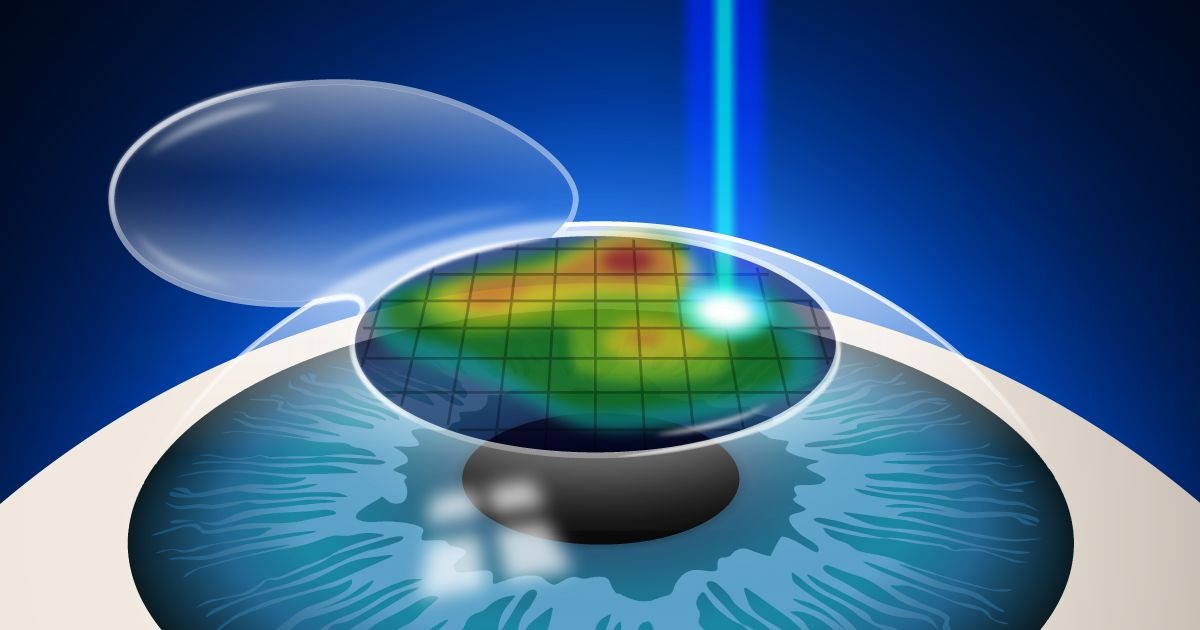
Custom wavefront LASIK — also called custom LASIK or wavefront LASIK — adds a greater degree of precision and personalization to LASIK vision correction surgery by using advanced wavefront technology to evaluate the unique characteristics of your eyes.
Conventional LASIK surgery attempts to recreate the vision correction that your eyeglass prescription provides.
But eyeglass prescriptions are not unique — thousands, even millions, of people can have the same eyeglass prescription. And because of unique characteristics of each person's eyes that cannot be measured with the conventional technology used to determine refractive error during an eye exam, people who have the same eyeglasses prescription will see the world with different degrees of clarity with those same prescription lenses.
Custom LASIK uses much more detailed information than a conventional eyeglasses prescription to program the excimer laser that reshapes your eye during the vision correction procedure.
1. Custom wavefront LASIK is more precise.
During a routine eye exam, your doctor will introduce different lenses in front of your eyes while you are looking at an eye chart and ask, "Which lens makes the letters look clearer — lens 1 or lens 2?" Sometimes the lenses will look the same, and it's hard to choose which one makes the chart look clearer. Maybe a lens in between the two?
Each "click" on the dial of that instrument your doctor uses to determine your eyeglasses prescription represents the smallest unit of power used to manufacture a conventional pair of eyeglasses, which is 0.25 diopter (D). This is why your eyeglass prescription has numbers like -1.25 D and -1.50 D, but not 1.3 D.
With custom wavefront LASIK, the power of lenses required to correct your vision is measured in 0.01 D units. In other words, imagine if during your eye exam, instead of having just "lens 1" and "lens 2" to choose from, you had 24 additional lenses in between these two to choose from!
Thankfully, choosing the lens that most accurately corrects your vision for a custom LASIK procedure is done instantaneously by a computer, instead of making you decide.
By evaluating the refractive errors of your eyes in 0.01 D increments (instead of 0.25 D increments, as in a routine eye exam), measurements used for custom wavefront LASIK are 25 times more precise than lens powers used in an eyeglasses prescription.
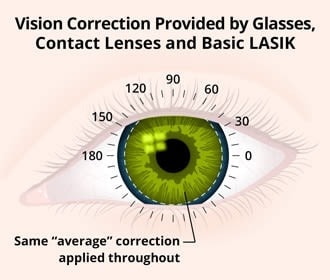
2. Custom wavefront LASIK is more specific.
When your doctor is determining your eyeglass prescription during your eye exam, he or she is evaluating your eye's ability to focus light as a unified whole. One lens prescription is determined for your entire eye.
Measurements gathered for custom LASIK are collected from hundreds of separate reference points on the front surface of the eye. All these data points used to create a detailed map of the refractive error and focusing imperfections called higher-order aberrations across the entire cornea.
This map is then used to program the excimer laser to deliver a personalized vision correction for your specific needs.
Types of custom LASIK
There are three basic types of custom LASIK procedures:
1. Wavefront-guided LASIK. This procedure uses detailed, wavefront-generated measurements of how light waves travel through your eyes and fall upon the retina, to create a laser treatment that is completely personalized for your eye anatomy and vision correction needs. In addition to correcting nearsightedness, farsightedness and astigmatism, wavefront-guided LASIK reduces irregular higher-order aberrations that can reduce visual clarity even after all major refractive errors are corrected.
2. Wavefront-optimized LASIK. This procedure uses detailed measurements of the curvature of the front surface of your eye to preserve the natural aspheric shape of your cornea. Preserving the cornea's natural shape reduces the risk of a particular type of higher-order aberration called spherical aberration, which can occur naturally in an eye or can be caused by other types of laser vision correction procedures. Spherical aberration often causes halos around lights and other night vision problems.
3. Topography-guided LASIK. This procedure uses detailed measurements of the surface of the cornea to program the laser to address vision problems caused by corneal irregularities (including corneal scars) in addition to refractive errors. Topography-guided LASIK is not a wavefront LASIK procedure, but it provides a more personalized vision correction than conventional LASIK.
How does custom LASIK compare to regular LASIK?
In one published report of a multi-center clinical trial of custom LASIK, uncorrected visual acuity (UCVA) at 12 months after surgery was 20/20 or better in 92.7% of eyes, 20/16 or better in 68.9%, and 20/12.5 or better in 31.6%. Compared with the patients' best spectacle-corrected visual acuity (BSCVA) before the procedure, UCVA after custom LASIK was better by one or more lines on an eye chart in 29.6% of eyes and equal to or better than pre-operative BSCVA in 60.3%.
Many factors should be considered when deciding between custom or regular LASIK — including your eyeglasses prescription, the thickness of your cornea, your current satisfaction with your vision with glasses, how critical you are about the quality of your visual acuity, your visual needs, and your budget.
During your pre-op exam and consultation, your eye doctor and/or LASIK surgeon can better inform you about your specific needs and whether you are likely to notice significantly better vision with custom LASIK compared with regular LASIK.
Also, your surgeon will be able to explain which type of custom LASIK technology they prefer and the visual outcomes patients with refractive errors similar to yours have attained with that technology.
How much does custom LASIK cost?
The cost of LASIK and other laser vision correction surgeries can vary significantly in different regions and by the type of facility where you choose to have your procedure performed.
During your LASIK consultation (see below), ask your surgeon about details regarding the cost of different custom LASIK procedures and options. (Read more about LASIK eye surgery cost.)
More questions? Schedule a consult
Now that you have the basics about custom LASIK, the next step is to find out if you are a good candidate for LASIK surgery.
Click here to find an eye doctor near you.
Schedule a pre-operative exam and consultation with an experienced refractive eye surgeon.
After your doctor has had a chance to examine your eyes and analyze the results of all measurements performed at this visit, he or she will be able to tell you with certainty whether you are a good candidate for laser vision correction and give you more details about the best procedure for your needs and the exact costs involved.