Q&A on LASIK and Other
Vision Correction Surgery
Q: I have worn hard contact lenses for 30 years. I now would like to have LASIK surgery done. How long will I have to wear my glasses before I can have the surgery? It's already been two months, and my eyes have not reshaped yet. D.M., Wisconsin
A: Many years of hard lens wear can cause significant alterations in the way your corneas work. They can take up to a year to recuperate!
Before you have LASIK, it is critical to make sure your corneas are completely stable. I tell my patients that I can't predict exactly how long this will take.
As soon as I find two prescription and cornea checks that are identical, that's when they are ready for the permanent surgery.
What goes into the laser (which is run by computer) determines what comes out. In other words, if you want the best result, be patient and don't rush. It will be worth it in the long run! Dr. Dubow
Q: I've heard rumors that RK, PRK and related laser surgery can, in the long term, bring on cataracts sooner than normal. Is this true? T.M., Florida
A: I am not aware of any current scientific studies with those outcomes or results. Dr. Slonim
Q: A local eye surgeon made the statement that the laser machines are "calibrated" for the climate of the area you live in. Therefore, if I live in the desert and go to a humid city to have my LASIK surgery, the results would not be as good. Is this true? L.M., Texas
A: No, the calibration is only for the humidity (and environment) in the room when the laser procedure is performed. Going to a different climate or environment should have no effect on the final refractive outcome. Dr. Slonim
Q: I went for LASIK, and the surgeon could not obtain a "good flap." He did not attempt the other eye and said to let it heal for three months, and he would try again. What are the chances of the same situation happening? Is it dangerous to have this happen again, or would there be a chance that it could be completed the next time? What would be the reason for not getting a good flap? I really want this surgery. B.D.
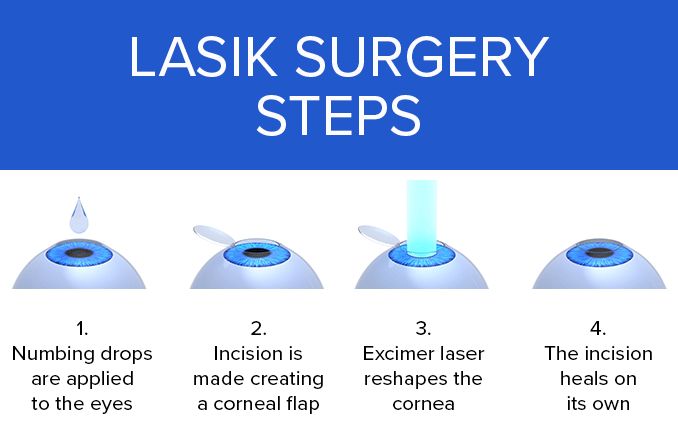
A: A bad flap could have been a mechanical phenomenon (e.g., poor centration, poor thickness) with the microkeratome that cuts the corneal flap. You don't want this to occur often. Chances are that it will be completed the next time. Most surgeons (as yours did not) would not do the other eye when this occurs. Dr. Slonim
Q: What is the likelihood of me becoming nearsighted again after LASIK surgery? Have any studies been done? F.B.
A: The potential for regression is much less than that of RK. The studies are difficult to assess, because the results are so surgeon dependent. Dr. Slonim
Q: If you have monovision surgery done, is there a range of correction between the eyes that cannot be exceeded? For example, can the distance eye be made too strong for the reading eye to be able to read? In my case, I need to be able to see up close to do my carpentry work, but I want to see to drive without glasses, and I have a fairly strong nearsighted prescription now. J.S.
A: Prior to having monovision surgery, make sure that you try monovision contact lenses first and then decide what power you want the surgeon to cut into your corneas. Dr. Slonim
Q: I heard that a man with LASIK had problems at high altitude. Is this true, and what causes this? Also, my sister REALLY wants to have this done but is diabetic. Should she be concerned? Thanks. G.S., New York
A: I am not aware of any reported altitude problems with LASIK, though high altitudes have been known to cause increased corneal edema in patients who sleep in their contact lenses. Diabetes is not a contraindication to having LASIK. It depends on how stable her diabetes is. Dr. Slonim
Q: I am thinking about LASIK surgery, but I am afraid that if the MD made a mistake and made a cut deeper or longer than it should be, I may end up blind. Has there been an incident where the patient ended up blind? Also, if the MD indeed made that type of mistake, is there a way to fix it? J.
A: There have been no documented cases of blindness from LASIK that I am aware of. Whether a "mistake" or unforeseen LASIK complication can be fixed depends on the type and severity of the "mistake" or complication. Surgical results can never be guaranteed. Dr. Slonim
Q: I am considering LASIK corrective eye surgery. I have rheumatoid arthritis. It is currently controlled by drugs. What are the problems that I might have as a result of LASIK surgery? J.B.
A: The main concern is the association of dry eyes with rheumatoid arthritis. LASIK procedures have been known to exacerbate dry eye symptoms. Dr. Slonim
[Read about LASIK and dry eyes.]
Q: I wear soft contact lenses all day, but take them out at night. What is the minimum time period I would have to wait (after ceasing contact use) before getting LASIK done? T.P.
A: Most docs will have you wait at least a week. Other, more conservative surgeons may stretch it out to two or three weeks. Dr. Slonim
Q: I wear eye makeup and was told no eye makeup on the day of surgery and for a few days afterwards, which I can understand because of risk of infection. My question is, when I can go back to wearing eye makeup? I usually remove the makeup at night with an oil-based mascara remover, and you have to gently stroke the closed eyelid to get it off the lashes. Will touching my eye in this manner hurt anything after, say, the fourth day after surgery? Debbie
A: The rules of makeup differ from one surgeon to the next. Rubbing your eye after LASIK is a no-no, but every surgeon has a different time limit. Ask your surgeon, and stick to his post-op instructions. Dr. Slonim
Q: I wonder if laser surgery is the way to correct vision in a person of my age. I am 71. I never seem to see anything regarding age in any of the ads. I am in very good health and am nearsighted and have some astigmatism. Thank you for your time, I really do appreciate it. D.Q.
A: No, LASIK is not for the patient in whom future cataract surgery might be the option to improve vision without eyeglasses. Dr. Slonim
Q: I am thinking of having LASIK performed but am concerned because I have some general body tremor and some involuntary eye movements. . . particularly if tense. My assumption has been that this would make the procedure difficult and greatly decrease the chances of success. Is this correct? Any recommendations? Thank you.
A: Everyone has involuntary eye movements. Let the LASIK surgeon assess your eye movements to see if you are a candidate. Dr. Slonim
Q: How long do I need to wait to fly in a pressurized commercial airliner after my surgery? Janet
A: It depends on what kind of surgery: after LASIK, probably no wait, except the dry cabin air may be uncomfortable; if it's retinal surgery with a gas bubble in the eye, you would have to wait until the bubble is gone. Dr. Slonim
[Whatever the surgery, please be sure to ask your own surgeon this question, since he or she knows the particular condition of your eyes. Ed.]
Q: I had LASIK surgery four months ago. My left eye was re-done after a month. The second time wasn't successful. My left eye still can't see clearly, even if I put on whatever grade of glasses. After the second LASIK, my doctor checked it and tells me that there is still some uneven surface left in my cornea that needs to be smoothed out. She recommends a third surgery. Is that OK? Aren't there any side effects from having too much LASIK surgery? I'm a bit hesitant about trying a third time because it may just bring about the same results. Plus, is there anything to prevent nearsightedness from coming back? V.A., Philippines
A: Yes, there are side effects of having too much of any surgery, including LASIK. If you want to have your vision improved (and not require glasses), then a third LASIK may be your only option. But before you get a third LASIK, get a second opinion. Dr. Slonim
Q: Has the military accepted vision correction procedures such as LASIK? I know they are looking into it, but I haven't heard anything in a long time.
A: I believe some branches of the military do accept LASIK. Ask your recruiting officer. Dr. Slonim
Q: I am 55. Can I have LASIK surgery? Without glasses I can see to read or do close work. But at medium to far my eyes are myopic. J.S., Ohio
A: There are no age limits for refractive surgery procedures. LASIK works just as well at 55 as it does at 25 to correct distance vision. However, you must realize that the near vision you enjoy without correction now will disappear following LASIK. In other words, you will probably see very well far away, but you will have to wear reading glasses to read anything up close magazines, books, newspapers, menus, maps, etc.
Some people who have refractive surgery over the age of 40 elect to correct one eye for distance and the other for near called monovision which works for some but not for others. And remember that your body will continue to change throughout your lifetime, making it very probable that you will have to wear glasses again at some point.
Having said that, I think LASIK can be an excellent alternative for those who understand its limitations and accept them even at the "ancient" age of 55! Dr. Dubow
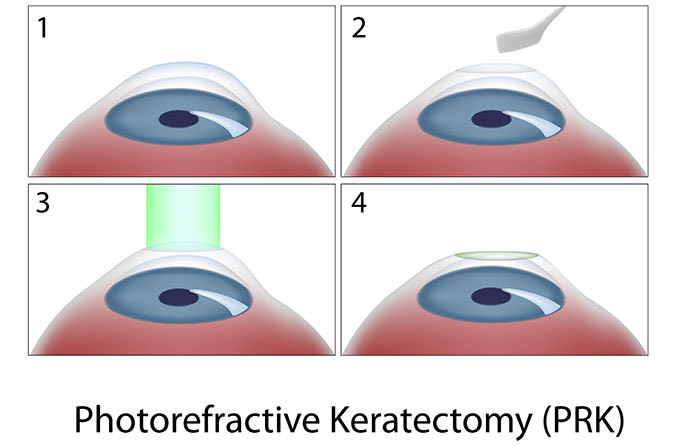
Q: I had PRK done about seven months ago. I had trouble with scar tissue building up, but there is only a small trace left due to use of steroids. Will I have difficulty with my vision later in life due to this? L.S., Canada
A: Depends on the density and location of the scar. It could possibly be permanent but might still fade away over more time. Dr. Slonim
Q: I am waiting for FDA approval of a higher degree of correction in LASIK surgery. I am farsighted and have astigmatism on the far end. My doctor was the one that suggested the wait. Is there any news of when the approval might be? Patricia, Louisiana
A: Find a LASIK surgeon that does farsighted people and keep in constant contact with that surgeon. They are usually in the information loop with the FDA and the laser-producing companies. Dr. Slonim
[Read more about current FDA approvals for LASIK lasers.]
Q: I have a key-hole shaped pupil. I've had this since birth. What causes this, and should it affect my vision? Also, would this affect my chances of getting laser surgery to correct my vision? M.K., North Carolina
A: Sounds like an iris coloboma. It is simply a congenital defect where the iris didn't close all the way at birth. Typically it's harmless. It is not a contraindication to laser vision correction surgery, but it depends on the size of the coloboma and on the surgeon. Dr. Slonim
Q: I hear about LASIK surgery, and it sounds great, since I'm pretty nearsighted. On the other hand, over the years I've developed a nasty allergic reaction to polysporin and neosporin. When my dad had lens implants done (admittedly many years ago), he had to put that stuff on his eye while healing. Does my drug allergy preclude me from having corrective surgery on my eyes? J.S., California
A: Drug allergies would only preclude your doctor from using that drug after surgery. Typically, after LASIK surgery an antibiotic and a steroid are used postoperatively for about a week or two. There are a number of different ophthalmic antibiotics that can be used. Polysporin and neosporin are not typically used after LASIK. Discuss your drug allergies and concerns with your ophthalmologist prior to having the procedure. Dr. Slonim
Q: I have been told that there are certain kinds of astigmatism that are not operable by LASIK. Is that true, and can corneal rings help? M.W., California
A: As a general rule, if the astigmatism is too great for LASIK, then the corneal rings won't be attempted. Dr. Slonim
Q: Can I have laser surgery after having cornea transplants? My eyesight without my contact lenses is 20/400 and 20/900+. Would the surgery help me? M.T., California
A: Assuming you are referring to LASIK surgery, this can be done after corneal transplants, but it is highly dependent on the condition of the rest of your eye. If you are referring to glaucoma laser procedures or retinal laser procedures, these can also be done after corneal transplant surgery. Dr. Slonim
Q: What is LTK? I have heard that it is not as invasive and problematic as LASIK. I am concerned with safety. P.D., Florida
A: Lamellar thermokeratoplasty (LTK) uses heat to cause localized shrinkage of the corneal tissue to change its shape and essentially reduce the refractive error. In experienced hands it is effective for certain levels of refractive error. Dr. Slonim
Q: What is the cost of LASIK surgery per eye? I am mildly nearsighted with a slight astigmatism. R.B., Missouri
A: The cost of LASIK depends on your location. Check your local newspapers, where LASIK surgeons tend to advertise. The price originated at $2,250 per eye. I have seen prices as low as $400 per eye in different parts of the country. Dr. Slonim
Q: My father is 83 years young and was told he has macular degeneration. Is he a candidate for LASIK surgery? My dad lives in Florida and is scared out of his wits. Joanie, New Jersey
A: At 83 years old, your father is not a candidate for LASIK except under some rare circumstances.
Cataract surgery would have the same effect as the LASIK in reducing your father's refractive error. When the cataract (cloudy lens of the eye) is removed, the surgeon replaces it with an artificial intraocular lens (IOL) whose power is calculated preoperatively, usually to eliminate the need for distance glasses. If he has a visually debilitating cataract, the degree of his macular degeneration will determine whether he is a good candidate for cataract surgery. Dr. Slonim.
Q: Could you please explain what is meant by the term "mixed astigmatism," and if this condition can be treated with LASIK? Thank you. F.G., California
A: An astigmatism refers to an irregular curvature of the cornea. Typically, this irregular curvature is best described as an egg shape, where one curvature is flat (end to end of the egg) and the second curvature, which is perpendicular to the first, has a steeper curvature (around the belly of the egg).
A mixed astigmatism or irregular astigmatism is best described when those two curvatures are not perpendicular to each other. This would make for a very unusual shaped egg. This type of astigmatism can be treated with LASIK when the degree of irregularity is small. The predictability of the final result is not as good as with the regular astigmatism. Dr. Slonim.
Q: My blepharitis is still bad, even though I wash my lids with a baby shampoo-soaked cotton ball twice a day, in addition to carefully washing my face at least twice a day and using daily throw-away contact lenses. Is there anything else I could do to stop this condition? Would LASIK surgery reduce its effect? Thanks. C.M., Rhode Island
A: Blepharitis is typically caused by having too many staph bacteria on your lid margins and in your lashes. Everyone has some staph, but too many is a problem. Lid hygiene procedures can help control the amount of staph you have, but they sometimes aren't enough. You may have to see your eye doctor for a prescription for antibiotics. These may be in the form of eyedrops, oral pills, or both.
But don't stop your lid scrubs once the amount of staph is reduced, they will work to keep the condition under control. Also, when washing your face, use an antibacterial soap. Cream soaps and soaps with emollients and/or scents are not real useful against staph.
It is best to get your blepharitis under control before having LASIK. Dr. Dubow
Q: I was born with a condition called nystagmus. My eyes involuntarily move back and forth. I rarely notice it, but sometimes it makes it difficult to read. Are there any treatments or suggestions that can help with this? Could I be a candidate for a LASIK type surgery for nearsightedness? S.M., Texas
A: One of my best friends has nystagmus, which is typically a back and forth jerkiness of the eyes that hinders clarity of vision and one's ability to focus. Nystagmus is neurologically based, and to the best of my knowledge, there are no effective treatments for it.
Many people with nystagmus have a null position, which is usually achieved by turning your head and looking to the side, which sort of pins the eyes into the corners of their sockets and lessens their movement.
I have found that prescribing contact lenses for patients with nystagmus can help with their vision, because rather than panning back and forth over the optical centers of their prescription, they are always looking through the lens centers when the contacts move with their eyes.
I imagine there might be some eye surgeons willing to immobilize the eyes of a nystagmic patient to perform refractive surgery, but I don't recommend it. The surgery would not help the nystagmus at all, and the risks are too great, in my opinion. Dr. Dubow
Have a question about LASIK or other vision correction surgeries? You may send your question to us, by filling out the form below. The most interesting and educational questions will be answered by an eye doctor and published on this website. Thank you!
Please note: If you have an urgent question about your eye health, contact your eye care practitioner immediately. This page is designed to provide general information about vision, vision care and vision correction. It is not intended to provide medical advice. If you suspect that you have a vision problem or a condition that requires attention, consult with an eye care professional for advice on the treatment of your own specific condition and for your own particular needs. For more information, read our Terms of Use.
[Page updated March 2010]
- Learn about iLASIK advanced laser vision correction
- Tears Again Hydrate gels contain omega-3 fatty acids to treat dry eyes
- Learn more about convenient payment plans from CareCredit
- Similasan eye drops relieve and soothe dry eyes after LASIK


Reproduction of any images or text from this website is prohibited by copyright law.