Diabetic retinopathy and diabetic macular edema
- How does diabetes cause diabetic retinopathy?
- Diabetic retinopathy and diabetic macular edema symptoms
- Types of diabetic eye disease

Diabetic retinopathy — vision-threatening damage to the retina of the eye caused by diabetes — is the leading cause of blindness among working-age Americans.
The good news: Diabetic retinopathy can often be prevented with early detection, proper management of your diabetes and routine eye exams performed by your optometrist or ophthalmologist.
According to the International Diabetes Federation (IDF), the United States has the highest rate of diabetes among 38 developed nations, with approximately 30 million Americans — roughly 11% of the U.S. population between the ages of 20 and 79 — having the disease.
About 90% of Americans with diabetes have Type 2 diabetes, which develops when the body fails to produce enough insulin — a hormone secreted by the pancreas that enables dietary sugar to enter the cells of the body — or the body becomes resistant to insulin. This causes glucose (sugar) levels in the bloodstream to rise and can eventually damage the eyes, kidneys, nerves or heart, according to the American Diabetes Association (ADA).
Between 12,000 and 24,000 new cases of blindness from diabetic retinopathy occur in the U.S. each year, according to CDC, and many could be prevented with early intervention. But a significant percentage of Americans with diabetes are not aware of their risk of vision impairment from the disease.
In fact, according to a survey conducted by Everyday Health, less than half of adults with diabetes in the U.S. recognize their risk for vision loss.
The survey results also showed that only 18% of respondents were familiar with diabetic macular edema (DME), a term that refers to swelling of the macula associated with diabetic retinopathy, and nearly one third (30%) of respondents said they don’t get annual dilated eye exams recommended by the National Eye Institute for people with diabetes, which could help protect against diabetes-related vision loss.
People who are most vulnerable to diabetic retinopathy, including the elderly and certain minorities, may not receive appropriate eye care because of lack of health insurance or access even to primary care physicians.
For these reasons, make sure you promptly advocate for your own eye health and that of affected family members or friends when any kind of diabetes is present.
Generally, diabetics don't develop diabetic retinopathy until they have had diabetes for at least 10 years. But it is unwise to wait that long for an eye exam.
With any diagnosis of diabetes, your primary care physician should refer you to an eye doctor (optometrist or ophthalmologist) for a dilated eye exam at least once a year.
How does diabetes cause diabetic retinopathy?
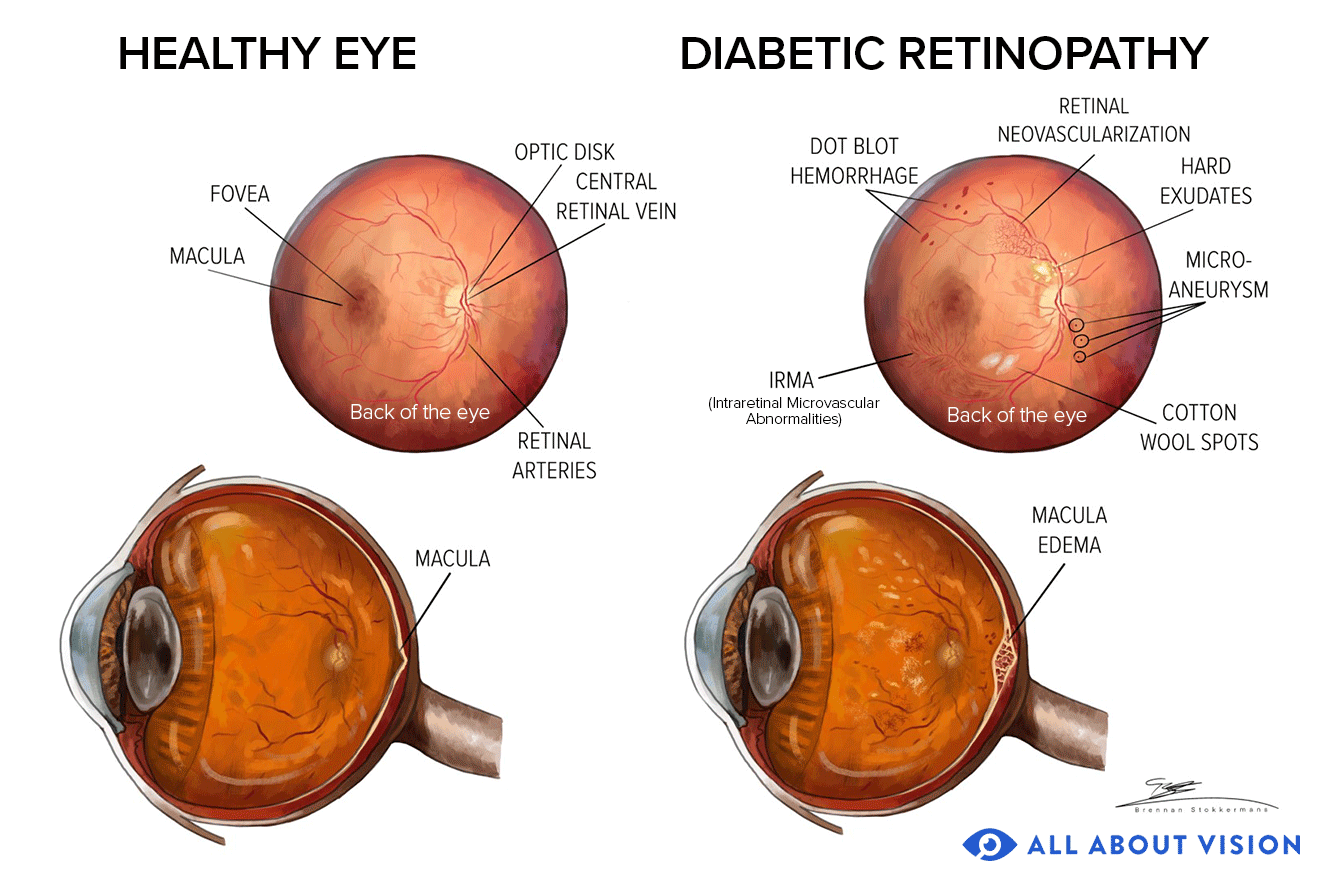
Diabetes mellitus (DM) causes abnormal changes in the blood sugar (glucose) that your body ordinarily converts into energy to fuel different bodily functions.
Uncontrolled diabetes allows unusually high levels of blood sugar (hyperglycemia) to accumulate in blood vessels, causing damage that hampers or alters blood flow to your body’s organs — including your eyes.
Diabetes generally is classified as two types:
Type 1 diabetes: Insulin is a natural hormone that helps regulate the levels of blood sugar needed to help “feed” your body. When you are diagnosed with Type 1 diabetes, you are considered insulin-dependent because you will need injections or other medications to supply the insulin your body is unable to produce on its own. When you don’t produce enough of your own insulin, your blood sugar is unregulated and levels are too high.
Type 2 diabetes: When you are diagnosed with Type 2 diabetes, you are generally considered non-insulin-dependent or insulin-resistant. With this type of diabetes, you produce enough insulin but your body is unable to make proper use of it. Your body then compensates by producing even more insulin, which can cause an accompanying abnormal increase in blood sugar levels.
With both types of diabetes, abnormal spikes in blood sugar increase your risk of diabetic retinopathy.
Eye damage occurs when chronically high amounts of blood sugar begin to clog or damage blood vessels within the eye’s retina, which contains light-sensitive cells (photoreceptors) necessary for good vision.
Diabetic retinopathy and diabetic macular edema symptoms
You may first notice diabetic retinopathy (DR) or other eye problems, including macular edema, related to diabetes if you experience symptoms such as:
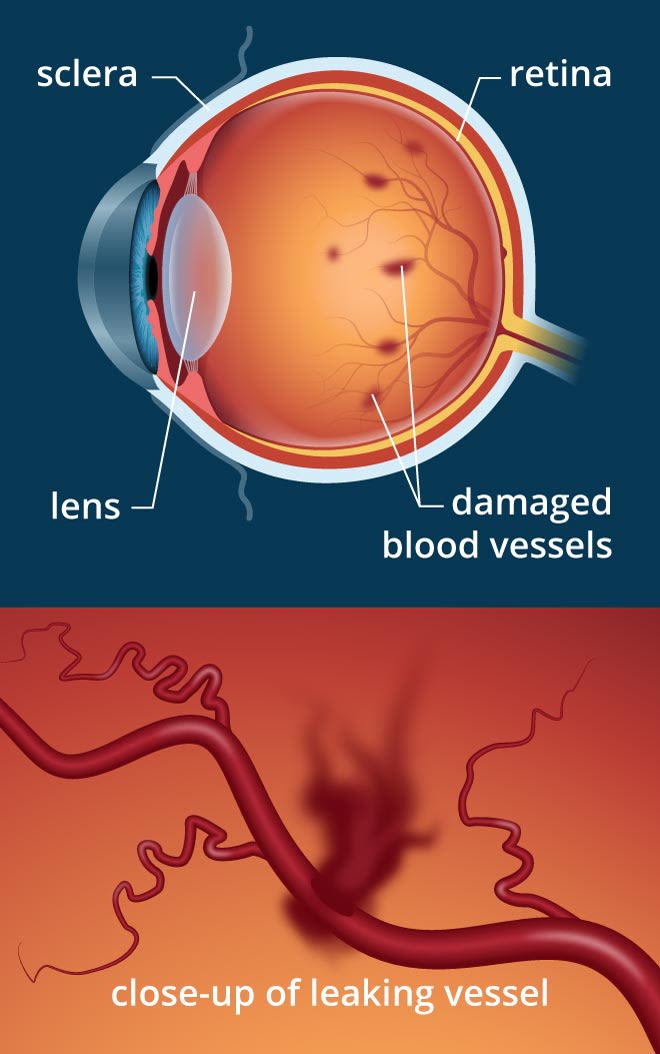
Among other problems, diabetes can damage blood vessels in the retina, causing them to leak blood into the posterior of the eye.
Development of a shadow in your field of view
Blurry and/or distorted vision
Near vision problems unrelated to presbyopia
During an eye examination, your eye doctor will look for other signs of diabetic retinopathy and diabetic eye disease. Signs of eye damage found in the retina can include swelling, deposits and evidence of bleeding or leakage of fluids from blood vessels.
Your eye doctor will use a special camera or other imaging device to photograph the retina and look for telltale signs of diabetes-related damage. In some cases, they may refer you to a retinal specialist for additional testing and possible treatment.
For a definitive diagnosis, you may need to undergo a test called a fluorescein angiography. In this test, a dye is injected into your arm intravenously and gradually appears in the blood vessels of the retina, where it is illuminated to detect diabetes-related blood vessel changes and blood leakage in the retina.
One sometimes-overlooked symptom of diabetic eye disease is nerve damage (neuropathy) affecting ocular muscles that control eye movements. Symptoms can include involuntary eye movement (nystagmus) and double vision.
SEE RELATED: Diabetic eye problems: Types and symptoms
Types of diabetic eye disease
Once high blood sugar damages blood vessels in the retina, they can leak fluid or bleed. This causes the retina to swell and form deposits in early stages of diabetic retinopathy.
In later stages, leakage from blood vessels into the eye’s clear, jelly-like vitreous in the back of the eye can cause serious vision problems and eventually lead to blindness.
Clinically significant macular edema (CSME): This swelling of the macula is more commonly associated with Type 2 diabetes. Macular edema may cause reduced or distorted vision. Diabetic macular edema (DME) typically is classified in two ways:
Focal, caused by other vascular abnormalities sometimes accompanied by leaky blood vessels.
Diffuse, which describes dilated or swollen tiny blood vessels (capillaries) within the retina.
If you have CSME, you typically are advised to undergo laser photocoagulation treatment.
Non-proliferative diabetic retinopathy (NPDR): This early stage of DR — identified by deposits forming in the retina — can occur at any time after the onset of diabetes.
Often no visual symptoms are present, but examination of the retina can reveal tiny dot and blot hemorrhages known as microaneurysms, which are a type of out-pouching of tiny blood vessels.
In Type 1 diabetes, these early symptoms are rarely present earlier than three to four years after diagnosis. In Type 2 diabetes, NPDR can be present even upon diagnosis.
Proliferative diabetic retinopathy (PDR): Of the diabetic eye diseases, proliferative diabetic retinopathy has the greatest risk of visual loss.
The condition is characterized by these signs:
Development of abnormal blood vessels (neovascularization) on or adjacent to the optic nerve and vitreous.
Pre-retinal hemorrhage, which occurs in the vitreous humor or front of the retina.
Decreased or blocked blood flow, with accompanying lack of oxygen needed for a healthy retina.
These abnormal blood vessels formed from neovascularization tend to break and bleed into the vitreous humor of the eye. Besides sudden vision loss, more permanent complications can include tractional retinal detachment and neovascular glaucoma.
Macular edema may occur separately from or in addition to NPDR or PDR.
You should be monitored regularly, but you typically won’t require laser treatment for diabetic eye disease until the condition is advanced.
SEE RELATED: The link between diabetes and glaucoma
Who gets diabetic retinopathy?
Beyond the presence of diabetes, how well your blood sugar is controlled is a major factor determining how likely you are to develop diabetic retinopathy with accompanying vision loss.
Uncontrolled high blood pressure (hypertension) has been associated with eye damage related to diabetes. Also, studies have shown a greater rate of progression of diabetic retinopathy in diabetic women when they become pregnant.
Of course, the longer you have diabetes, the more likely you are to experience vision loss.
The American Academy of Ophthalmology (AAO) notes that all diabetics who have the disease long enough eventually will develop at least some degree of diabetic retinopathy, though less advanced forms of the eye disease may not lead to vision loss.
Minorities and diabetic retinopathy
In the United States, minorities appear particularly vulnerable to vision loss caused by diabetic eye disease.
According to the National Eye Institute (NEI), more than 13% of African-American adults have been diagnosed with diabetes, and at least 825,000 have diabetic retinopathy. NEI expects the number of black Americans with diabetic retinopathy will increase to more than one million by 2030 and to nearly two million by 2050.
Also, a study conducted at the University of Alabama at Birmingham and Wills Eye Hospital in Philadelphia found that African-Americans with diabetes are among those at highest risk for diabetic retinopathy and have one of the lowest rates of eye care access.
Hispanics with diabetes are also at higher-than-average risk of developing diabetic retinopathy and vision loss.
Results of the NEI-sponsored Los Angeles Latino Eye Study show that 42% of Hispanics who have had diabetes for more than 15 years will also develop diabetic retinopathy, compared with 15% for all individuals with diabetes of similar duration.
Native Americans are also at high risk of developing diabetes and related diabetic eye disease. Pima Indians, for example, have a 35% prevalence of diabetes compared with 9.4% among the general U.S. population.
When is diabetic retinopathy a disability?
You must make every effort through medical intervention and other remedies to address diabetes and diabetic retinopathy before you qualify for special considerations under the Americans with Disabilities Act (ADA).
A disability basically means that you are substantially limited in the way you function in daily activity. When you are disabled, you are entitled to certain reasonable accommodations at the workplace and at public places such as schools.
The ADA also requires that diabetics in particular have certain protections under the law, such as needed breaks at the workplace for insulin injections or lunches at set times to maintain blood sugar levels.
You cannot be fired from your job or denied employment strictly because you are diabetic, as long as you are able to handle the basics of your work tasks.
As an example, the American Diabetes Association says that a person with mild diabetic retinopathy might easily perform daytime tasks but could have difficulty with night vision. In this case, special accommodation such as appropriate lighting might be needed at the workplace.
If questions arise, you may need a letter from your physician that advises an employer regarding how well you will be able to perform certain work tasks. Any special accommodations you might need, such as extra lighting, could also be explained by your doctor(s).
State regulations governing disability differ, so you should also check guidelines established by the state in which you reside.
If you are visually impaired enough that you cannot work and expect the condition to last at least a year, you may be qualified for Social Security disability benefits.
To qualify, you must have been in the workforce previously for a length of time that depends on your age. You can contact your local Social Security representative for details or go online to view specific U.S. Social Security Administration guidelines at www.ssa.gov.
Eye exam assistance programs
If you have diabetes (or are at risk for diabetes) and cannot afford an eye exam, there are programs available to help you obtain the eye care you need. Examples include:
VISION USA. Administered by the Optometry Cares — The AOA Foundation, this program provides free eye exams to uninsured, low-income workers and their families. For more information about VISION USA, visit the AOA Foundation website.
EyeCare America. This public service program of the Foundation of the American Academy of Ophthalmology provides free eye exams for qualifying seniors. Eligible individuals receive a comprehensive medical eye exam and up to one year of care for any disease diagnosed during the initial exam at no out-of-pocket cost. To determine if you or a senior family member or friend qualify for this program, visit the EyeCare America website.
Lions Clubs International. This organization provides financial assistance to individuals for eye care through its local clubs. You can find a local Lions Club by using the “club locator” feature on the organization's website.
SEE RELATED: How Does Ozempic (Semaglutide) Affect Eye Health?
Gary Heiting, OD and Vance Thompson, MD, also contributed to this article.
Patients' adherence to recommended follow-up eye care after diabetic retinopathy screening in a publicly funded county clinic and factors associated with follow-up eye care use. JAMA Ophthalmology. November 2016.
New diabetes cases among Americans drop for first time in decades: CDC. HealthDay. December 2015.
Annual number (in thousands) of new cases of diagnosed diabetes among adults aged 18-79 years, United States, 1980-2014. U.S. Centers for Disease Control and Prevention. Accessed December 2015.
New survey of U.S. adults with diabetes reveals less than half understand their risk for vision loss. Press release issued by Regeneron Pharmaceuticals. November 2015.
Diabetic retinopathy. National Eye Institute, National Institutes of Health (NEI/NIH). Accessed December 2011.
National diabetes fact sheet: National estimates and general information on diabetes and prediabetes in the United States, 2011. U.S. Centers for Disease Control and Prevention. Accessed December 2011.
Self-reported visual impairment among persons with diagnosed diabetes — United States, 1997-2010. Morbidity and Mortality Weekly Report. U.S. Centers for Disease Control and Prevention. November 2011.
U.S. Latinos have high rates of developing vision loss and certain eye conditions. U.S. National Institutes of Health, National Eye Institute. Press release issued in May 2010.
Diabetes mellitus. Ferri's Clinical Advisor 2010, 1st ed.
Diabetic retinopathy: An update on treatment. The American Journal of Medicine. March 2010.
Page published on Monday, March 4, 2019